
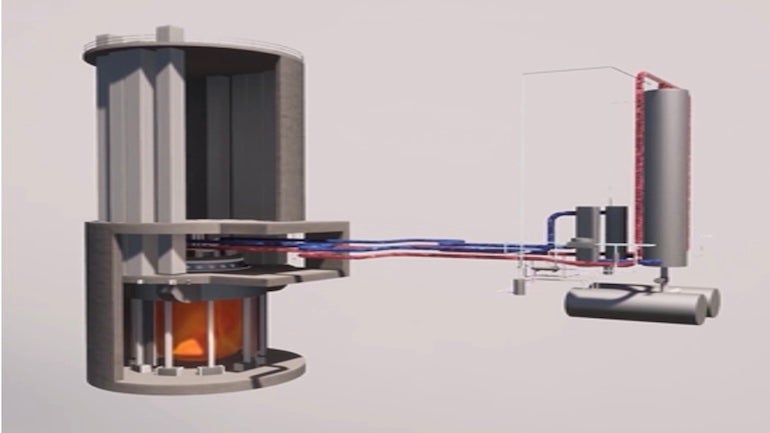
Canada-based ARC Clean Technology has signed a term sheet with IC Nuclear & Industry (ICN), a member of IC Holding, to establish the commercial framework for deployment of its ARC-100 in Türkiye and the wider region. ICN is one of Türkiye’s leading diversified investment groups while IC Holding was a key partner in the engineering, procurement & construction (EPC) of Türkiye’s Akkuyu NPP being built by Rosatom.
The collaboration supports ICN’s active role in Türkiye’s Domestic Nuclear Reactor Development Project announced by the Ministry of Industry and Technology, while establishing a comprehensive framework for advanced nuclear deployment. In line with Türkiye’s energy infrastructure and industrial priorities, reactor design adaptation, engineering development, and local integration activities will be shaped under the leadership of ICN. In parallel, the parties aim to develop a Türkiye-based commercialisation strategy, positioning Türkiye as a regional hub for advanced nuclear solutions and enabling their long-term commercialisation and broader regional deployment.
The ARC-100 is a 100 MWe integrated sodium-cooled fast reactor with a metallic uranium alloy core. The design is based on the Experimental Breeder Reactor-II (EBR-II) fast reactor prototype which operated at the USA’s Argonne National Laboratory from 1961 to 1994. ARC Nuclear signed an agreement with GE Hitachi Nuclear Energy in March 2017 to collaborate on the development and licensing of an SMR using proprietary technology from GEH’s PRISM reactor, which is also based on the EBR-II.
The ARC-100 completed Phase 2 of the Canadian Nuclear Safety Commission (CNSC) Vendor Design Review (VDR) in July 2025. CNSC concluded that no fundamental barriers to licensing had been identified. A licence to prepare site application for commercial demonstration of the ARC reactor in New Brunswick, Canada, was submitted to the CNSC in 2023 and remains under active review. ARC is also a participant in the US Department of Energy’s Advanced Reactor Demonstration Program (ARDP).
The cooperation framework includes joint technical, economic, and regulatory feasibility studies for the deployment of the ARC-100 in Türkiye, as well as the development of a long-term commercialisation and industrialisation roadmap for advanced nuclear technologies. Having reached consensus on the principal commercial terms, the parties intend to negotiate definitive agreements governing technology licensing, engineering collaboration, and project implementation. The term sheet is a non-binding preliminary document that outlines the fundamental terms and conditions for the proposed collaboration.
The term sheet outlines collaborative efforts for identifying potential project sites and conducting feasibility assessments within the region. Beyond electricity for the grid, a specific goal is utilising the ARC-100’s capacity to provide industrial heat for heavy industries and potential future applications like hydrogen production. For ARC the agreement is a critical component of its international expansion and also aligns with recent US–Türkiye civil nuclear cooperation frameworks.
Türkiye aims to finalise regulatory frameworks and begin construction on prioritised small modular rector (SMR) projects between 2030 and 2034. This aligns with the government’s broader goal to have its first SMRs generating power before 2035. After 2035, the focus will shift to scaling up construction and increasing local production to over 50%, establishing Türkiye as a regional manufacturing hub for advanced nuclear solutions.
As yet physical reactor construction of the ARC-100 has not begun. It remains in the pre-licensing and engineering phase, with some tangible progress toward physical development. In late 2025, ARC and Canadian Nuclear Laboratories (CNL) advanced their joint project to deliver a technology demonstration for the specific metallic fuel fabrication process. Following the July 2025 completion of the Phase 2 Vendor Design Review, engineers are producing the high-fidelity blueprints and safety analyses required for the Licence to Construct application. ARC has also begun formal engagement with specialised manufacturers like Hatch to design the secondary “balance of plant” systems (cooling and heat exchangers) necessary for the physical reactor build.
ARC is targeting a Licence to Construct in 2027 – the critical regulatory “green light” needed to break ground and begin pouring safety-grade concrete at the New Brunswick site. Following a Series B funding in January, ARC is expected to begin ordering long-lead items (like the reactor vessel and major sodium pumps) which often take years to manufacture. Nevertheless, physical assembly of the first unit in New Brunswick is targeted to begin in the late 2020s, with a goal for the reactor to achieve criticality and start power generation by 2030.
A 2030 criticality for a First-of-a-Kind (FOAK) reactor is an extremely ambitious schedule leaving little margin for the typical delays associated with nuclear projects. Even with the CNSC Phase 2 review complete, ARC still needs a Licence to Construct. However, regulators typically take 24 to 36 months to review these applications. If submitted in late 2026, approval might not arrive until 2028 or 2029.
The reactor vessel and sodium pumps are not off-the shelf components. Manufacturing heavy nuclear components requires specialised forges with massive backlogs. Lead times for these items are currently 3-5 years. While SMRs are designed for modularity, the New Brunswick project is a prototype build and engineering challenges always emerge during FOAK assembly.
However, ARC argues that their timeline is possible because they are not inventing a new physics model but are scaling the EBR-II, which reduces the FOAK engineering risk. ARC plans to manufacture major sections in factories in parallel with site work, theoretically reducing construction time to under 36 months.
“The ARC-100 represents a highly compelling advanced nuclear technology with significant potential to support Türkiye’s clean energy transition, industrial competitiveness, and long-term energy security,” said ICN Board Chairman Murad Bayar, “Against the backdrop of deepening US-Türkiye cooperation in civil nuclear energy, our collaboration with ARC Clean Technology creates a strategic platform to assess how next-generation nuclear solutions can be adapted to Türkiye’s needs, strengthen domestic engineering and industrial capabilities, and contribute to sustainable economic growth.”
ARC CEO James Wolf said: “ARC is extremely excited to begin this collaboration with IC Nuclear & Industry to explore deployment opportunities for the ARC-100 in Türkiye. This collaboration is an important step in ARC’s global market strategy, as we work with leading partners to deploy advanced nuclear solutions internationally.”


