
Microsoft and NVIDIA have announced a partnership to use artificial intelligence (AI) to boost the “entire lifecycle” of nuclear power. They plan to use AI tools to target bottlenecks that slow down projects, particularly in the design phase and regulatory review process. This could streamline everything from permitting to the construction and operation of reactors.
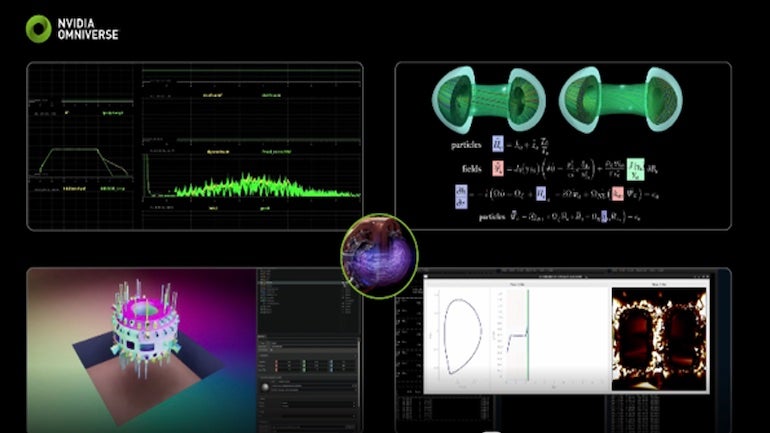
By combining Microsoft’s cloud and AI ecosystem with NVIDIA technologies such as Omniverse, CUDA-X, and AI Enterprise, the companies are building a unified digital environment tailored for nuclear development.
According to an article on the Microsoft blog by Darryl Willis, Corporate Vice President, Worldwide Energy and Resources Industry, “The world is racing to meet a historic surge in power demand with an infrastructure pipeline built for the analogue age. Driven by the exponential expansion of digital technologies and the reindustrialization of supply chains, the mandate for always-on, carbon-free power is urgent and absolute. Nuclear energy is the essential backbone for this future, but the industry remains trapped in a delivery bottleneck. Before a shovel even hits the dirt, critical projects are slowed by highly customized engineering, fragmented data, and mountains of manual regulatory review.”
To break the infrastructure bottleneck and shift the industry from ambition to delivery, Microsoft announced its AI for nuclear collaboration with NVIDIA, “to provide end-to-end tools that streamline permitting, accelerate design, and optimise operations across the industry”.
These technologies can provide disciplined engineering to the entire lifecycle of a nuclear plant from site permitting, design and construction to continuous operations. “By enabling these capabilities within a connected, AI-powered foundation, we are empowering energy developers to make highly complex work repeatable, traceable, secure, and predictable – slashing development timelines and eliminating rework without sacrificing safety,” said Willis.
Even more complex than building a nuclear plant is designing and permitting one. Permitting can take years, cost hundreds of millions of dollars, and involve an immense amount of data processing and reporting. Engineers can spend thousands of hours drafting, cross-referencing, formatting, searching, reviewing, and reworking materials. This includes identifying and fixing inconsistencies across tens of thousands of pages.
“To break this infrastructure bottleneck, we need to move away from highly customized engineering towards repeatable, reference-based delivery while maintaining regulatory standards and engineering accountability,” Willis noted. “With AI, we can identify tiny documentation inconsistencies and resolve them quickly.”
By unifying data and simulation across the lifecycle, this complex work becomes:
- Traceable: Every engineering decision is digitally linked to the evidence and regulations that back it up.
- Audit-Ready: The system keeps a perfect “paper trail,” ensuring that regulators can verify safety instantly.
- Secure: High-level intelligence is applied within a governed, protected environment.
- Predictable: High-fidelity simulations map time and cost, catching delays before they happen in the real world.
According to Willis: “This isn’t just about speed; it’s about trust. Engineers and regulators are freed to focus on what matters most: building a safe, secure, high-capacity, carbon-free power source that’s on-time and on-budget.”
AI and digital twins can carry a project from the initial phases to efficient operations. With respect to design and engineering, digital Twins and high-fidelity simulations enable faster iteration. Engineers can reuse proven patterns and instantly see how a tiny design change impacts the entire model, creating a validated plan before breaking ground.
For licensing and permitting, generative AI can handle the “heavy lifting” of document drafting and gap analysis. It unifies all project information, ensuring comprehensive applications aligned with historical permits. This allows expert regulators to focus their time on safety judgments rather than reconciling thousands of pages of text.
When it comes to construction and delivery, traditional 3D models only map physical space. “4D (time scheduling) and 5D (cost tracking) simulations can virtually construct the plant before shovels hit the dirt,” Willis said. AI and digital twins allow developers to track physical progress against the digital plan in real-time, catching potential delays and preventing the schedule collisions that lead to expensive rework.
Suring operations and maintenance, AI-powered sensors and operational digital twins detect anomalies early, ensuring higher uptime and predictive maintenance that keeps the grid stable with human operators firmly in control.
Willis concludes: “By unifying data, traceability, and simulation across phases, AI accelerates design validation with high-fidelity 3D models and digital twins, improves licensing consistency through AI-assisted document workflows, and connects design assumptions to operational performance giving operators, regulators, and stakeholders clearer, continuous visibility.”


