
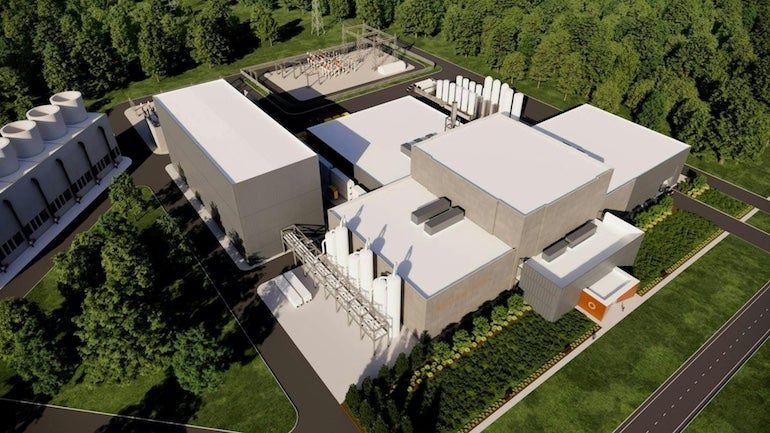
A surge of new fusion finance deals and some significant technical breakthroughs suggest that private finance is playing a substantial role in developing new nuclear technology. Among the technical achievements comes Polaris, which its developers say has become the first privately-developed fusion energy machine to demonstrate measurable deuterium-tritium (D-T) fusion and achieve plasma temperatures of 150 million degrees Celsius (MoC).
The prototype machine, developed by Washington-based fusion company Helion, set new fusion industry benchmarks on the road to make commercially viable fusion. Significantly, the developments are firsts for the private fusion industry having broken its own commercial fusion industry record for plasma temperatures of 100MoC set by its 6th-generation Trenta prototype. Within the fusion industry, 100MoC is considered the threshold plasma temperature for a commercially relevant fusion machine.
Helion began operating its 7th-generation Polaris prototype at the end of 2024. The machine was used for extensive test campaigns and consistently exceeded the performance of the Trenta prototype. In January this year Polaris switched to a D-T fuel mix and publicly announced the 100MoC results after they were reviewed by external experts from the US Department of Energy (DOE) and the University of Michigan. Now with the 150MoC threshold breached, the company will continue testing to reach optimal temperatures for a deuterium-helium-3 (DH3) fuel that it plans to use for commercial operations. Helion will also continue to increase plasma temperatures in Polaris to demonstrate that it can reliably operate with D-H3. Helion is developing a proprietary, closed-loop fuel cycle to produce the rare isotope Helium-3 as a byproduct of Deuterium-Deuterium (D-D) fusion reactions. Half of the D-D reactions produce Helium-3 immediately. The other half produces tritium, which Helion stores to let it naturally decay into Helium-3 at a rate of around 5.5% a year.
Unlike tokamaks, which depend on achieving steady state fusion using magnetic confinement fusion (MCF), Helion’s prototypes use pulsed magneto-inertial fusion (MIF). This is a hybrid approach that is designed to combine the strengths of MCF and Inertial Confinement Fusion (ICF). In the Helion devices, a magnetic field is used to thermally insulate and confine a relatively low-density plasma, which is then rapidly compressed by an external driver, such as a metal shell, high-speed plasma jets, or magnetic coils, to reach the extreme temperatures and pressures required for fusion.
MIF operates in a cyclic, “pulsed” manner in which the plasma is initially held in place by a “seed” magnetic field before the compression phase amplifies the internal magnetic field and heats the fuel to millions of degrees. The resulting fusion reaction causes the plasma to expand, pushing back against the magnetic field. This change in magnetic flux can induce an electric current that is directly captured as electricity, skipping the need for traditional steam turbines.
Commenting on the new record David Kirtley, co-founder and CEO of Helion, said: “We’ve built and operated seven prototypes, setting and exceeding more ambitious technical and engineering goals each time. The historic results from our deuterium-tritium testing campaign on Polaris validate our approach to developing high power fusion and the excellence of our engineering.”
In July 2025, Helion broke ground on the site of the 50 MW Orion plant, its first commercial machine, in Malaga, Washington state, which is intended to deliver electricity from fusion to the grid for Microsoft by 2028. Later the same year Helion also began installing assembly line equipment at its new manufacturing factory, Omega. It is designed to transition Helion from a research-focused start-up to a large-scale industrial manufacturer by mass-producing the thousands of high-voltage pulsed capacitors that act as the drivers for Helion’s fusion machines. This facility will produce the approximately 2500 capacitors needed for the Orion power plant using advanced robotic assembly lines, including off-the-shelf and custom automation technology. As of early 2026, Omega had become an active production site with the start of equipment installation. High-volume production is expected to ramp up throughout this year and is being designed to support the next generation of machines planned for 2030 and beyond.
More recently, fusion company Inertia Enterprises raised $450m from Google Ventures and others to commercialise its fusion pilot plant based on what it says will be the world’s most powerful laser, Thunderwall. This will deliver a 10 kJ beam 10 times per second with 10% efficiency. Alongside the laser, a production line will mass manufacture fuel targets at scale.
“Our plan is clear: build on proven science to develop the technology and supply chain required to deliver the world’s highest average power laser, the first fusion target assembly plant, and the first gigawatt, utility-scale fusion power plant to the grid. Inertia is building the team, partnerships, and capabilities to make this real within the next decade,” said Jeff Lawson, the co-founder and CEO of Inertia.
Inertia co-founder Dr. Annie Kritcher served as the lead designer of fusion experiments at the National Ignition Facility (NIF) at the Lawerence Livermore National Laboratory (LLNL) and its inertial confinement fusion design, including the hohlraum, capsule, and laser specifications. In December 2022, that design enabled the first controlled fusion experiment to achieve net target energy gain. “In just three years, we’ve gone from the first experiment to ever produce more fusion energy than was delivered to the target, to repeating that result many times and pushing the target gain higher,” said Kritcher.
“Inertia represents our first investment into the direct fusion market, because it is the first company that we’ve seen with a clear roadmap to commercial energy that’s compelled us to act,” said Byron Deeter, a partner at Bessemer Venture Partners who led the investment round.
Another privately-financed fusion company is Commonwealth Fusion Systems (CFS). Last year the company raised $863m in a fundraising round which followed a $1.8bn round in 2021. CFS is using the new funds to complete its SPARC tokamak demonstration machine and progress on development work on its first ARC power plant, which will be located in Chesterfield County, Virginia, USA and rated at 400 MW. Late last year CFS announced a power offtake agreement worth more than $1bn had been signed by Italy’s Eni, expanding on a longstanding strategic partnership between the two companies.
The power purchase agreement (PPA) relates to the ARC plant, which is expected to connect to the grid in the early 2030s. Detailed financial terms weren’t disclosed but it is the second offtake agreement that CFS had signed in three months for its first grid-scale fusion power plant. “The agreement with Eni demonstrates the value of fusion energy on the grid. It is a big vote of confidence to have Eni, who has contributed to our execution since the beginning, buy the power we intend to make in Virginia,” said Bob Mumgaard, Co-founder and CEO of CFS commenting on the deal. Eni CEO Claudio Descalzi, added: “Eni has been strengthening its collaboration with CFS through its technological know-how since it first invested in the company in 2018. As energy demand grows, Eni supports the development of fusion power as a new energy paradigm.”
CFS followed up the ENI deal with an agreement earlier this year to develop a digital twin of its SPARC machine. The collaborations with NVIDIA and Siemens will apply artificial intelligence (AI) and data and project management tools to accelerate commercial fusion using data from the Siemens Xcelerator portfolio of industrial software. CFS will also use NVIDIA Omniverse libraries and OpenUSD to integrate data with classical and AI-powered physics models to create the digital twin of SPARC to run simulations, test hypotheses, and compare experimental results with simulations.
Said Mumgaard: “Through this collaboration, we’re demonstrating how AI and integrated digital engineering can accelerate progress from design to grid power. This will allow us to transform how we build and operate fusion machines in the race to commercial fusion.”
Meanwhile, a New Zealand-based fusion energy company has also recently raised funding to build a new research facility. OpenStar Technologies secured a NZ$35m (US$21m) commitment from the government’s Regional Infrastructure Fund to further their research. The new facility will be used to house the company’s next-generation device ‘Tahi’.
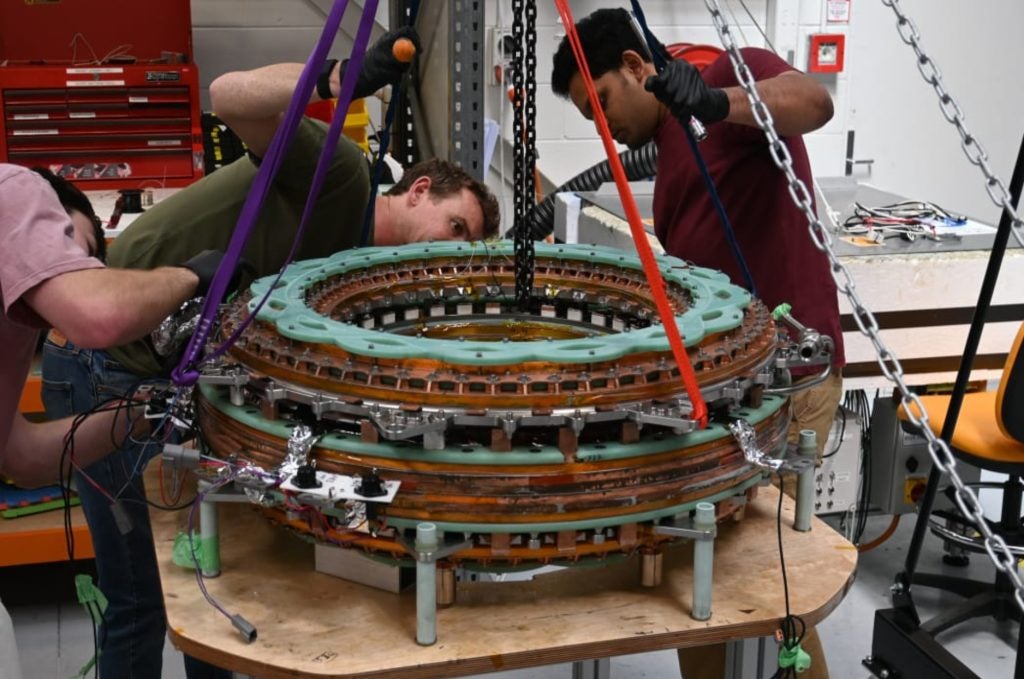
The current prototype device, ‘Junior’ achieved first plasma within two years using a unique approach known as a levitated dipole in which a powerful 500 kg superconducting magnet is levitated inside a large vacuum chamber.
The Tahi will feature a magnetic field four times stronger than Junior performing at up to 20 Tesla. During one experiment, OpenStar broke the record for energy stored in a magnet at 170 kJ. The levitated dipole has its roots in research across Japan and the United States after Dr Akira Hasegawa proposed the dipole in 1987 while at Bell Labs.
OpenStar CEO Ratu Mataira said: “The levitated dipole… is a much faster and cheaper way of pushing into this space. We’re the people that are going to catch up quick and play at that international level.”
While it is clear that some significant engineering hurdles still remain if commercial fusion is to become a reality, with cash flowing into the sector the fundamental research needed to bridge that knowledge gap is advancing at pace.


