
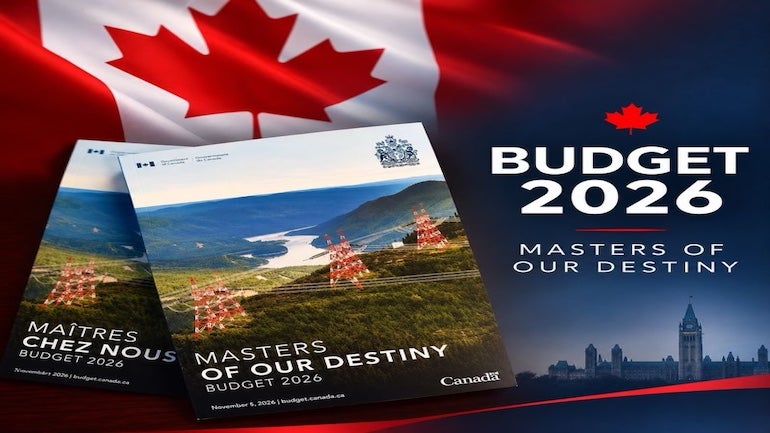
Canada’s 2026 federal budget, titled Masters of Our Destiny, explicitly positions nuclear power as a cornerstone of the country’s clean electricity strategy. The budget, introduced under Prime Minister Mark Carney and Finance Minister François-Philippe Champagne, commits significant direct capital and long-term tax incentives to rapidly scale the domestic nuclear sector.
The total federal commitment to nuclear energy – combining new and previously existing funding – reaches CAD6.5bn ($4.6bn). This nuclear push is integrated into a broader CAD50bn master plan aimed at doubling Canada’s total electricity grid capacity by 2050.
The budget allocates CAD518.5m over five years (starting in 2027–28) to directly implement the national nuclear strategy. This includes:
- CAD261m for domestic supply chain development and advanced research;
- CAD127m assigned to Atomic Energy of Canada Limited for research infrastructure and workforce growth; and
- CAD131.1m allocated to the Canadian Nuclear Safety Commission to accelerate regulatory reviews and approvals for new builds.
The budget offers long-term tax certainty. Both the 30% Clean Technology Investment Tax Credit (ITC) and the 15% Clean Electricity ITC have been extended to 2040. This extension provides the long-term horizons required to de-risk highly capital-intensive projects like large-scale reactors and small modular reactors (SMRs).
The ITC is a refundable federal tax mechanism designed to drive massive corporate investment into the clean economy. Instead of acting as a typical tax deduction, an ITC functions as a dollar-for-dollar reduction of a company’s tax liability based on the capital spent on qualifying equipment. Because it is refundable, if a company’s credit exceeds its taxes owed, the Canadian government covers the difference.
The 2040 extension of these ITCs means that eligible property only needs to become available for use before 2041 (pushed back from original 2035). This provides the long-term runway required to finance decade-long nuclear builds.
The government launched a consultation to establish a domestic content bonus (up to 10% for Clean Tech and up to 5% for Clean Electricity). This rewards developers who source engineering and components from Canadian nuclear supply chains.
The budget highlights a targeted mix of domestic SMRs, large-scale expansions, and strategic international exports. Carney’s overarching mandate is to eventually construct 10 new large-scale reactors while simultaneously deploying localised grid solutions.
The specific reactor projects and regional initiatives backed by the federal framework include:
- Darlington New Nuclear Project – North America’s first commercial, grid-scale SMR rollout uses the GE Hitachi BWRX-300 design. It is backed by $970m in direct financing through the Canada Infrastructure Bank. It incorporates a CAD715m federal Indigenous Loan Guarantee. This enables seven Ontario First Nations to acquire an equity ownership stake in the project.
- The Candu Cernavodă Export Project – This supports the construction of two new domestic Candu (Canada Deuterium Uranium) reactors at the Cernavodă Nuclear Power Plant in Romania. The government is committing up to CAD3bn in combined equity and financing through the Canada Growth Fund and the Building Ontario Fund. This secures Canada’s export pipeline for homegrown heavy-water reactor intellectual property.
- The SaskPower Estevan SMR – The development of Saskatchewan’s first utility-scale SMR near Estevan is aimed at transitioning the province’s grid away from coal baseloads. The budget allocates CAD74m in direct federal funding to advance the necessary engineering, design, and site-specific impact assessments.
- Bruce Power multi-unit expansion – This is an ongoing, multi-decade infrastructure asset management plan to refurbish existing reactors and scale up generation capacity on the shores of Lake Huron. The budget provides CAD50m specifically earmarking immediate pre-construction and early site preparation work for the next phases of its multi-unit build.
- Chalk River Laboratories – The budget commits CAD2.2bn over 10 years to the Canadian Nuclear Laboratories at Chalk River, Ontario. This funds nuclear research infrastructure, waste management solutions, and medical isotope logistics.
- Microreactor Development – a distinct $40m is allocated to advance off-grid “microreactors”. These are designed to displace diesel reliance in remote industrial mining operations and northern communities.
“Being masters of our destiny is about having the confidence to build on our strengths and shape our own future,” said Finance Minister François-Philippe Champagne. “Canada has the resources, talent and ambition to succeed. Budget 2026 builds on those strengths by unlocking investment, building more at home, strengthening our energy and natural resource advantage, and helping Canadian businesses grow and compete on the world stage. That’s how we will create good jobs, make life more affordable, and build a stronger, more resilient and more united Canada for generations to come.”


