
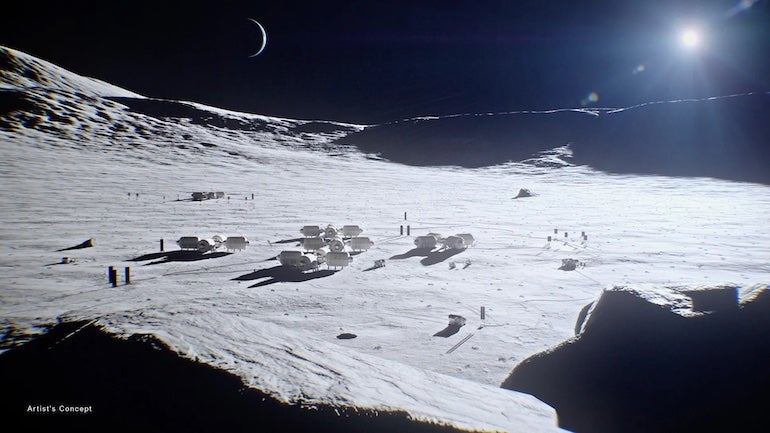
NASA has unveiled a $10bn contracting framework, new lunar transportation task orders, and a nuclear-powered rover mission to rapidly scale up infrastructure for a permanent lunar outpost by 2032. “We are building the Moon Base mission by mission,” said NASA Administrator Jared Isaacman. “When our astronauts return to the Moon, they will arrive with the first elements of the Moon Base already waiting for them on the surface.”
NASA selected eight companies for the next phase of its CLPS (Commercial Lunar Payload Services) initiative. Under the 10-year CLPS 2 framework, the companies will compete to provide lunar delivery services, including managing, building, and operating landers that transport NASA science, technology, and infrastructure payloads to the Moon. They include Blue Origin, Firefly Aerospace, Intuitive Machines, ispace-US, Lockheed Martin Space, Northrop Grumman Space Systems, SpaceX and Voyager Technologies. The original CLPS 1 contract will remain in place to November 2028, with an additional five-year period to complete awarded lunar deliveries to November 2033.
NASA also announced it is moving forward with development of PROMISE (Polar Rover for Observation, Mapping, and In-Situ Exploration). The six-wheeled, rover, powered by a radioisotope thermoelectric generator (RTG) and carrying science instruments and technology demonstrations, will land at the Moon’s South Pole to characterise the surface and subsurface, assess resource potential, and provide data to enable landing site selection, as well as future infrastructure and exploration activities.
The agency’s Jet Propulsion Laboratory in Southern California, a division of Caltech, will manage the mission and build the rover using spare flight components and engineering test models for NASA’s Curiosity and Perseverance Mars rovers. This significantly reduces cost and enables integration and testing on a shorter timeline. NASA is targeting late 2028 to launch PROMISE, planning an 18-month mission.
NASA awarded Blue Origin a $94m base contract, with an option period worth an additional $140m based on performance to deliver PROMISE to the lunar South Pole. The award expands the task order awarded in May to deliver two lunar terrain vehicles to the Moon. Blue Origin will use its Mark 1 lander to deliver and deploy the rover as part of the Moon Base’s first phase.
Delivering Moon Base infrastructure will require a robust transportation network between Earth and the Moon. Orbital Transfer Vehicles (OTVs) will act like long-distance freight trucks, carrying large loads across space. Lunar landers will handle the final delivery, bringing supplies, equipment, and infrastructure down to the Moon’s surface.
NASA plans to purchase commercial components for a Mini-Communications and Solar Tower (miniCAST), including solar arrays, batteries, and wireless power-transfer hardware. The miniCAST will combine power and communications capabilities to support future Moon Base activities. Engineers at NASA’s Marshall Space Flight Center in Alabama, will assemble and test the systems before they are delivered to the lunar surface. NASA expects work to begin within months.
The project has a phased timeline. Phase 1 (to 2029) targets:
- Deploying early robotic rovers (late 2027) to map ice.
- Launching “MoonFall” scouting drones via commercial partners.
- Testing advanced orbital navigation and relay systems (CAPSTONE 2).
- SpaceX is contracted to launch a specialised constellation of Moon-scoped satellites to ensure the base maintains constant high-bandwidth communication with Earth.
Phase 2 (2029 – 2032) focuses on infrastructure deployment:
- Delivering high-mass commercial cargo landers (CLPS 2).
- Setting up the miniCAST tower for regional power and mesh communications.
- Deploying unpressurised Lunar Terrain Vehicles (LTVs).
Phase 3 (2032 & beyond) envisages:
- Finalising a permanent Foundation Surface Habitat to house four astronauts.
- Deploying JAXA’s large, pressurised mobile habitat (a high-tech camper van) for multi-week rover journeys.
When fully realised, the base camp will rely on interconnected survival systems. The Foundation Surface Habitat will support four astronauts simultaneously for short-duration stays. Astronauts will use unpressurised rovers (developed by Astrolab and Lunar Outpost) for local operations, while the pressurised mobile platform will allow exploration more than 12 miles away from the main hub without the need to wear space suits inside.
Because the base must survive the 14-day lunar night, surface power will combine solar energy storage with specialised 10 kWe nuclear fission surface power units. NASA’s development of nuclear fission reactors for the Moon Base represents the critical baseline infrastructure. The Fission Surface Power (FSP) project jointly overseen by NASA and the Department of Energy (DOE), aims to launch and demonstrate its first operational unit, Lunar Reactor-1 (LR-1), by 2030.
Each reactor is designed to continuously generate 40-100 kWe – enough baseload power to support multiple astronaut habitats, life-support recycling systems, and vehicle-recharging docks simultaneously. The reactors will operate autonomously for at least 10 years without requiring any maintenance or refuelling.
To fit commercial cargo launch fairings, the micro-reactor architecture is exceptionally compact – comparable to a small car and strictly limited to under six tonnes in mass. The heat produced will be transformed into electricity via advanced, dynamic power-conversion units developed by contracted partners such as Rolls-Royce, Brayton Energy, and General Electric.
The units will be pre-assembled on Earth and delivered as sealed, dormant packages. Once on the lunar surface, remote-controlled robotic landers and rovers will deploy the reactors to a safe distance from the central base camp, stringing heavy electrical lines back to the hub to protect astronauts and equipment from radiation or rocket blast dust.
NASA is advancing reactor designs through competitive industry contracts. Westinghouse Electric is scaling its space micro-reactor engineering through rigorous hardware component validation. Lockheed Martin Space and IX (the joint venture between Intuitive Machines and X-energy) have submitted deep-conceptual architectures optimised for long-term lunar environment stability.
In October, NASA and the DOE signed an updated agreement to launch a precursor mission, Space Reactor-1 (SR-1) Freedom, in 2028. SR-1 Freedom will test the core fission reactor in deep space while acting as a nuclear-electric propulsion system to qualify the nuclear supply chain and minimise operational hazards before attempting a physical landing on the moon.
Also in October, Kratos Defense & Security Solutions was awarded a $33.6m contract to design, build, and deliver the power conversion system. Kratos is executing this as a subcontractor to Sierra Lobo, which is integrating the closed-loop Brayton cycle engine with the core reactor.
The core fission reactor, currently being designed and developed by the Idaho National Laboratory (INL), will use a high-assay low-enriched uranium (HALEU) fuel core. To accelerate the tight timeline, NASA is repurposing the already constructed Power and Propulsion Element (PPE) chassis, originally built for the Lunar Gateway station, to serve as SR-1’s primary spacecraft bus.
The spacecraft is in its active sub-component hardware build phase. NASA’s schedule dictates the following sequence in 2028: January – complete integration, final assembly, and system-wide environmental testing; October – full launch readiness review; and December – targeted launch on an Earth escape trajectory.
Landing a nuclear fission reactor on the Moon involves a highly choreographed, automated sequence designed to prioritise launch safety and isolate radiation from the astronaut base. NASA and DOE have designed a specialised “Inert Delivery and Robotic Deployment” protocol.
The reactor will be launched from Earth in a completely inert configuration. Specialised safety rods will be mechanically locked inside the uranium core to prevent any fission from starting prematurely. During launch, transit, and landing, the unit is inactive. If a launch or landing anomaly occurs, it remains inert encased metal. To survive the brutal G-forces and violent vibrations of rocket flight, the reactor’s radiator panels are tightly folded and stowed into a compact structural shell the size of a small car.
The fully assembled six-tonne reactor will be slotted as a primary payload onto a next-generation commercial lander contracted under NASA’s CLPS 2 framework. The lander will use autonomous hazard-detection and terrain-relative navigation to touch down smoothly on a precise ridge near the lunar south pole.
Once on the lunar surface, the entire setup is managed by remote-controlled robotic cranes, lander arms, and autonomous rovers before any astronauts arrive. A robotic rover will hitch onto the reactor (or the reactor package itself will be a mobile unit), pull it off the lander deck, and move it to its final operational destination. The rover will pull weighty, heavily insulated electrical cables back to the Foundation Surface Habitat.
The reactor will be positioned 1-2 kilometres away from the crew habitats to provide a natural buffer from any low-level radiation and to protect the reactor’s radiators from abrasive moon dust kicked up by subsequent landers.
Rather than flying heavy lead shielding from Earth, NASA’s architecture aims to use the Moon itself. Robotic excavators will either drop the reactor into a small, natural lunar depression or pile several metres of loose lunar soil (regolith) over the core structure. This soil acts as an effective shield against solar cosmic rays, micrometeoroids, and human habitat exposure.
Once the radiator panels deploy and the electrical lines are connected to the central grid, NASA controllers on Earth will send the final command. Mechanical actuators will slowly withdraw the safety rods from the core allowing a chain reaction that generates intense heat. This loops into a liquid metal or gas heat-pipe system, driving a closed Brayton engine to pump out a flawless, uninterrupted electricity for the next decade
However, achieving a fully operational, nuclear-powered lunar base by 2032 requires a flawless run through unprecedented engineering, financial, and logistical bottlenecks. While the contracts are signed, several key technical and political hurdles stand in the way.
The micro-reactors require HALEU. Currently, global supply chains for this fuel are incredibly constrained. If DOE cannot rapidly scale domestic production and qualification facilities over the next three years, the reactors will not have fuel to launch.
NASA’s plan relies completely on private providers (like SpaceX and Blue Origin) successfully fielding massive, complex landers that have never flown or landed heavy payloads on the Moon. If their development schedules slip by even a year or two, the entire cascading timeline breaks down.
Surviving the lunar south pole means dealing with jagged terrain, abrasive regolith (moon dust) that destroys mechanical joints, and extreme temperature swings. Relying on autonomous robotic rovers to unpack, bury, and wire a nuclear reactor completely unassisted by humans requires flawless AI and mechanical execution on the first try.
Space programmes operate on multi-decade timelines, but they are funded by annual Congressional appropriations and subjected to changing presidential administrations. A shift in government priorities or an economic downturn could easily stall funding, pushing 2032 well into the late 2030s.
Despite the steep odds, NASA is forcing this tight timeline for two primary reasons.
China, in partnership with Russia, is developing its own International Lunar Research Station (ILRS) targeting the same resource-rich craters at the lunar south pole by the early 2030s. NASA’s aggressive dates are heavily driven by geopolitical pressure to establish international legal precedents and operational hubs first.
By issuing strict 2028 and 2030 benchmark deadlines (the SR-1 flight and LR-1 landing), NASA forces contractors to build and test hardware now. Even if the agency misses the 2032 target by a few years, forcing this timeline ensures that hardware is built, rather than letting the project languish in perpetual conceptual design phases.
Ultimately, space analysts agree that while the infrastructure will eventually be built, a fully operational base by 2032 is a “best-case scenario.” A slip to 2035 or later is highly probable if any single critical path encounters a major setback.


