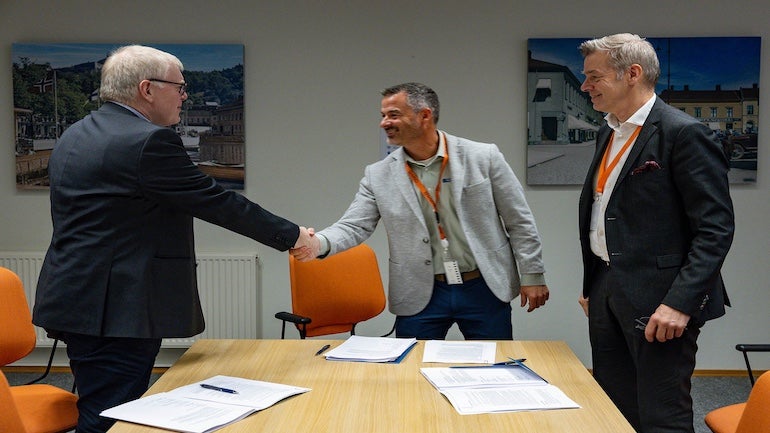
NAC International has been contracted by Norwegian Nuclear Decommissioning (NND – Norsk nukleær dekommisjonering) to deliver passive dry storage and transport casks for Norway’s legacy research reactor fuel.
The contract addresses approximately 16.5 tonnes of used nuclear fuel accumulated over six decades of operations at the Halden and Kjeller research reactors. NAC’s solution comprises a passive dry storage design consisting of a stainless-steel container surrounded by a protective concrete silo.
For off-site transport, a separate dedicated transport container will be used. The system is engineered for long-term safety, featuring a design life of more than 70 years.
This announcement comes shortly after a SEK 3–4bn ($307-409m) contract signed between NND and the Swedish nuclear technical services provider Studsvik.
The two contracts work together to resolve Norway’s complex nuclear waste legacy. About 10 tonnes of Norway’s legacy inventory consists of unstable metallic uranium and aluminium-clad fuel. Metallic uranium is highly pyrophoric (it can ignite spontaneously in air) and reacts dangerously with water. It cannot be stored long-term in its current state.
Under the agreement running until 2055, Studsvik will transport the legacy fuel across the border to its licensed facilities in Nyköping, Sweden. There, the fuel will undergo inspection and oxidation treatment to stabilise it for permanent disposal.
NND noted that the newly contracted NAC casks will play a critical role in enabling the transport and handling required for this specialised treatment process. After treatment and interim storage in Sweden, the stabilised fuel will ultimately be returned to Norway for final deep geological disposal.
Moving the used fuel out of the current ageing storage facilities clears the path for NND to proceed with the comprehensive, multi-decade dismantling and decommissioning of the Halden and Kjeller nuclear sites.
NND received four offers in the tender process for the casks, according to Peter Bennett, NND’s Officer for Spent Fuel Management. All were technically good, he said, but NAC came out best in the evaluation of both price and quality. “This will be a big job that will take many years,” Bennett noted.
Rather than deploying an immediate off-the-shelf system, NAC is partnering with NND and the Institute for Energy Technology (IFE) to initiate a 22-month engineering design and system analysis phase. This step ensures the generic cask blueprints are meticulously customised to interface with the unique spatial constraints and specialised infrastructure of the Kjeller and Halden facility footprints.
Because Norway’s legacy fuel inventory features a volatile mix of unstable metallic uranium, aluminium-clad elements, and experimental variants, the regulatory baseline is extremely strict. The engineering team will spend this initial phase generating comprehensive safety analysis reports to satisfy Norwegian nuclear regulators, proving the systems can maintain completely passive, long-term structural integrity under all hypothetical accident scenarios.
The “construction and transfer” phase bridges the gap between passive storage and cross-border transport. While the final destination for long-term dry storage requires concrete silos, a separate, heavily shielded transport configuration must be manufactured and deployed for the active moving phases. Simultaneously, facility operators will map out the precise sequence for extracting the 16.5 tonnes of fuel from their ageing wet or temporary housing units.
These 22 months of preparation directly feed into the cross-border logistical pipeline with Sweden’s Studsvik facility. The finalised casks must be fully certified and operationally ready to safely withstand the journey to Nyköping for the stabilising oxidation processes, as well as the eventual return trip to Norway decades down the road.


