

The third Russia-Africa Summit was held in the Grand Kremlin Palace in Moscow under the chairmanship of Russian President Vladimir Putin and the Chairperson of the African Union, Burundi President Évariste Ndayishimiye. Representatives of 48 African countries including 22 heads of state, attended the summit as well as leaders of the continent’s integration associations.
The summit marked a strategic shift from broad political declarations to highly specific economic, technological, and security agreements and yielded several key achievements. A total of 92 cooperation agreements and 54 memoranda were finalised during the main summit, the Economic & Humanitarian Forum, and the Russia–Africa Media Forum.
The summit concluded with the implementation of the Declaration of the Third Russia–Africa Summit, the Declaration of Cooperation on Artificial Intelligence Technologies, and the Russia–Africa Partnership Forum Action Plan for 2027–2029. Moscow solidified its role as a key agricultural supplier, noting that over 40 African states receive Russian grain and fertiliser. Bilateral trade increased significantly, notably with specific partners such as Ethiopia, where trade grew to over $1.3bn for the first nine months of the year.
On the margins of the summit, Russia leveraged its growing diplomatic network, expanding toward 49 embassies on the continent, to offer formal mediation to resolve ongoing regional tensions between Ethiopia and Eritrea. Individual state delegations finalised distinct defence contracts. The summit generated frameworks for technology transfers, infrastructure, and nuclear energy exploration.
Russia expanded its university quotas, with roughly 40,000 African students currently studying in Russian institutions and scholarship caps raised to 5,500 places. The joint sanitary and epidemiological assistance programme aimed at public health infrastructure across the continent was formally extended to 2029.
At the close of the summit, Vladimir Putin and Évariste Ndayishimiye, held a joint press conference. Putin said Russia was ready to continue working closely with Africa in all areas. “This naturally applies to economic cooperation. I would like to note that Russia’s trade with African states exceeded $27bn last year. Since our previous summit [in 2023], this figure has increased by 50%. This is a positive trend, but the true potential of our interaction is, of course, considerably greater.”
He added: “Many Russian companies have long been successfully implementing major investment projects in Africa, covering a wide range of sectors, including energy production, the peaceful use of nuclear energy, mining and mineral extraction, industrial cooperation, logistics, tourism and several other areas.”
He also referred to Russia’s efforts to expand its diplomatic presence on the continent. “Since the previous summit in 2023, we have opened eight new embassies in African countries, bringing their total number to 48. At the same time, we are expanding our network of trade missions. Although there are currently only six, their activities cover 16 African countries…. We know that Botswana, Seychelles and Togo intend to open embassies in Moscow in the near future, and we naturally welcome and support these plans.”
African Union Chairman, Burundi President Ndayishimiye, gave his assessment of the joint work undertaken and the decisions adopted at the meeting, noting that cooperation in the energy sector was discussed in detail. “Many participants highlighted Russia’s significant contribution over the decades to the development of national energy systems across African countries.…With the involvement of our companies, large-scale projects are being implemented in the power sector. This applies not only to traditional power generation but also to nuclear power.”
He added: “Rosatom, for example – as is well known – is building a nuclear power plant in Egypt and implementing a whole range of peaceful nuclear energy programmes with other African partners. We see considerable interest both in large power plants and small-capacity nuclear reactors, as well as in the use of nuclear technologies in medicine and agriculture. We are fully ready for these joint initiatives.”
In answer to a question during the press conference, Putin noted: “Of the 32 nuclear power units currently under construction abroad, 28 are being built by the Rosatom State Corporation. The investments involved are considerable. In just one nuclear power plant in Egypt, we are investing almost $25bn. There are other similar examples: the project in Türkiye costs approximately the same. Admittedly, Türkiye is not in Africa, but we are fully prepared to carry out similar work in Africa as well.”
He added: “Our partners are showing great interest in small nuclear power plants. Across the world, practically all our competitors talk about their readiness to build small-capacity nuclear power plants, but so far no one has actually built any. Only in Russia have such small nuclear power plants been built and put into operation, specifically in the North. We are currently completing the construction of two more such plants.
Nuclear energy was also discussed at a special session, Nuclear Technologies in Africa: Gaining momentum for the Future held as part of the Economic & Humanitarian Forum during the summit. The session was moderated by Chairman of the Board of Directors of the Atomic Energy Council of Rwanda and Advisor to the President of Rwanda, Lassina Zerbo.
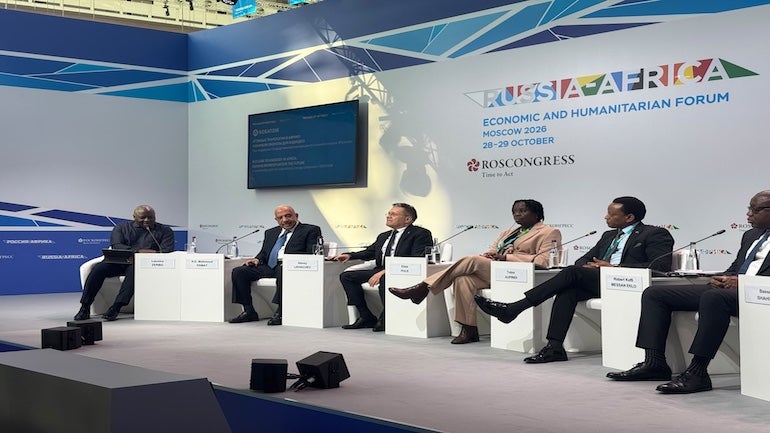
Also taking part in the discussion were Rosatom Director General Alexey Likhachev; Robert Coffey Messan Eklo, Togo Minister of Mining & Energy Resources; Toby Aupindi, Chairman of the Standing Parliamentary Committee on Natural Resources of Namibia’s National Assembly; and Mahmoud Esmat, Egypt’s Minister of Electric Power & Renewable Energy.
The participants discussed the first steps in the development of the nuclear industry, the use of national competencies and resources, as well as challenges in the implementation of nuclear projects. The speakers noted the role of nuclear technologies in ensuring reliable energy supply and the development of nuclear medicine, agriculture and science. Likhachev reported on Rosatom’s work in 29 of the 54 African countries and on the interest of African partners in nuclear energy. Special attention was paid to floating nuclear power units, after Rosatom signed the world’s first export agreement for the supply of electricity from such units in Indonesia. Rosatom noted significant interest in this technology from African countries.
“For African countries, nuclear technologies can become an effective tool for building national technological sovereignty.: the ability to independently determine development priorities, train their own specialists, and master advanced manufacturing. This is a complex work that requires systematic cooperation: from personnel training, infrastructure development to large projects worth billions of dollars. For us, working in Africa is primarily a responsibility to people.”
Rwanda’s Lassina Zerbo noted: “Every successful programme develops step by step, and the IAEA’s approach serves as a guideline for us. Before building reactors, we train engineers, regulatory specialists, and technicians and gain the trust of our citizens. No African country should go down this path alone: regional power grids, shared training centres, and regulatory cooperation will make project implementation faster and safer. Nuclear energy in Africa has moved from discussions to construction, and this is exactly what we are talking about with Rosatom today. Let’s make sure that it now moves from construction to transformation: electricity for our homes, medicine for our hospitals, jobs for our youth and sovereignty for the continent.”
On the sidelines of the summit both Togo, Rwanda and Uganda signed agreements with Rosatom on nuclear co-operation while Ghana revealed that talks were underway with Rosatom on NPP construction. In bilateral talks with Putin both Egyptian President Abdel Fattah al-Sisi and Ethiopian Prime Minister Abiy Ahmed discussed extending their nuclear cooperation (see related stories).


