Thorizon and the Netherlands Organisation for Applied Scientific Research (TNO) have launched a comprehensive materials and corrosion programme. The initiative is designed to generate the experimental data and predictive models necessary to qualify structural materials for advanced molten salt reactors (MSRs).
The programme aims to establish scientific evidence demonstrating how chosen reactor materials withstand intense radiation, high temperatures, and hot, corrosive salt. The resulting data will be critical for determining cartridge lifetimes, validating design choices, and satisfying nuclear regulatory bodies.
The initiative, led by TNO, directly supports the licensing of Thorizon’s Pioneer demonstrator facility in Petten, Netherlands, alongside the subsequent commercial rollout of the Thorizon One reactor.
The Thorizon Pioneer is a critical intermediate research facility designed to be Europe’s first operational nuclear molten salt installation. Positioned as the bridge between laboratory tests and commercial deployment, its primary purpose is to industrialise molten salt reactor (MSR) technology. First integrated nuclear operations at research scale, using an existing licensed site are scheduled for 2030.
Thorizon One is a 100 MWe small modular molten salt reactor designed to generate both electricity and industrial heat. It is designed to operate on liquid fuel and will require high-assay low-enriched uranium (HALEU delivered specifically in molten salt form. It is targeted for operation in 2034.
A distinct challenge for MSRs is long-term material degradation. Thorizon addresses this by placing its liquid fuel salt into sealed, replaceable cartridges engineered for a 5-10-year lifespan. The TNO partnership will provide the independent verification required to confirm that these components can reliably operate throughout their scheduled cycles.
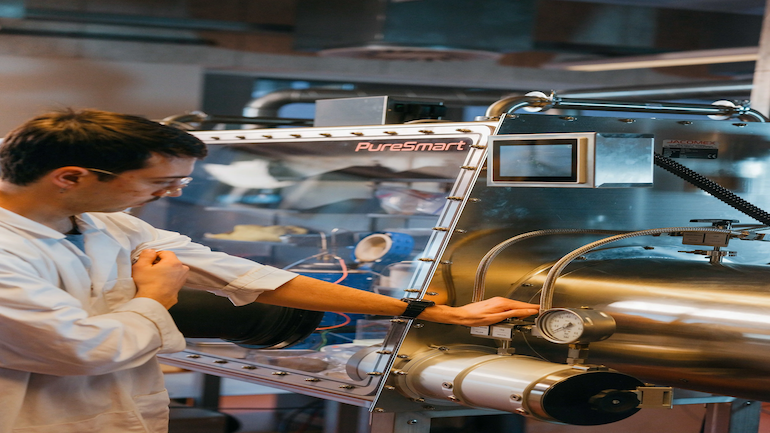
Initial research and testing tasks are underway at Thorizon’s facilities in Amsterdam and TNO’s specialised laboratories in Petten. While this is currently a Dutch initiative, the partners intend to broaden the programme into a larger international framework. They plan to collaborate closely with domestic entities such as Delft University of Technology and NRG PALLAS, as well as international groups such as the French Alternative Energies and Atomic Energy Commission (CEA – Commissariat à l’énergie Atomique et aux énergies Alternatives) and the European Commission’s Joint Research Centre (JRC).
“As a highly energy-dense, low-carbon source, nuclear energy has the potential to play an important role in a reliable energy system,” said Tjark Tjin-A-Tsoi, CEO of TNO. “New reactor technologies offer opportunities to further improve safety, sustainability and performance, while expanding the range of possible applications. These innovations can only move from concept to deployment on the basis of strong scientific evidence.”
Thorizon CEO Kiki Lauwers noted: “Our cartridge design makes material degradation a manageable engineering challenge. This programme will provide the independent evidence needed to validate that design and give regulators and operators confidence in material performance and cartridge lifetime. TNO is the right partner to build that qualification basis with us.”
Thorizon, a spin-off from the Nuclear Research & Consultancy Group (NRG), collaborates with industry leaders such as Hyundai Engineering and Construction, Orano, VDL Groep, Tractebel, EPZ and NRG PALLAS. Its project has been selected by the European Commission and the French government under the France 2030 investment plan. Thorizon is also funded by the European Commission, the Dutch Government and the Province of Noord-Brabant and Zeeland. TNO, the largest independent research and technology organisation in the Netherlands, collaborates closely with governments, universities and the private sector.


