
Armenian Prime Minister Nikol Pashinyan has said that a small modular reactor (SMR) may not be sufficient to meet the country’s growing electricity needs, as approved investment programmes have pushed Armenia from an electricity surplus to a deficit. He told a press briefing that the government is continuing discussions on the construction of a new NPP but walked back previous statements that the preference would be for a SMR.
The ageing Armenian NPP (ANPP) at Metsamor currently meets roughly 30% of Armenia’s domestic electricity demand but is due to close in 2036. It was built in the 1970s with two Soviet-supplied VVER-440-V230 units but was closed following a devastating earthquake in 1988. However, unit 2 was recommissioned with Russian help in 1995 following severe energy shortages. The plant In 2014, the government decided to extend the plant’s service life to 2026. Most of the overhaul (until 2019) was funded by an interstate loan from Russia.
In 2024, it was decided to extend the life of the plant until 2036. The government allocated $65m for this programme, which is being undertaken by Russian company Rusatom Service. Armenia’s leadership and the NPP’s management are now considering operating the plant until 2041-2046, subject to all assessments and approval by the IAEA. This is being discussed with Rosatom.
According to Rosatom Director General Alexey Likhachev, this is technically possible but may not be economically viable. Extension beyond 2036 would requires large-scale modernisation of safety and automation systems, additional work on the reactor vessel, ensuring the condition of the equipment, as well as expanding and repairing the storage capacity for used nuclear fuel. “Quite major investments are needed, and we estimate them at the level of hundreds of millions of dollars,” he said. These costs will affect the electricity tariff and could double to cost of electricity. Armenia needs to compare the economic feasibility of further life extension with the possibility of building a new power unit.
“The fact is that one year and four months ago, Armenia was a country with a surplus of electricity, and we had to think about where to consume our energy.” Pashinyan said. “One year later, Armenia has become a country with an electricity deficit. The fact that two AI factories have been established is not the issue. The issue is that the investment programmes that have already been approved are of such a scale that Armenia now has an electricity deficit. In other words, our entire surplus is being fully consumed by the investment programmes, and therefore, we need to think about what to do.”
He added that it has become necessary to consider the possibility of importing electricity and the development of new generation capacity. “I have said dozens of times before that we need nothing more than a small modular nuclear power plant. That has been our position. But now, due to this change, we have to understand that, most likely, a modular plant will not be enough for us…. We need to look at what will happen in 10 years.”
Asked about the possibility of a 1,000 MWe nuclear plant, Pashinyan said such an option could prove to be the most logical solution, although no decision has yet been made. “It cannot be ruled out that a 1,000 MWe nuclear power plant could be the most logical solution. It cannot be ruled out,” he said, stressing that the issue is currently under expert discussion. He confirmed that a decision on the construction of a new nuclear power unit is expected by the end of 2027, as envisaged by the government’s programme, while emphasising that an earlier decision would be preferable. He noted that constructing a NPP takes years, estimating that it would be 7-8 years before a new facility is connected to the grid.
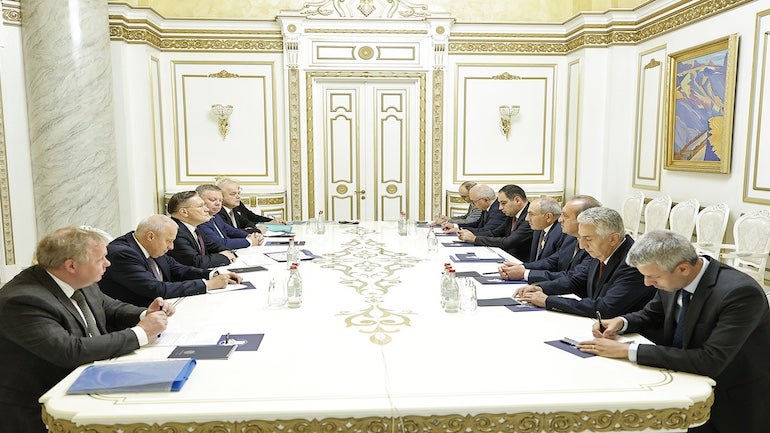
His policy shift followed detailed talks with Rosatom Director General Alexey Likhachev. Rosatom has submitted a concrete proposal to the Armenian government to build a 1,000 MWe VVER-1000 plant, Likhachev said. He told reporters that the construction of a new unit was discussed during a series of meetings with Pashinyan and Deputy Prime Minister Mher Grigoryan, alongside the issue of extending the operating life of the ANPP.
“And here, for the first time, we heard words from Nikol Pashinyan that are very important to us: Armenia will decide on the technical specifications in the coming months and select partners to build the new plant. This sets us the task of formulating the most competitive proposal possible in the coming months as Armenia chooses a company to build the new unit,” Likhachev said.
Rosatom considers a unit with capacity of at least 1,000 MWe is necessary based on projected demand and shortages in Armenia’s energy system by 2040. “And if we talk about the longer term – and we must always plan for decades – then, of course, a decision on a second unit is also not far off. But I want to emphasise once again that this is a sovereign decision of the Armenian government,” he stressed. With respect to electricity demand in Armenia, Likhachev said it is being met at acceptable prices, while consumption grew by 7% last year.
“Even if we assume moderate annual consumption growth of 4%, by 2036 – that is, right at the end of the operating period – we will reach a capacity deficit of around 1 GWe, taking into account the retirement of Metsamor. Therefore, you may have sufficient capacity in terms of wind and solar energy, but from the standpoint of practical and affordable electricity in the grid, the issue has not been resolved.”
The VVER-1000 nuclear units “are precisely the VVER reactors that we are developing at home, and these are the ones we have built and continue to build in India and Iran,” Likhachev noted. “They offer very high economic efficiency, particularly low electricity costs, while also incorporating all necessary Generation III+ safety systems. In our view, this proposal is the best currently available on the global market. Of course, that is our assessment, which the Armenian government has not yet endorsed, but today we officially handed Nikol Vovayevich [Pashinyan] and the entire large team present at the negotiations all the materials needed to begin discussions.”
He added that Rosatom was also prepared to implement the project with the participation of international suppliers, with which the corporation continues active cooperation despite external pressure. The international projects being implemented in Egypt, Türkiye, Uzbekistan and Kazakhstan have incorporated the best solutions available in global practice, in coordination with the national customer.
“A number of competent companies from European Union countries and countries in the Asian region could be involved. We are not discussing specific companies yet, because here we will act exclusively in line with the wishes of the customer – the Armenian government – and the specialists who will lead the technical side of the negotiations.” Likhachev pointed to the example of Kazakhstan, “where a two-unit VVER-1200 project will be implemented in an international consortium format involving French, Korean and Chinese manufacturers.”
According to Pashinyan, the government continues to discuss proposals received from international partners for the construction of a new nuclear power unit, and a decision will be made in the near future. He emphasised that the final decision will be purely economic in nature, taking into account price, quality, safety, deadlines, and guarantees.


