
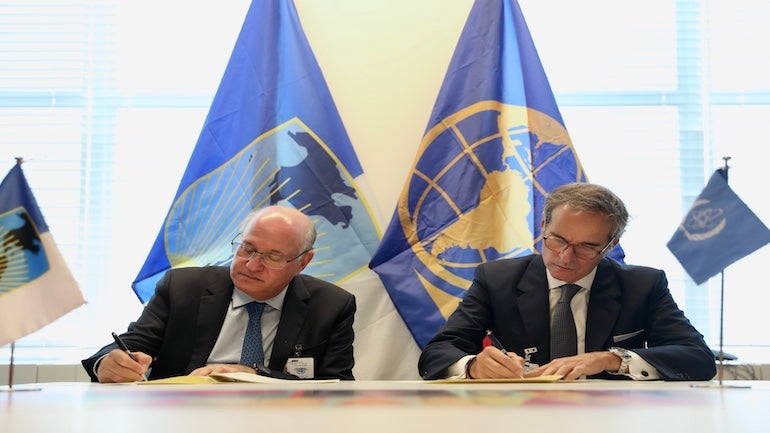
The International Atomic Energy Agency (IAEA) and the Inter-American Development Bank (IDB) have signed a memorandum of understanding (MOU) to strengthen cooperation on the safe, secure and sustainable use of nuclear energy in Latin America and the Caribbean.
IAEA Director General Rafael Mariano Grossi and IDB Group President Ilan Goldfajn signed the MOU on the margins of the United Nations General Assembly in New York, marking an important step in expanding collaboration between the IAEA and international financial institutions to support countries seeking reliable, low-carbon energy solutions. The agreement provides a framework for cooperation on nuclear energy and development, including dialogue, knowledge sharing, technical assistance, capacity building, energy-system planning, and infrastructure.
In addition to energy-related cooperation, the MOU builds on the IAEA and IDB’s existing work together in areas such as health, food security and water management. It also broadens cooperation on access to health services, including cancer care and control, as well as agricultural productivity, sustainable and climate-resilient agricultural practices, and soil, nutrient and water management.
The IAEA and the IDB will explore cooperation on the technical, institutional and economic aspects of nuclear technologies, including large-scale reactors, small modular reactors (SMRs) and other emerging technologies, in line with the IAEA’s recent agreements with other international financial institutions. In addition, the MOU builds on the IAEA and IDB’s existing work together in areas such as health, food security and water management. It also broadens cooperation on access to health services, including cancer care and control, as well as agricultural productivity, sustainable and climate-resilient agricultural practices, and soil, nutrient and water management.
“Today’s agreement reflects the growing recognition that nuclear energy can play an important role in supporting sustainable development, energy security and economic growth,” said IAEA Director General Rafael Mariano Grossi. “By combining the IAEA’s technical expertise with the IDB’s development experience and regional reach, we can help countries in Latin America and the Caribbean make informed decisions as they assess their future energy options.”
Over the past two years, the IAEA has expanded cooperation with institutions including the World Bank Group, the Asian Development Bank, CAF – Development Bank of Latin America and the Caribbean, and the OPEC Fund for International Development. These partnerships seek to support countries in evaluating nuclear energy as part of the growing international momentum to explore the role of nuclear energy in meeting rising electricity demand while advancing energy security and climate goals.
Argentina, Brazil and Mexico are currently the only countries in Latin America and the Caribbean using nuclear power, which accounted for only 1.8% of the region’s electricity generation in 2025, compared with 8.4% globally. According to the IAEA’s 2026 projections, total nuclear electrical generating capacity in the region could more than double by 2050 and increase approximately 2.5-fold by 2060. SMRs are expected to account for around 40% of new nuclear capacity in the region. Brazil joined the global commitment to triple nuclear energy capacity by 2050, originally adopted at COP28 in Dubai, in the United Arab Emirates.


