
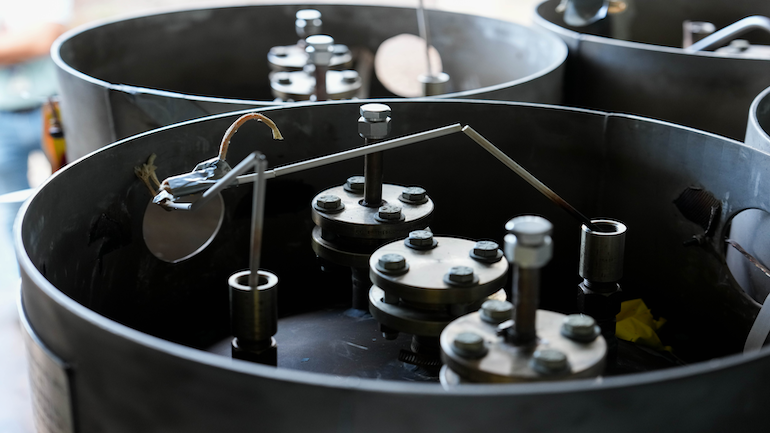
The US Department of Energy (DOE), Oak Ridge National Laboratory (ORNL), and Idaho National Laboratory (INL) have completed a shipment of more than 4,700 pounds of a coolant salt to private nuclear company Natura Resources.
The shipment consists of FLiBe salt, a specialty liquid-fuel reactor coolant comprising lithium fluoride and beryllium fluoride. It contains 99.99% enriched lithium-7, a rare isotope that allows molten salt reactors to operate safely at high temperatures and low pressures.
This specific batch of FLiBe was originally used in ORNL’s pioneering Molten Salt Reactor Experiment (MSRE), which ran from 1965 to 1969. The material had been kept in inventory at Oak Ridge for over 50 years.
The salt was transported over 1,000 miles to Abilene Christian University (ACU) in Abilene, Texas. It will be used in Natura Resources’ MSR-1, a 1 MWt molten salt demonstration reactor currently under construction at ACU.
Natura Resources secured the material through a competitive DOE solicitation managed by INL. The initiative is part of the DOE Office of Nuclear Energy’s Reactor Pilot Program, which aims to speed up the testing and commercial deployment of advanced, private-sector reactor designs. Once operational, MSR-1 is on track to become the first salt-fuelled molten salt reactor to run in the United States since the original Oak Ridge experiments concluded in 1969.
ORNL transferred the salt from the MSRE’s original coolant tank into five large canisters in 1999. In 2012, salt from one of the large canisters was transferred into several smaller canisters for research use. The freight shipment to Natura includes the four remaining large canisters along with two smaller canisters.
“Few materials in the nuclear industry carry the history and significance of this FLiBE inventory,” said Natura Resources CEO Jordan Robison. “We are honoured to build upon the foundation established by Oak Ridge National Laboratory and grateful to the Department of Energy for enabling its continued use in advancing molten salt reactor technology. This milestone connects one of the nation’s most important reactor experiments with the next generation of nuclear innovation.”
Kevin Robb, head of ORNL’s Energy Systems Development Group, who is leading the project to transport the salt, noted: “ORNL has the only significant supply of lithium-7 enriched FLiBe salt currently available in the United States. This transfer is helping accelerate the deployment of the next generation of molten salt reactors while commercial suppliers develop lithium-7 production capacity in the US.”
ORNL supports a broad range of research, from fundamental salt property measurements to applied engineering data that can inform design, licensing and eventual operation. The laboratory hosts several test facilities supporting molten salt reactor development, including the Facility to Alleviate Salt Technology Risks, a Liquid Salt Test Loop, and the Salt Pot Instrumentation and Components Evaluation Experiment. In partnership with the University of South Carolina, ORNL oversees DOE’s Molten Salt Database, a comprehensive resource used by developers to develop models and accurately inform reactor design.
“ORNL’s facilities and expertise have become increasingly significant as commercial interest in molten salt technologies has grown,” said Robb. “We’ve been a trusted partner in the broader MSR community for more than 60 years, reducing risk, strengthening confidence and moving molten salt technologies closer to commercial reality.”


