
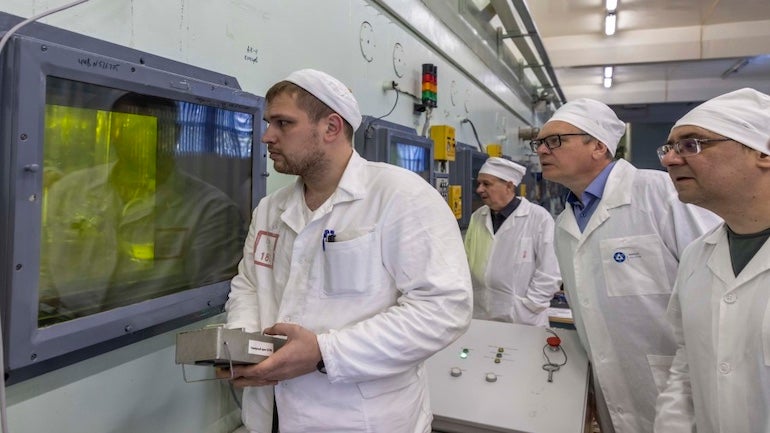
Rosatom has successfully completed the acceptance testing for the first three nuclear fuel assemblies (FAs) produced for the MBIR (Mnogotselevoi Bistrii Issledovatelskii Reaktor) multi-purpose fast neutron research reactor at the Research Institute of Atomic Reactors (NIIAR – Nauchno Issledovatelskii Institut Atomnikh Reaktorov) in Dimitrovgrad.
This marks a critical transition from manufacturing individual fuel elements to mastering the full production technology for complete assemblies ready for the reactor core. An expert commission verified the production readiness, exact technical parameters, and quality controls, declaring the assemblies suitable for the reactor’s initial core loading. The commission comprised representatives from the NA Dollezhal Scientific Research & Design Institute of Power Engineering (NIKIET – Nauchno-Issledovatelskii i Konstruktorskii Institut EnergoTekhniki) in Moscow, the AI Leipunsky Institute of Physics & Power Engineering the Institute of Physics and Power Engineering (FEI – Fiziko-Energeticheskiy Institut imeni AI Leypunskovo) in Obninsk, and the Machine-Building Plant (MSZ – MashinoStroitelny Zavod) in Elektrostal.
“Based on the results of the commission’s work, the pilot batch was recognised as having passed the tests and as suitable for operation as part of the initial core of the MBIR reactor,” noted Sergei Kiverov, Deputy Director for Facilities under Construction at NIIAR.
“Development work for the MBIR fuel assembly has been completed. The production of fuel assemblies in the fuel complex of our institute was recognized by the commission as competent,” affirmed NIIAR Chief Technologist and Deputy Head of the Fuel Technologies Department. Elena Fokeeva.
By the end of the year, Rosatom plans to finish delivering all remaining components for the fuel elements and the subsequent batches needed for the assemblies.
Construction on MBIR is nearing completion and the facility is planned to be put into operation in 2028. The 150 MWt multi-purpose sodium-cooled fast neutron MBIR reactor will be the world’s largest facility of its kind. It is expected to provide the nuclear industry with a modern and technologically advanced research infrastructure for the coming 50 years. Research time needed at the new reactor will be several times less in comparison with the currently operating installations.
Recently the Afrikantov Experimental Design Bureau of Mechanical Engineering (OKBM Afrikantov – Opitnoye Konstruktorskoye Byuro Mashinostroyeniya imeni II Afrikantova) manufactured and delivered the main primary circuit circulation pumps for MBIR. The pumping systems are critical to the reactor’s core operations, serving as its engineering “heart” by ensuring the continuous and reliable circulation of the primary coolant.
Because the MBIR uses liquid sodium as its primary coolant, the pumping infrastructure must withstand exceptionally demanding conditions. Liquid sodium requires the equipment to feature strict hermetic tightness, heavy-duty resistance to corrosive chemical media, and the ability to operate under intense thermal stress. To meet these requirements, engineers at OKBM Afrikantov adapted and upgraded field-tested design solutions previously used in Russia’s sodium-cooled reactors, including the BOR-60 in Dimitrovgrad and the BN-600 and BN-800 at units 3&4 of the Beloyarsk NPP.
Before delivery, the pumps successfully passed rigorous qualification testing to verify that their reliability, safety thresholds, and hydraulic performance match the required Generation IV safety benchmarks.
“Successful tests confirmed that we were able to comply with all requirements and ensure the required level of reliability and safety,” said Sergei Babushkin Chief Designer of Centrifugal Machines & Fittings at OKBM Afrikantov. “This is an important step for the MBIR reactor plant – it should become the main experimental site for IV generation nuclear energy technologies.”


