
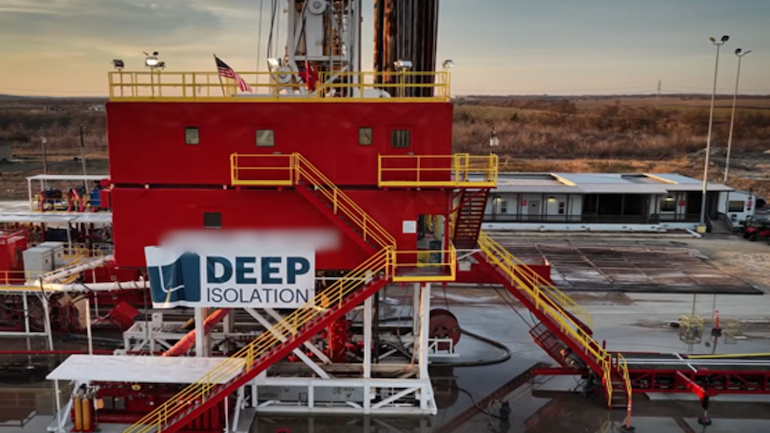
US-start-up Deep Isolation has completed a three-year study funded by the Department of Energy’s DOE’s Advanced Research Projects Agency–Energy (ARPA-E) programme. The results confirmed that deep borehole repositories provide a safe and highly economical option for permanently disposing of nuclear recycling waste.
The study evaluated multiple packaging and disposal setups using Deep Isolation’s Universal Canister System (UCS) buried up to a mile underground. The analysis considered Deep Isolation’s UCS in both horizontal and vertical deep borehole configurations.
Every scenario analysed was projected to cost less than the programme’s strict economic target of 0.1 cent per kilowatt-hour of electricity generated. Rather than calculating a single abstract lump-sum cost for a repository, the industry and DOE standardise waste management costs by tying them directly to the amount of power the reactor originally supplied to the grid.
Physics-based modelling confirmed that long-term safety criteria were easily met. Under normal expected conditions, projected radiation doses to the public were orders of magnitude below the standard regulatory benchmark of 10 millirem per year.
The project was conducted as part of DOE’s ARPA-E CURIE programme in collaboration with alongside Argonne National Laboratory (ANL), Oklo and Case Western Reserve University. It validated that nuclear waste streams partitioned from electrorefining processes are fully compatible with generic shale and granitic deep borehole isolation.
Oklo is developing an integrated fuel strategy for used fuel recycling, fuel fabrication, and power generation. It plans to recover usable fuel materials through pyroprocessing, fabricate that material into fuel, and use that fuel in its advanced fast reactors.
Although the results of the study offer a clear technical blueprint for closing the nuclear fuel cycle and managing advanced reactor waste, implementation in the US will ultimately require legislative updates to formally authorise borehole repositories for high-level waste.
“Closing the fuel cycle is about unlocking the full value of used nuclear fuel – recovering its energy potential and extracting isotopes, while safely and permanently managing what remains,” said Ed Petit de Mange, Vice President of Fuel Recycling at Oklo. “This three-year study shows what’s possible when we design recycling and disposal together: an integrated approach that can meet rigorous safety standards while keeping disposal costs low. That’s the model we should work toward as we build the infrastructure for a more complete nuclear fuel cycle.”
“CURIE was structured to address several of the technical and economic challenges that need to be considered together as fuel recycling technologies advance,” said Krista Hawthorne, ANL Section Manager for Pyroprocess Engineering. “By bringing together expertise in oxide reduction, process monitoring, fuel-cycle planning and waste disposal, this team has developed a more integrated understanding of how these systems could work together. Deep Isolation’s disposal work provides an important component of that broader fuel-cycle strategy.”
DOE has heavily supported Deep Isolation through multi-million-dollar grants, sub-contracting research partnerships, and technology integration into federal nuclear clean-up initiatives. In December 2025, Deep Isolation completed a three-year project funded under the ARPA-E Optimizing Nuclear Waste and Advanced Reactor Disposal Systems (ONWARDS) initiative. This project resulted in the production and physical testing of the world’s first disposal-ready UCS.
In April, ARPA-E committed $40m split across two projects, positioning Deep Isolation to receive up to $20m to test deep borehole disposal using a non-radioactive Commercial Pilot in Cameron, Texas (ARPA-E SCALEUP). Deep Isolation has also finalised its engineering work on various secondary ARPA-E funded projects as a subrecipient to nuclear developer Oklo and the Electric Power Research Institute (EPRI).


