
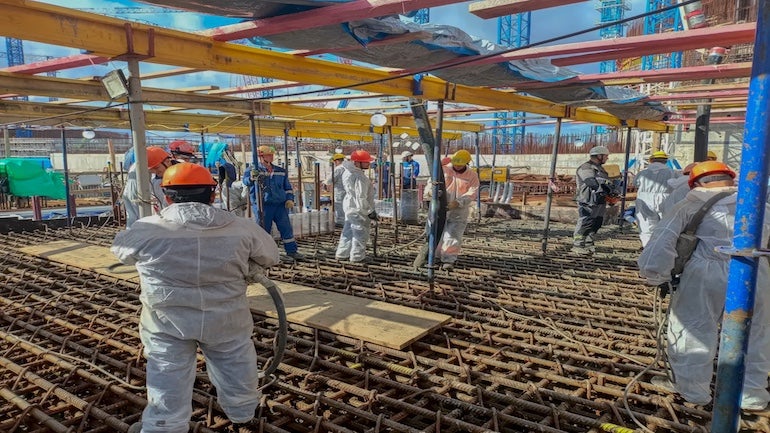
Concreting of the foundation of the turbine building has begun unit 7 of Russia’s Leningrad NPP (also known as unit 3 of Leningrad-II). Builders have initially filled the central grip of the future base with almost 5,000 cubic metres of concrete mixture.
Currently Leningrad NPP has four units in operation – units 3&4 with Soviet RBMK-1000 reactors, as well units 5&6 with new VVER-1200 units (also known as Leningrad-II 1&2). Units 5&6 replaced the RBMK-1000 reactors at units 1&2, which were decommissioned in 2018 and 2020. New VVER-1200 units (7&8), now under construction, will replace units 3&4. Unit 7 is scheduled to begin operation in 2030 and unit 8 in 2032.
To create a particularly strong foundation, builders will need almost 5,000 tonnes of steel reinforcement and more than 20,000 cubic metres of especially strong concrete. Work is being carried out in parallel in seven areas. The result will be a monolithic slab two and a half metres high and with an area of more than eight thousand square meters.
“A good foundation is, first and foremost, high‑quality, high‑strength concrete, adherence to the technology for its placement, and proper care. Particular care is required in the first few days, when maintaining the temperature and humidity conditions at the site and protecting the concrete from mechanical damage play a decisive role,” said Konstantin Khudyakov, director of the programme for facilities of the Leningrad NPP, at general contractor Titan-2. “After the concrete mix reaches the design strength, we will check the building structure together with the customer using non‑destructive testing methods, including ultrasonic flaw detection.”
Control samples made from the same concrete will be tested additionally: they will be tested for compression using a hydraulic press. This is necessary to confirm the strength of the future foundation, and therefore its ability to withstand significant loads from walls, ceilings, pipelines, and multi‑tonne operating equipment.
The entire foundation slab for the unit 7 turbine building is expected to be completed by the end of November. After that, the builders will begin constructing the walls and floors, as well as laying foundations for the condensers – heat‑exchange equipment that converts the steam from the turbine into condensate. The construction of the foundation for the turbogenerator, which includes a steam turbine and a turbogenerator, will begin next year. In the future, one of the most significant key events will be installation of the turbogenerator. This is scheduled for 2029.
“The turbine building is the main component of the turbine island of any power unit. It is here that the steam will be converted into mechanical energy, and then into electrical energy, with subsequent transmission to consumers,” said Evgeny Milushkin, Deputy Director of the Leningrad NPP for capital construction and head of the Capital Construction Department. “In addition, this is the first link in the chain of production and supply of thermal energy to consumers.”
Steam from the turbine will be used to heat the network water, which will then be sent to the satellite town of Sosnovy Bor and its industrial zone for their hot water supply and heating. During the phased replacement of the Leningrad RBMK‑1000 units with VVER‑1200 units, this will continue to ensure comfortable living and working conditions for the 65,000 people living and working there. Grid connection is scheduled for 2030.


