
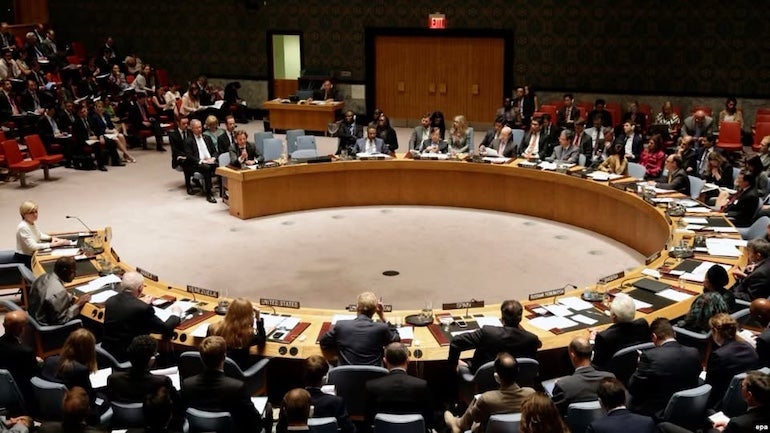
A day after the International Atomic Energy Agency (IAEA) Board of Governors voted to refer Iran’s case to the United Nations Security Council (UNSC), members of the Council convened to discuss the reactivation of the sanctions committee established in connection with Resolution 1737 adopted 20 years ago. Despite opposition from Russia and China, the Council approved opening discussions on the matter with 11 votes in favour.
Under the resolution, the sanctions committee was required to review Iran’s case every 90 days and report back to the Security Council. The committee’s quarterly reports continued for nine years, until the conclusion in 2015 of the Joint Comprehensive Plan of Action (JCPOA) and the subsequent adoption of Resolution 2231. That resolution suspended all previous sanctions resolutions, including Resolution 1737, and consequently brought the committee’s periodic reports to an end.
The IAEA Board of Governors had voted 23 to 3 (with 8 abstentions) to refer Iran to the UNSC, marking the first time in 20 years that the Agency has referred Tehran for allegedly violating international non-proliferation safeguards. While Western nations overwhelmingly supported the measure, Russia, China, and Niger voted against it.
The resolution, submitted jointly by the US, UK, France, and Germany, alleges a complete breakdown in nuclear transparency. Reviving a long-standing contentious issue, the resolution accused Tehran of failing to provide technically credible explanations for uranium particles detected at several undeclared locations at a time when the Agency was still conducting regular inspections. The Agency also estimates that Iran possesses roughly 400–440 kg of uranium enriched to 60%.
The initial wave of UN Security Council (UNSC) sanctions against Iran was triggered in 2002 after the National Council of Resistance of Iran (a Western-backed opposition group) publicly exposed the secret construction of the Natanz enrichment plant and the Arak heavy water facility.
Iran explicitly argued that it had not violated international law and was abiding by its original Comprehensive Safeguards Agreement (CSA) with the IAEA. The 1976 version of the safeguards agreement that Iran originally signed only legally required a country to inform the IAEA about a new nuclear facility 180 days before nuclear material (fissile material) was introduced into the building. Iran said it was on track to notify the Agency within the 180-day window.
In 1992 the IAEA updated its rules (Modified Code 3.1) mandating that states must report nuclear facilities as soon as the decision to construct them. However, Iran had not ratified the Code. Under intense international pressure, Tehran agreed to temporarily adopt the new Code in February 2003 but in 2007, after the UN began passing sanctions, Iran suspended its compliance saying it had the right to revert to the old 1976 rules. Iran also relied heavily on Article IV of the Nuclear Non-Proliferation Treaty (NPT), which guarantees all signatories an “inalienable right” to develop and use nuclear energy for peaceful purposes.
In July 2006, following an IAEA declaration that it could not verify the peaceful nature of Iran’s nuclear materials, the UNSC passed its first resolution demanding Iran halt all enrichment activity. When Iran ignored the mandate, the UNSC unanimously enacted Resolution 1737, imposing the first legally binding international sanctions under Chapter VII of the UN Charter. These UN sanctions came on top of stringent US-European sanctions on Iran that had been in force since the Islamic Revolution of 1979.
Following decade of increasing sanctions and abortive negotiations, the JCPOA was signed in 2015 between Iran and the P5+1 (US, UK Russia, China and France plus Germany) whereby Iran agreed to restrict its nuclear development in return for sanctions relief.
This collapsed after the US unilaterally withdrew from the deal in 2018 and reimposed harsh sanctions. In 2019 Iran once again began nuclear development.
In June 2025, Israel and the US conducted an unprovoked military strike on Iran’s nuclear facilities at a time when key US-Iran negotiations were apparently being prepared. In response, Iran’s parliament voted to suspend cooperation with the IAEA. In August 2025, Western European powers (E3) officially triggered the JCPOA “snapback” mechanism aiming to restore all old pre-2015 UN sanctions. However, Moscow and Beijing declared the snapback entirely illegitimate and refused to abide by it.
Because the UN Resolution 2231 framework expired in late 2025, the original legal architecture of JCPOA no longer exists. In February 2026, the US and Israel resumed their strikes on Iranian facilities, setting in stone Iran’s refusal to co-operate with the US or the IAEA. This latest IAEA referral to the UNSC can only harden Iran’s resolve and effectively marks the transition into a post-JCPOA era, where any future nuclear limitations will require an entirely new framework to be negotiated from scratch.
Moreover, experts emphasise that referral to the UNSC is largely a symbolic and diplomatic move because permanent UNSC members Russia and China hold veto powers, making the introduction of new binding UN sanctions against Iran almost impossible. .
Tehran strongly condemned the IAEA vote, dismissing it as a politically motivated move. Iranian officials argue that routine inspections are physically impossible and unsafe due to the recurring US and Israeli military strikes on their facilities since mid-2025.
IAEA Director General Rafael Grossi said giving the Agency access to key nuclear facilities in Iran would have “positive repercussions” for the Islamic republic. However, Iran condemned the resolution, saying it would “not bring any results”. Iran’s representative to the IAEA, Reza Najafi, told PressTV: “This resolution was passed under political pressure from the US and its allies and in our view has no basis,”
For Western nations, the resolution serves as the ultimate justification to reactivate the old UN sanctions committees. The text notes “with grave concern… Iran’s continued non-compliance with its obligations” and “reiterates its call upon Iran to urgently remedy its non-compliance”. It also calls on Tehran “to engage seriously and without preconditions in talks aimed at building international confidence in the exclusively peaceful nature of Iran’s nuclear programme”.
Since June 2025, the fate of Iran’s stockpile of enrich uranium has remained uncertain. Israel and the US have long accused Iran of wanting to build a nuclear weapon. Tehran has repeatedly denied having any military nuclear ambitions, insisting on its right to the technology for civilian purposes.
Ali Vaez, of the International Crisis Group, told AFP that some see the resolution as “an opportunity to add legal pressure to economic strangulation and naval blockade to turn the screws on Iran”. He added: “Ultimately, though, it is an exercise in futility” with Russia and China “likely to ensure that Western pressure hits a wall at the Security Council”.


