
Rosatom’s Director General, Alexey Likhachev, has detailed plans to construct a dedicated shipyard near Murmansk to support the expanding demands of the Arctic and international energy markets for floating NPPs (FNPPs). The primary motivation for establishing this new facility is the physical and infrastructural limitations facing the Baltic Plant (Baltiysky Zavod) in Saint Petersburg.
While the Baltic Plant historically has handled key nuclear shipbuilding projects such as the Project 22220 icebreakers and the Akademik Lomonosov, its geographical footprint is restricted by the Blagoveshchensky Bridge. This bridge creates a strict size and navigation bottleneck, preventing the facility from taking on the dozens of upcoming orders required for large-scale, serial completion FNPPs.
Initial project cost estimates sit at several tens of billions of Rubles, with some industry projections ranging up to RUB100bn ($1.15bn) Design work and site surveys are slated to extend through autumn 2026, with physical construction scheduled to begin in 2027.
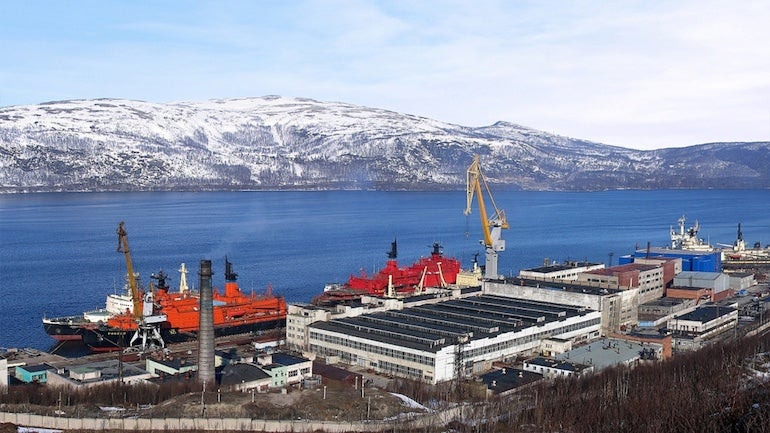
In preparation for these logistics, a specialised subsidiary named Energoflot Murmansk LLC was formed under Rosatom, with industrial machinery giant Uralmashzavod (part of UZTM-Kartex Group) acquiring a 50% stake to co-manage the shipbuilding initiatives. The new shipyard will be constructed on a land plot situated along the coast of the Kola Bay, positioned directly next to the existing Atomflot base.
This offers distinct operational benefits. Unlike the Baltic Plant, this site bypasses shallow transit lanes and urban bridges, giving immediate, ice-free access to the open ocean. Placing the yard next to Atomflot allows Rosatom to seamlessly tap into the existing maintenance docks, technical personnel, and service facilities currently used to support Russia’s nuclear-powered icebreaker fleet.
This facility will act as a primary production hub for completing the floating hulls of power stations, such as the upcoming units designed to power the Baimskaya ore zone in Chukotka, securing a reliable and localised energy supply line for global and Arctic industrial projects.
In May, ZiO-Podolsk plant (part of Rosatom’s Mechanical Engineering Division) completed manufacture of the first RITM-200S reactor unit for the lead floating nuclear power unit (PEB-106) for the Baim project in the Arctic. A series of four such power units (Project 20871) is being built to supply energy to the Baimskaya ore zone in Chukotka. The developer of Project 20871 is the Iceberg Central Design Bureau. The developer of the reactor plant is OKBM Afrikantov. The first of the four units is scheduled for commissioning in 2028.
Since 2020, the world’s first floating power unit Akademik Lomonosov has been operating at Pevek in Chukotka, during which time it has generated more than 1.2 TWh of electricity and avoided 400,000 tonnes of greenhouse gases emissions.


