
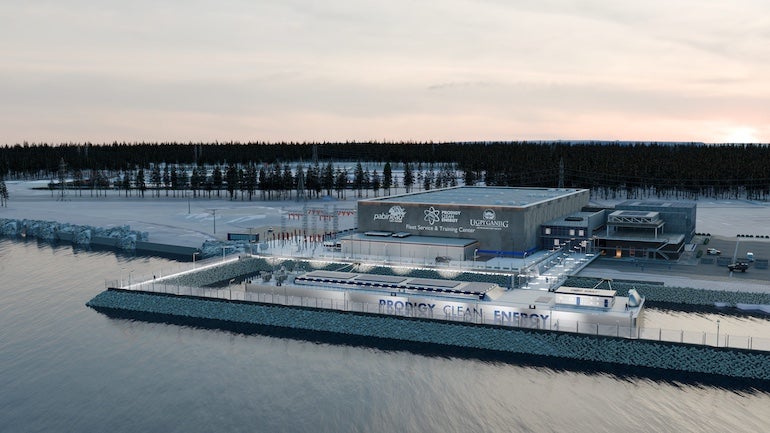
Montreal-based Prodigy Clean Energy, the Pabineau First Nation, and the Eel River Bar First Nation have announced a joint, Indigenous-led proposal to deploy Canada’s first full-scale, 50 MWe Transportable Nuclear Power Plant (TNPP). The facility is proposed to be built at Belledune, New Brunswick, within the traditional territories of both First Nations. It coincides with the federal mandate for the nearby Belledune coal-burning station to cease coal operations by 2030.
The pilot plant will be fully owned by the First Nations communities. Leaders, including Chief Terry Richardson of the Pabineau First Nation, have highlighted it as a blueprint for economic reconciliation, local jobs, and energy sovereignty.
Unlike traditional fixed nuclear facilities, Prodigy’s TNPP infrastructure is reactor-agnostic. The modular plant is built entirely in a factory setting, shipped as heavy-lift cargo aboard a vessel, and installed at a shoreline or marine site. At the end of its life cycle, the entire plant can be removed by ship for centralised decommissioning, leaving no permanent nuclear waste or cleanup liabilities at the site.
The New Brunswick plant is intended to validate the logistics and operational requirements of transportable reactors. The ultimate goal is to mass-deploy a fleet of these plants to help remote Arctic communities, northern mining operations, and defence sites transition away from diesel fuel.
The project has secured a Letter of Intent from the province of New Brunswick to purchase the electricity. Supported by strategic nuclear partners BWXT Canada and Kinectrics, the team plans to finalise their reactor technology down-selection by 2032 and targets commercial operation in the early 2030s and has formally notified Natural Resources Canada (NRCan) of its institutional support and intent to advance the project to Canada’s federal Major Projects Office (MPO) as a nationally transformative infrastructure initiative.
“By deploying the first Prodigy TNPP and anchoring the supply chain here in New Brunswick, we are demonstrating the strength and leadership of the province, our First Nations, and our nuclear-trained workforce, to support Northern sovereignty and Canada’s new Nuclear Energy Strategy. This project has potential to supply clean energy for Northern New Brunswick communities and support significant regional economic development,” said René Legacy, New Brunswick Deputy Premier and Minister Responsible for Energy.
“By integrating this Canadian clean baseload energy technology with Indigenous ownership and economic participation, this initiative establishes a replicable model to deploy transportable nuclear power infrastructure across Canada, especially in Northern and Arctic regions where energy sovereignty is vital to community prosperity and economic reconciliation. This project will further demonstrate an export-ready power plant for markets outside of Canada, generating prosperity not only for Indigenous Peoples and New Brunswick, but also for the country as a whole,” said Pabineau First Nation Chief Terry Richardson.
“The successful integration of microreactors and Transportable Nuclear Power Plants into Canada’s Northern and Arctic energy portfolio begins with demonstrating a commercially operating facility south of 60 in an established nuclear jurisdiction,” said Mathias Trojer, President and CEO of Prodigy Clean Energy. “This deployment strategy is consensus-driven, reflecting years of dedicated engagement with Northern Indigenous Rights Holders, provincial and federal governments, utilities, and industry.”
The immediate priority for the project team (Prodigy Clean Energy, BWXT Canada, and Kinectrics) involves securing site selection and characterisation. The project will formally secure a qualified nuclear operating organisation during this initial planning window to act as the primary facility licensee with regulators.
The team will collect site data to lay the groundwork for submitting a formal Licence to Prepare Site application to the Canadian Nuclear Safety Commission (CNSC). Completion of these site licensing preparations is designed to drive the venture toward a Final Investment Decision (FID) within 18 months.
Because Prodigy’s TNPP structures are reactor-agnostic, the team has until 2032 to finalise the specific small modular reactor (SMR) technology to be integrated into the hull. The selected reactor must be proven demonstrably ready for commercial electricity generation by that year. Working alongside Lloyd’s Register, the project is mapping out lifecycle, transport, and marine fabrication standards to ensure full compliance with both CNSC and International Atomic Energy Agency (IAEA) safety requirements.
The role of BWXT Canada and its subsidiary Kinectrics is to bridge the gap between Prodigy Clean Energy’s marine infrastructure designs and the practical realities of nuclear regulation, component manufacturing, and lifecycle operations. Both companies provide the regulatory expertise needed to navigate the CNSC framework. They are laying the groundwork for the project’s upcoming Licence to Prepare Site application.
Because Prodigy’s TNPP hull is reactor-agnostic, Kinectrics and BWXT leverage their extensive engineering experience to evaluate how different Small Modular Reactor (SMR) technologies will physically and safely integrate into the transportable marine structure.2
BWXT Canada brings the necessary world-class industrial capacity to manufacture massive, safety-critical nuclear components. This ensures the supply chain can scale to produce these transportable plants in a standardised factory setting. BWXT is already a dominant fuel and nuclear component supplier across Canada.
Kinectrics functions as a specialist in global nuclear lifecycle management, equipment testing, and specialised plant services and is helping engineer the operational protocols required to safely ship, maintain, and eventually extract the entire reactor unit by vessel at the end of its life cycle, supporting Prodigy’s goal of leaving zero permanent waste at the host site.
Because the project targets an output of up to 50 MWe, the partners have the flexibility to select either a single medium-sized SMR or multiple ultra-compact microreactors grouped together inside the plant structure.
While a final technology decision is not expected until 2032, Prodigy and the First Nations already have established agreements, joint studies, or structural compatibilities with three leading reactor technologies.
The Westinghouse eVinci microreactor is currently the primary frontrunner for this project. In early 2026, Prodigy wrapped up a two-year Government of Canada-backed R&D programme using the eVinci design as its core technical benchmark. Each eVinci unit produces about 5 MWe plus high-temperature industrial heat. The Belledune plant would bundle a cluster of up to 10 eVinci modules within its floating structure.
Even before the Prodigy announcement, the Pabineau and Eel River Bar First Nations in May 2025 signed a formal memorandum of understanding with Westinghouse specifically to evaluate SMR opportunities at the Port of Belledune. AP300 is a downscaled 300 MWe version of AP1000. While the AP300 exceeds the project’s initial 50 MWe target, the First Nations are using this relationship to explore larger, long-term regional grid-scale expansions at the Belledune Green Energy Hub.
Prodigy has a long-standing commercial agreement with NuScale Power to integrate its modular technology into Prodigy’s larger SMR Marine Power Station designs. The two companies began investigating the feasibility of integrating NuScale Power Modules (NPMs) into Prodigy’s marine architecture in 2018 with further agreements signed in 2021. In 2022, the partners unveiled an advanced, updated concept design for a transportable facility capable of housing 1-12 NuScale modules to pitch directly to global utilities and shipyard manufacturers.
Although BWXT Canada is an active project partner, its proprietary BWXT Advanced Nuclear Reactor (BANR – a 50 MWt/17 MWe microreactor designed for transport remains a conceptual option. However, BWXT’s primary commercial strategy for this pilot is to act as the overarching industrial fabricator and component supplier for whichever reactor wins the final contract.
However, the Port of Belledune is shaping up to be a diverse nuclear hub. Instead of picking just one technology, the region is dividing its strategy based on different industrial needs. In addition to the Prodigy TNPP, ARC Clean Technology has a proposal to build its liquid sodium-cooled ARC-100 reactor at the Port’s Green Energy Hub to produce hydrogen for export. These larger on-grid SMRs such as the AP300 and BWXT’s BWRX-300 are being evaluated by New Brunswick Power and regional First Nations for heavy industrial operations, large data centres, and regional baseload grid capacity as coal phases out.


