
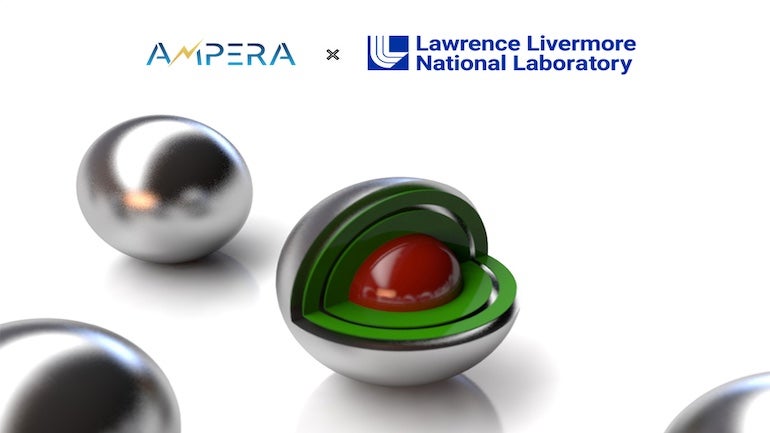
US energy technology start-up Ampera has partnered with Lawrence Livermore National Laboratory (LLNL) to develop scalable advanced nuclear fuel for compact and subcritical reactor platforms, with potential maritime applications. The collaboration will evaluate liquid-metal-jetting technology to produce highly uniform, spherical thorium-232 kernels for tri-structural isotropic (TRISO) fuel.
The strategic partnership is based on the THUNDER (Thorium Unimodal Droplet Ejection for Reactors) project. This aims to mature advanced manufacturing for next-generation nuclear applications. The project, transferred from LLNL’s foundational PowderJet research, leverages “droplet-on-demand” liquid-metal jetting to produce highly spherical, size-controlled particles.
The work encompasses computational modelling, nozzle/materials compatibility testing, high-temperature process development, and structural particle characterisation. The aim is to establish a secure, vertically integrated domestic thorium-232 fuel supply chain to reduce reliance on foreign fuel sources.
TRISO fuel typically uses a uranium-based kernel encased in three distinct layers of protective carbon and ceramic materials. This project re-engineers that platform by replacing uranium with thorium-232. TRISO encapsulation makes particles highly resistant to corrosion, high temperatures, and irradiation, making meltdowns virtually impossible.
Thorium, as a nuclear fuel material, offers several advantages: it is abundant, produces a less persistent waste stream and is more difficult to weaponise, adding a layer of proliferation resistance. Thorium-232 cannot sustain a fission chain reaction on its own, but when it absorbs a neutron, it decays into uranium-233, which is fissile. A thorium reactor therefore breeds its own fuel as it operates, though it still needs a “seed” of fissile material, typically uranium or plutonium mixed with the thorium, to start and sustain the reaction.
“Public-private projects like this show the value of connecting LLNL’s world-class research capabilities with industry partners who have a clear technology need and sharp commercial focus,” said Viktor Sukhotskiy “Project THUNDER shows how early LLNL investment in manufacturing and materials science can lead directly to external partnerships in strategically important technology areas,” Sukhotskiy said. “PowderJet grew out of foundational work in liquid metal jetting, and we are now applying it to a challenging nuclear fuel problem with real commercial relevance.”
LLNL said THUNDER connects several key Department of Energy (DOE) and Laboratory priorities, including domestic energy resilience. Small modular reactors (SMRs) can deploy to infrastructure-limited locations, offering a way to supply reliable power to isolated communities, military installations and industrial sites without placing demand on a centralised grid. This project also sustains Laboratory leadership in advanced manufacturing and demonstrates a technology-transfer pathway that spins out early-stage LLNL research into commercially relevant partnerships.
“Lawrence Livermore National Laboratory has a long and distinguished record of translating advanced science into technologies of national importance,” said Ampera founder and CEO Brian Matthews. “We believe this collaboration can accelerate the technical foundation required to vertically integrate our fuel supply, reduce cost and supply-chain risk, and support the deployment of our compact subcritical nuclear energy systems.”
Ampera’s advanced fuel platform is built on proprietary processes protected by trade secrets and a growing intellectual property portfolio. This includes more than 60 patents covering proprietary liquid-metal-jetting technology, together with additional patent filings specifically directed toward advanced TRISO fuel manufacturing processes and technologies. In June, Ampera announced its advanced fuel strategy to support the development of a secure thorium fuel supply chain and future advanced fuel production capabilities.
Ampera believes advanced fuel cycles, combined with advanced manufacturing and next-generation neutron technologies, can play an important role in enabling a new generation of compact, scalable nuclear energy systems. Amera said the collaboration supports its long-term strategy to develop advanced fuel for its solid-state, subcritical nuclear energy platform, designed to provide compact, factory-built power systems with up to 30 years of operation without refuelling.
Florida-based Ampera, founded in 2025, is pioneering subcritical thorium-based microreactor systems specifically designed for high-density, off-grid power demands. The company has rapidly scaled to between 51 and 200 employees and positions itself as a sister company to the additive manufacturing firm ADDiTEC.
Ampera is shifting away from traditional nuclear designs by focusing on a “Core-for-Life” solid-state system that can operate for up to 30 years without refuelling. Unlike conventional critical reactors, Ampera’s system uses an integrated neutron driver to maintain operation. If power to the neutron driver is cut, the nuclear reaction stops instantly, eliminating any risk of a runaway meltdown.
The microreactors use thorium-232 rather than enriched uranium. The reactor is based on a high-efficiency supercritical carbon dioxide (sCO2) power cycle. A single standard core is engineered to output 30 MWt. A cornerstone of Ampera’s rapid development is its heavy reliance on 3D printing to bypass traditional industrial manufacturing bottlenecks.
In July, Ampera unveiled what it claims is the first full-scale, additively manufactured demonstration module of its nuclear core architecture. The spherical, monolithic gyroid structure was 3D printed in silicon carbide and represents the architecture being developed to support up to 30 years of operation without refuelling.


