
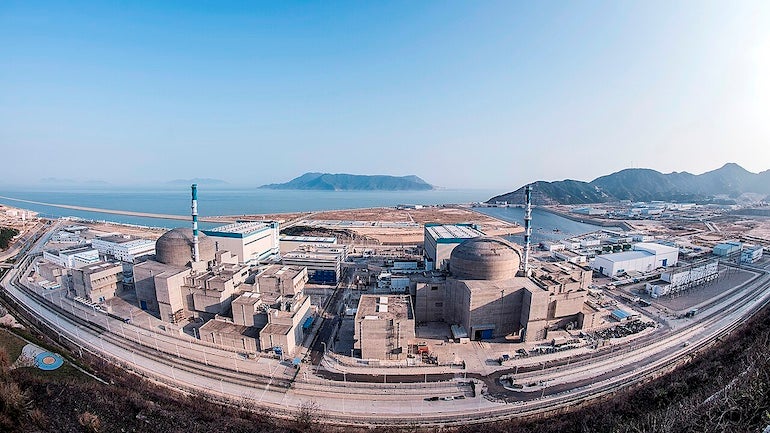
The Nuclear Emergency Committee Office of Guangdong Province notified the Hong Kong Security Bureau of a minor operational event China’s Taishan Nuclear Power Station involving a localised leak. During a routine inspection of unit 2, station staff discovered minor seepage at the boundary door of the transfer pool alongside a small accumulation of water on the adjacent floor. The incident was promptly managed and declared safe.
Maintenance teams quickly repaired the seepage point and cleared the accumulated water, with subsequent testing confirming all parameters returned to normal. Throughout the process, unit 2 remained fully functional and safe. The plant’s three safety barriers remained entirely intact, and zero radioactive substances were released into the environment.
The Hong Kong Security Bureau confirmed that the event posed no risk or impact to the safety of the unit, worker health, the surrounding community, or public safety. In accordance with the International Nuclear & Radiological Event Scale (INES), the event was classified as a Level 0 deviation (an event of no safety significance).
This marks the second minor operational incident reported at the facility in 2026, following an April event where two small, chip-shaped foreign objects were safely removed from a unit 1 steam generator under the same Level 0 classification.
Taishan NPP features two operational French-designed EPR-1750 (European Pressurised Reactor / Evolutionary Power Reactor). Unit 1 construction began in 2009 and unit 2 in 2010. They entered commercial service in 2018 and 2019 – a five-year delay from its original targeted timeline of 2013–2014.
The EPR design was simultaneously being constructed at sister sites in Europe: Olkiluoto 3 (Finland) and Flamanville 3 (France). Both projects suffered multi-year delays over critical safety vulnerabilities, including weaknesses detected in the structural steel of the reactor vessels and non-compliant component welding that required extensive, time-consuming repairs. Whenever a defect was exposed by regulators in Europe, the Chinese National Nuclear Safety Administration (NNSA) halted work at Taishan for test to ensure the same faults were not repeated.
Construction was also disrupted following the 2011 Fukushima disaster in Japan after which China froze all new nuclear approvals and mandated exhaustive safety reviews for plants already under construction. Taishan’s design had to be fundamentally upgraded to include tougher backup power systems, enhanced flood protection, and tighter emergency cooling protocols, adding years to the timeline.
Building Taishan required close integration between the French engineering team at Framatome/EDF and the Chinese workforce from CGN. Industrial reviews highlighted persistent friction and communication bottlenecks between French designers and Chinese construction regulators regarding safety verification protocols, technical compliance thresholds, and contingency measures. Nevertheless, Taishan’s nine-year build time was still considered a success compared with Olkiluoto 3, which took 18 years and Flamanville 3, which took 17 years.
Regulatory approval was given to construct Tiashan units 3 and 4 but with Chinese HPR1000 (Hualong One) reactor technology rather than EPRs
In 2021, a buildup of inert noble gases (xenon/krypton) was detected in the unit 1 cooling system due to a minor structural deterioration on the coating of about five fuel rods. The gas was safely collected, treated, and vented via controlled emissions. The unit was later powered down for fuel replacements. Technical investigations by the International Atomic Energy Agency (IAEA) and the National Nuclear Safety Administration (NNSA) classified the incident as a Level 0 deviation
Out of more than 60,000 fuel rods in the unit 1 reactor core, only about five rods were damaged. The regulatory authority, China’s Ministry of Ecology and Environment (MEE), attributed the degradation to uncontrollable physical factors during fuel manufacturing, transportation, or core loading. Plant designers from EDF Energy verified that the reactor was completely stable, dismissing any concerns of an unmanaged crisis or core meltdown. However, to ensure the long-term structural health of the unit, China General Nuclear (CGN) shut it down for repairs and inspections. It was restarted and resumed power supply after a one-year maintenance outage.
The initial fuel assemblies were designed, manufactured, and supplied by Framatome (formerly part of Areva), a French subsidiary of Électricité de France (EDF). Framatome handled the precision component assembly and final processing of the initial fuel loads. In line with China’s strategy for nuclear technology transfer, fuel supply management is integrated with the plant’s majority owner, CGN, which holds a 51% controlling stake in the operating venture. While Framatome continues to provide direct technical support, engineering, and fuel rod core design services, fuel localisation ensures long-term that domestic Chinese fabrication capabilities now handle core reloads and maintenance cycles.


