
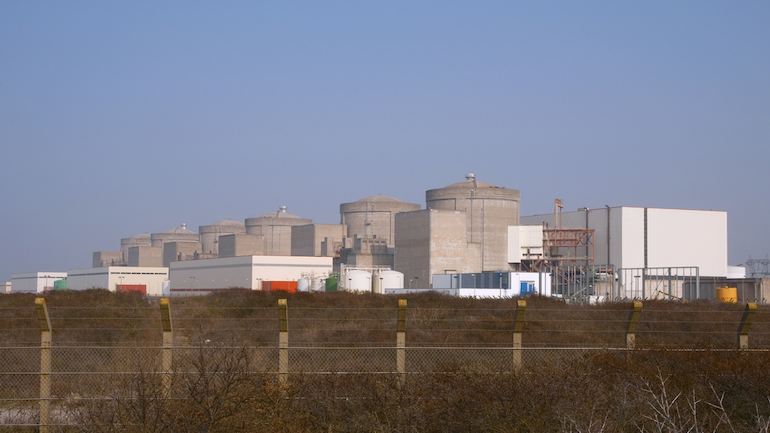
Swarms of jellyfish have severely disrupted power generation at Western Europe’s largest nuclear facility, EDF’s Gravelines NPP in northern France. The plant has been forced to shut down multiple reactors to prevent the jellyfish from completely clogging its seawater cooling systems. The Gravelines comprises six 900 MWe pressurised water reactors (PWRs).
According to grid data and statements from EDF, units 3, 4&6 are entirely shut down. Unit 3 had only just been reconnected on 18 August following an earlier jellyfish wave. Units 1&2 are operating at reduced power as a preventative measure to avoid overwhelming their filter systems. No safety, environmental, or public risks have been reported, as the blockages occur entirely within the non-nuclear water filtration infrastructure.
Coastal nuclear facilities such as Gravelines draw immense amounts of water from the North Sea to cool their reactors. During late summer, hot weather causes massive spikes in plankton levels at the water’s surface, which draws native jellyfish up to feed.
Marine biological data from the North Sea and English Channel identify the primary culprits as a combination of native, blooming species. These include Blue Jellyfish (Cyanea lamarckii), readily identified in aerial and shoreline footage around the Gravelines station by their bright blue and purple coloration; and Moon Jellyfish (Aurelia aurita) – translucent, saucer-shaped native jellyfish that frequently form massive “smacks” in shallow coastal waters during the late summer. These particular species are weak swimmers that drift passively with marine currents. When hot weather spikes plankton levels near the surface, they gather in the thousands to feed, directly aligning them with the intense suction fields generated by the nuclear facility’s water intake channels.
To combat this recurring issue, which also forced partial shutdowns at Gravelines in August 2025, EDF has implemented several mitigation strategies. Working with organisations such as France Pêche Durable, EDF has deployed seven boats working round-the-clock to scoop up jellyfish swarms and release them further offshore. Early-stage monitoring and tracking systems have been integrated to flag massive marine gatherings before they reach the plant. Vacuum trucks and specialised mechanical cleaning crews are being used to clear the filters that have already been compromised.
This comes at a time when the French government has authorised EDF to begin preparatory work for the construction of two new EPR2 reactors at Gravelines. More than four years ago, President Emmanuel Macron announced plans to build six new-generation pressurised water nuclear reactors, with an option for eight more. The final investment decision on the construction of these new EPR2 reactors is expected by the end of 2026. The sites chosen for the first three pairs are Penly (Seine-Maritime), Gravelines (Hauts-de-France) and Bugey (Ain). The first pair of reactors (in Normandy) is due to come on stream around 2038.
Two 1,600 MWe EPR2 (Evolutionary Power Reactor 2) reactors are planned at the Gravelines site, which will be added to the six units already in operation. Under Decree No 2026-807 published in the Journal Officiel on 22 August, EDF is granted “environmental authorisation” to start site preparation work for the new reactors.
The authorised scope includes ecological relocation measures, servicing of construction platforms, temporary site installations, relocation of the existing rail terminal serving the nuclear site, new construction access, parking, earthworks, ground reinforcement, initial civil engineering, and creation of the future cooling-water intake channel. However, it is not an authorisation to construct or operate the reactors. Further regulatory decisions will be required before the EPR2 units can progress through full construction and commissioning.
The recurring jellyfish influxes highlight a significant engineering hurdle for the new expansion. Because the EPR2 reactors will require massive, continuous volumes of cooling water like their predecessors, EDF’s preparatory work must account for changing marine conditions. Designers are tasked with building upgraded, more resilient filtration infrastructure for the new units to ensure that future power generation is better protected against climate-driven marine life blooms.
The technological evolution from the older 900 MWe reactors to the new EPR2 design focuses heavily on lessons learned from seasonal environmental disruptions. While a reactor’s core thermodynamics remain similar, the cooling water intake infrastructure and filtration architecture for the EPR2 are designed with far more robust defensive redundancies to prevent marine life from causing full operational shutdowns.
As authorised in the August preparatory works decree, the EPR2 units will feature a brand-new, dedicated cooling-water intake channel. This hydraulically separates the new units from the existing basin, preventing a single concentrated swarm from choking the entire eight-unit complex simultaneously. The intake structures are being geometrically optimised to reduce water suction velocity at the entry mouth. Slower intake speeds allow weaker swimmers, such as moon jellyfish, to drift past the channels rather than being forcefully sucked into the plant.
The initial physical barriers are upgraded with robust, automated raking systems designed to pull heavy organic masses out of the water before they hit the internal finer filters. Older units rely on single-entry filtration drums that clog and seize under extreme pressure. The EPR2 design incorporates high-capacity, dual-flow traveling water screens. If one side experiences a sudden pressure differential from a jellyfish mass, emergency bypass pathways allow the plant to maintain safe cooling volume while backwashing the clogged screens.
Unlike the reactive systems of the past, EDF is standardising digital surveillance inside the intake canals. Fixed, automated optical cameras use algorithms to monitor water turbidity and immediately flag early-stage buildup on the drum filters. The EPR2 is the first fleet designed entirely via digital simulation. Engineers use multi-phase fluid dynamics to model how massive jellyfish swarms move through the intake channels. This allows the plant’s control software to predict a clog before it physically manifests, giving operators time to adjust pump speeds safely.


