
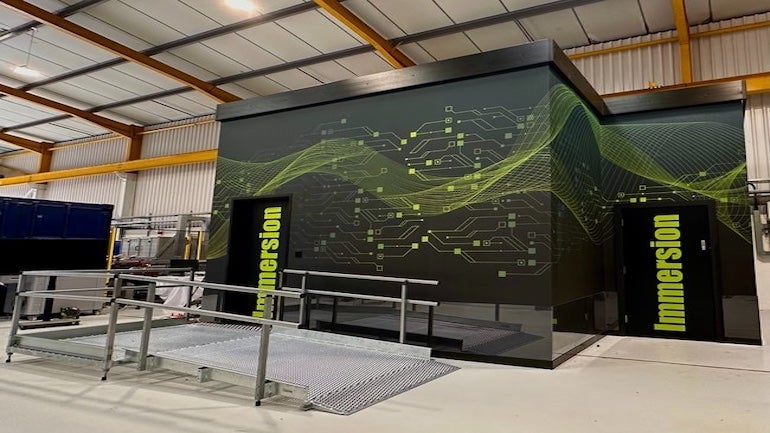
Canada-based engineering services and nuclear company AtkinsRéalis has helped to deliver a new immersive environment at the Robotics & Artificial Intelligence Collaboration (RAICo1) facility in West Cumbria in partnership with Sellafield Ltd and UK-based immersive technology specialist Igloo Vision with offices and demonstration centres across five countries.
The facility gives nuclear specialists a powerful way to plan and deliver decommissioning work more safely. It brings together remotely operated robotics systems and data visualisation in a single interactive space. It is expected to reduce time spent in hazardous environments by up to 40%, using robotics and live data streaming to enable remote operations and monitoring.
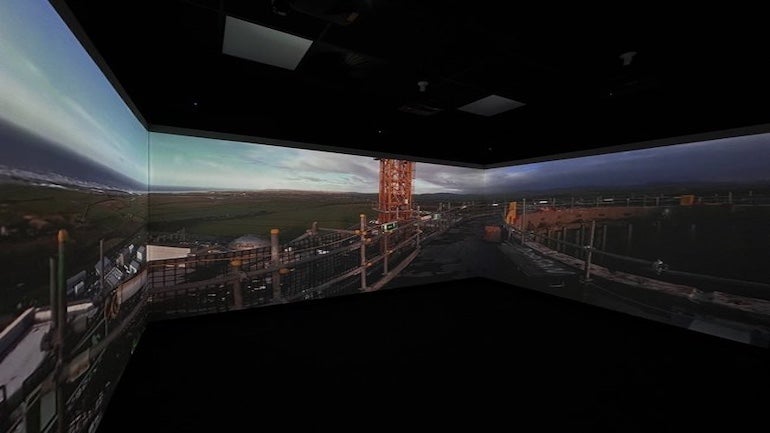
The 360-degree visual environment is designed to accommodate up to 10 users, allowing engineers, operators and project teams to step inside digital versions of facilities and operational scenarios before work begins on site. Those planning work in a restricted area can walk the route virtually, with live imagery from robotic platforms on site displayed as conditions change. The facility also provides a dedicated space for collaborative operations planning, enabling multidisciplinary teams to test approaches and respond quickly to emerging issues.
This immersive environment forms part of Sellafield Ltd’s wider strategy to combine robotics, artificial intelligence, modelling capabilities and advanced visualisation technologies to transform how nuclear decommissioning is planned, rehearsed and delivered. The project builds on expertise gained through AtkinsRéalis’s Lava Lab network and the delivery of Sellafield Ltd’s immersive facility at Hinton House in Risley, Cheshire.
AtkinsRéalis used its global network of Lava Labs to perfect the core virtual reality (VR), augmented reality (AR), and digital twin frameworks. AtkinsRéalis’s parent organisation (formerly SNC-Lavalin) first launched its global Lava Labs technology hubs in Autumn 2021 across London, Montreal, and Bangalore to develop advanced virtual and digital twin frameworks.
The initial immersive facility at Sellafield Ltd’s Risley office proved that 360-degree virtual spaces drastically improve team collaboration during early-stage planning. While the Hinton House office building in Risley has been a nuclear engineering hub since 1984, Sellafield built up its specific immersive VR and robotics capabilities there over the last few years leading up to the August 2026 launch of the new integrated RAICo1 facility. This takes the Hinton House concept further by connecting the virtual environment directly to live, remote-controlled robotics on a licensed nuclear site.
AtkinsRéalis played a key role in integrating Igloo Vision’s immersive platform with Sellafield Ltd’s digital information and operational requirements, creating a practical tool for planning, training and decision-making. Early engagement between the project partners ensured the design met operational needs while allowing flexibility for future expansion and innovation.
As Sellafield Ltd continues to explore and deploy advanced technologies, the immersive environment will also act as a hub for industry, academia and supply-chain partners, supporting the development, testing and demonstration of innovative solutions for nuclear decommissioning and other high-hazard environments.
“Decommissioning some of the UK’s most complex nuclear facilities requires teams to make critical decisions efficiently and safely,” said Richard Brook, Digital Solutions Lead for Nuclear at AtkinsRéalis. “This new capability gives nuclear and engineering experts a completely different way to engage with information. Teams can better visualise challenges and work through solutions together before activities begin on site. What’s particularly innovative is the way we’re bringing immersive technology and robotics together in one place. That’s creating new opportunities to reduce risk, improve efficiency and help accelerate the delivery of decommissioning programmes.”
Rav Chunilal, Head of Robotics and Artificial Intelligence at Sellafield Ltd, said the most exciting aspect is not the technology itself, but the opportunity to fundamentally change how to tackle some of the most complex challenges in nuclear decommissioning. “We’ve spent the last few years building capability across robotics, AI, digital twins and remote operations, and this is another important step on that journey. By allowing our people to explore, test and understand complex environments before work begins, we’re creating a safer, smarter and more connected way of working.”
He added that the Immersion Room at Hinton House in Cheshire is already demonstrating the value of immersive environments, bringing together and enabling teams to collaborate on simulation models of our nuclear facilities. “With RAICo1 now providing a dedicated environment for innovation, development and demonstration, and a further immersive capability being developed on the Sellafield site itself, we’re creating a connected ecosystem that links innovation and operational planning to frontline delivery.”
He explained that this reflects a broader shift in how high-hazard industries can operate in the future from bringing together immersive environments, live operational data, robotics and intelligent systems to create a richer understanding of complex challenges. “As these technologies converge, we move away from reacting to problems in the field to anticipating and rehearsing how to solve them virtually before work begins. That means less time spent in hazardous areas, greater collaboration between our experts regardless of location, and faster, more informed decision-making.”
Kerry Head, CEO at Igloo Vision, said: “The RAICo1 facility demonstrates the real-world value of immersive technology in some of the most complex and safety-critical environments. By bringing data, robotics and 360-degree visualisation together in one shared space, teams can explore operational scenarios, understand challenges more clearly and make better-informed decisions before work begins on site. For Igloo Vision, this is exactly where immersive environments can make a meaningful difference, helping expert teams collaborate more effectively, reduce time spent in hazardous settings and support safer, more efficient delivery across nuclear decommissioning programmes.”


