
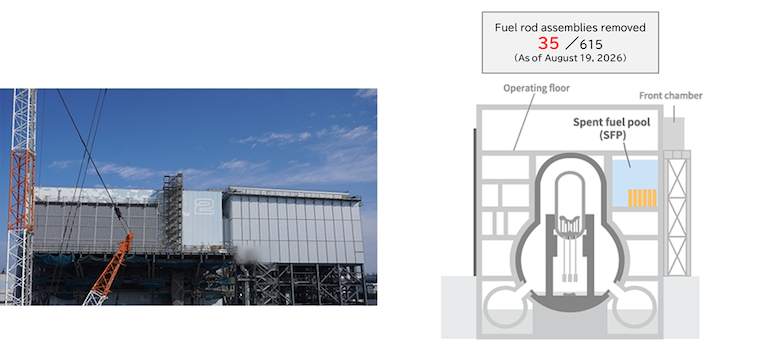
Tokyo Electric Power Company Holdings (Tepco) has begun the highly challenging phase of extracting used nuclear fuel emitting high-level radiation from the storage pool of the unit 2 reactor at the Fukushima Daiichi NPP. Tepco has already removed seven of the 587 used fuel assemblies stored in the reactor pool. In July, workers completed removal of all 28 unused fuel assemblies, which have a comparatively lower radiation risk.
The company aims to safely finish transferring all remaining assemblies by the end of fiscal year 2028. Because radiation levels inside the unit 2 reactor building remain dangerously high, human access is impossible. Tepco uses a specialised engineering approach to complete the transfer. Operators control a submerged, remotely operated crane from a completely separate, distant building on the plant grounds. The crane lifts the highly radioactive, four-metre-long assemblies one by one and places them into a heavy metal protective container (cask) inside the pool.
Once filled, the cask is hoisted out, lowered onto a trailer, and driven to a much safer, shared common storage pool on the plant’s premises for long-term cooling. The extraction process will be temporarily suspended in October. This scheduled break is required to perform facility equipment check-ups and to clear out adequate space within the shared common pool. Tepco has already completely cleared the storage pools of units 3&4. Meanwhile, debris clearing is ongoing at reactor No. 1, with fuel removal scheduled to begin in fiscal 2027 or 2028
At unit 2, the used fuel pool in the upper part of the reactor building stores fuel rod assemblies that were used to generate power before the accident cause by the 2011 earthquake and tsunami which resulted in core meltdowns at units 1-3 (units 4-6 were offline at the time, although unit 4 suffered some damage). Hydrogen explosions occurred in units 1,3&4, whereas unit 2 avoided an explosion because hydrogen escaped through the partially collapsed walls of the reactor building. Tepco said it is “moving forward steadily and safely with fuel removal”.
In preparation for removal of fuel from the unit 2 fuel pool, a room – front chamber – was built on the west side of the reactor building and in June 2018, an outer wall opening was completed on the west side of the building. Survey work inside the operating floor was conducted in advance of studies on measure to suppress scattering of radioactive materials when the upper part of the reactor building is dismantled.
After studies were conducted based on various risk scenarios, it was decided to revise plans to dismantle the upper part of the reactor building, given the downward trend in air dose rates on the operating floor. Following the revision, a fuel handling facility (access gantry+front chamber) was constructed for transporting fuel rod assemblies out of the building on the south side.
After connecting the front chamber and the building, fuel handling equipment was lifted onto the fuel removal work platform by cranes in May 2025 and affixed to previously installed runway girder rails. Test operation of the fuel handling equipment, which began in December 2025, was completed in March before removal of the unused fuel began in June. Since this method does not involve dismantling the upper part of the building, work can be performed while dust, including radioactive materials, is controlled.
At unit 1, which suffered a hydrogen explosion, installation of the large cover for the purpose of suppressing dust dispersion and developing a work environment when removing rubble, and suppressing rainwater inflow was completed in January 2026, and full-scale rubble removal began in June after installing an overhead crane, related equipment including dust monitor and air conditioning system. Full-scale rubble removal began in June.


