
The growth of nuclear energy has not been smooth or uniform the world over. Rather, there have been successive waves of development triggered by major energy crises and policy initiatives such as Atoms For Peace. On the other hand, there have also been events, principally nuclear accidents, that put a handbrake on this development.
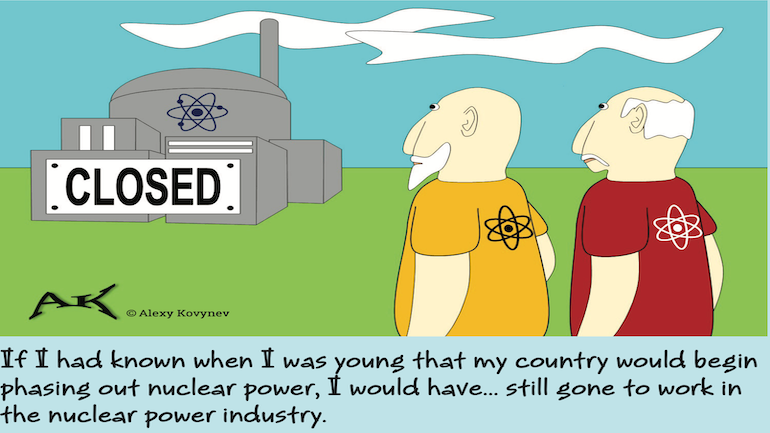
In other words, the nuclear industry has historically grown in fits and starts – and sometimes those starts have turned out to be false ones. The history of nuclear energy is speckled by countries that initiated their nuclear development journey and reached various milestones, only to turn around and give up. Most notorious amongst these, of course, are the phase out countries. Those nations that went through the difficult steps of building and operating nuclear plants but then arbitrarily decided to close them all down and institute a policy block on new-builds. Thankfully this is a short list, one that includes Italy, Germany and Taiwan.
Italy once had as many as four nuclear power reactors operating, but the Chornobyl accident in 1986 prompted a government-mandated phase-out that was fully enacted by 1990. This was a brutally short time frame that left little room for mind-changing. Germany and Taiwan are both within recent memory, alas, and were decisions triggered by the accident at Fukushima Daiichi in 2011. The German phase-out, completed in 2023, remains a devastating loss to the nuclear industry at large. Especially in the end phases, the country was left with large, high-performing plants that closed far in advance of when they should have. Taiwan probably takes the prize for the most self-harming nuclear phase-out of all time, given the regular grid and supply challenges it now faces, and which were always pretty obvious, even to outsiders.
On an adjacent list to the phase-out countries are those that had nuclear energy but then lost it for some reason, although with no apparent ill will from government. The shutdown of nuclear power here was coincidental rather than desired or planned.
Lithuania heads this list. The country was home to the Ignalina nuclear power plant but was essentially forced to close this facility – an RBMK – as a condition of joining the EU. Kazakhstan belongs here as well. With a story that would depress many a fan of advanced nuclear technology today, this country was once home to a small sodium-cooled fast reactor that provided desalination in addition to electricity. It was decommissioned for economic reasons when it reached the end of its originally planned life and no replacement has been constructed so far.
On yet another list are the countries that got as far as beginning to construct nuclear power plants but never achieved first criticality. Counted here are Austria, the Philippines, Poland and Cuba. In two notable cases, these plants (Bataan and Zwentendorf) were basically complete and ended up serving as destinations for technical tours – allowing visitors a rare glimpse of the inner sanctum. While they were never the powerhouses they were supposed to be, they still managed to provide some benefit to nearby communities and the nuclear sector globally.
The story behind each of these nuclear false starts or premature ends is unique and probably deserves its own book to explain the various factors that contributed. There are some common elements, however. In many if not all cases a surge in radiophobia played its part in eroding public and political acceptance – heightened by a nuclear accident.
Another recurring theme is a loss of trust either in government, industry or both. In fact, it is the government that often becomes the primary focus of public ire – but if the nuclear sector is too closely associated with a given leader, political party or perhaps foreign hegemon, it can find itself the victim when regime change finally takes place.
There is a certain irony to the fact that none of the countries that have directly experienced a major nuclear accident are among the false start countries. Indeed, these countries are now some of the most pro-nuclear of all. The recent news that Japan has proposed replacing up to 14 nuclear reactors by 2040 is music to the ears, and a clear sign that the Japanese sector is on the path to recovery.
If there is a lesson to be found in the above, it is that there is no single global narrative defining nuclear energy development. The opportunities and challenges confronting the industry vary country by country, and are all tied to larger socio-economic, political and even cultural movements. Certainly, nuclear accidents play a role, but this role is surprisingly complex, and accidents may also serve as teaching moments. To be an effective advocate for the technology requires awareness of all this.
It is easy to forget that the global nuclear industry spent the better part of the last decade in the doldrums. The discovery of hydraulic fracturing and the emergence of a super-cheap fracked natural gas resource pressured otherwise perfectly fine US nuclear plants to retire early, while the accident at Fukushima Daiichi cratered the Japanese nuclear sector and led to government-mandated phase-out policies in certain European countries and Taiwan.
Today, halfway through 2026 – and riding high on the back of surging AI-driven energy demand, and in the context of an apparently never-ending series of energy crises disrupting fossil fuel supply – the prospects for nuclear energy are perhaps better than they have ever been. Announcements of countries or companies moving ahead with new-build programmes seem to come almost weekly. We appear to have entered a golden age of nuclear acceptance.
Indeed, many of the false start countries are now back on the path of nuclear development, Italy, Kazakhstan, the Philippines and Poland among them. There are even whispers floating around that Germany and Taiwan might join them. It is as if the final act of closing that last nuclear plant is not so final after all.
Put simply, the nuclear phase-out is itself on the brink of becoming a relic of the past. South Korea, Sweden and Belgium have changed course. Switzerland was never really in this club, but even there the block on new-builds looks like it will soon be lifted. The number of countries that are actively maintaining this policy have been whittled down to arguably just one. The last nuclear phase-out remains steadfastly under way in Spain.
There are seven operating nuclear power reactors in Spain, which generate roughly 20% of national electricity. The country’s phase-out plans would see four reactors close by the end of 2030, while the remaining three reactors are due to shut by 2035.
Spanish energy policy continues to sing from the renewables hymn sheet, aiming for 100% renewable electricity generation by the year 2050. This is a target it seems inclined to meet sooner rather than later, with the 2030 target having been increased from 74% to 81%.
Certainly, the country is amply blessed with renewable resources, and the current mix consists of around 22% wind, 19% solar photovoltaic and 12% hydropower. Combined cycle gas plants make up 14% and other renewables account for roughly 4%. With the addition of nuclear this mix is already mostly decarbonised, balanced between energy sources and quite enviable.
It is not too late for Spain to see the light, and with national elections next year it seems there is everything to fight for. The global nuclear industry should be ready to chip in here and assist local advocates in any way it can. While from a big picture perspective perhaps it doesn’t matter if the Spanish phase-out goes through on a more intimate level, yes it counts. We should not allow Spain to repeat Germany’s mistake without trying our level-headed best to change that outcome.
One of the symbolic moments of victory for the anti-nuclear activist is when cooling towers are demolished in a spectacular detonation. If/when the Spanish phase-out is defeated, perhaps the towers at Asco or Cofrentes could be repainted with the addition of an epitaph: ‘Here lies the last nuclear phase-out, defeated by common sense and a global cultural movement that finally appreciates the value of nuclear energy’. A fitting epitaph fit for the future of energy.


