
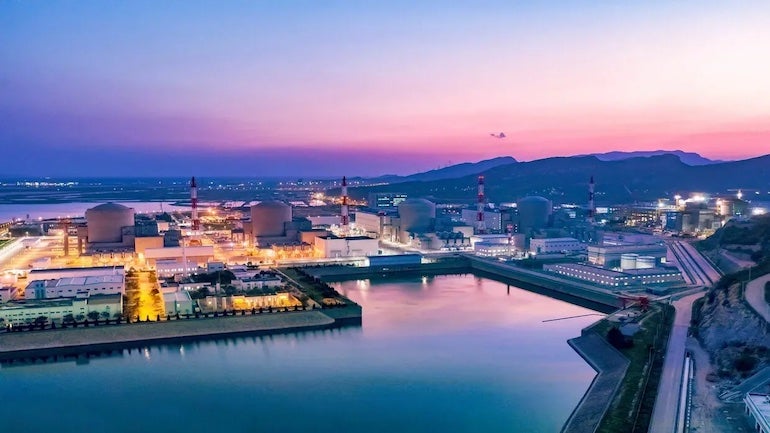
The loading of 163 nuclear fuel assemblies is underway at unit 7 of China’s Tianwan NPP, paving the way for initial criticality, grid connection, and full commercial operations planned for later this year, China National Nuclear Corporation (CNNC) reported.
In 2018, Russia and China signed four agreements, including for the construction of two VVER-1200 reactors for Tianwan units 7&8. Construction of unit 7 began in May 2021, and unit 8 in February 2022. Tianwan 7 is scheduled to be commissioned in 2026 and Tianwan 8 in 2027. Tianwan 1-4, with VVER-1000 reactors, commissioned between 2007 and 2018, are already in operation. Units 5&6 with Chinese ACPR-1000s were commissioned in 2020 and 2021.
Tianwan NPP is owned and operated by the Jiangsu Nuclear Power Corporation, whose shareholders are CNNC (50%), China Power Investment Corporation (30%) and Jiangsu Guoxin Group (20%).
Tianwan 7 will be the first Generation III+ VVER-1200 to begin operation in China. It represents an evolutionary step up from the older VVER-1000 models used in units 1–4. The VVER-1200 features double the expected operational lifespan (60 years). It also includes a two-thirds slower refuelling cadence and advanced passive safety systems.
The fuel assemblies or Tianwan 7 were manufactured in Russia by Rosatom’s Fuel Division (TVEL) at the Novosibirsk Chemical Concentrates Plant. Future fuel manufacturing for the VVER-1200 units is planned to be localised at the Yibin fuel plant in Sichuan Province.
Tianwan is on track to become the largest single nuclear power plant in the world by capacity. Once units 7&8 reach full capacity, they will collectively generate 18.8 TWh of electricity annually. This will bring the total output of the entire eight-unit station to roughly 70 TWh a year, providing clean energy for about 15m households and reducing carbon dioxide emissions by 57.4m tonnes annually.


