
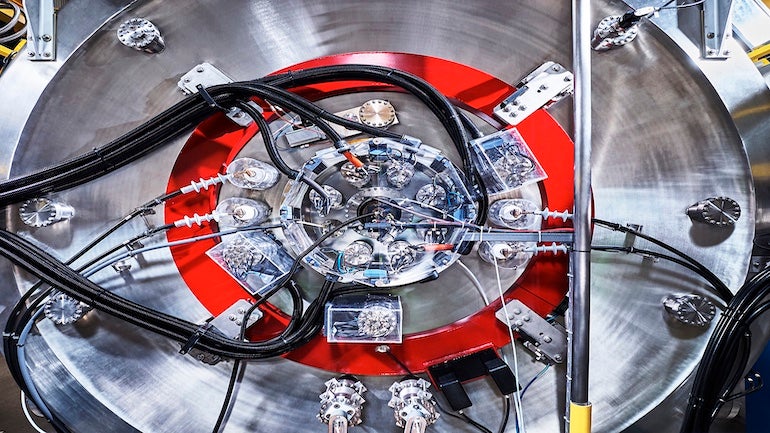
US private fusion firm TAE Technologies has signed an agreement with US start-up Black Moon Energy Corporation (BMEC) to support the future commercialisation of fusion power through a prospective helium-3 (He-3) fuel supply option and commercial development collaboration. Under the agreement, BMEC will supply helium-3 fuel to TAE.
TAE Technologies is one of the world’s oldest, largest, and highest-funded private fusion energy companies. The company, founded in 1998 and headquartered in Foothill Ranch, California, spent its first decade operating in near-total stealth. Instead of traditional magnetic confinement such as tokamaks, TAE developed a non-traditional, ultra-clean fuel cycle using a unique linear reactor design.
The firm initially incorporated as Colliding Beam Fusion Reactor, before changing its name to Tri Alpha Energy. The name refers to the three alpha particles (helium nuclei) generated during a hydrogen-boron fusion reaction. It rebranded to TAE Technologies in 2017.
Most fusion companies use deuterium-tritium (D-T) fuel, which releases high-energy neutrons that degrade reactor walls and create radioactive waste. TAE instead uses proton-boron, which is non-radioactive, safe, and abundant, but requires much higher core temperatures of around 3bn degrees Celsius.
To hold this superheated plasma, TAE uses Field-Reversed Configuration (FRC) – a linear, cylinder-shaped accelerator rather than a donut-shaped tokamak. Two spinning smoke-ring-like structures of plasma are shot from opposite ends into a central chamber at supersonic speeds, fusing into a hollow, high-stability “football” shape held together by its own magnetic fields. TAE uses massive high-energy particle accelerators (atom guns) along the reactor walls to continuously inject neutral atoms, heating and stabilising the plasma matrix.
TAE validates its physics through sequentially larger, more powerful machines. In 2015, their C-2U machine proved that sustaining FRC plasma via neutral beams was possible. In 2017, they turned on C-2W (nicknamed Norman after their late founder). Norman repeatedly broke company records, keeping plasma stable at up to 75m degrees Celsius.
In 2025, TAE proved they could form, heat, and sustain FRC plasma directly and solely using neutral beam injection, completely removing massive, expensive “formation sections” from the reactor body. This design iteration (demonstrated in the newest operational platform, Norm) dramatically slashes capital costs and hardware complexity. TAE is currently advancing towards Copernicus, a machine designed to demonstrate net energy capability using conventional fuels. This clears the runway for Da Vinci, their planned first commercial utility-scale reactor.
While proton-boron remains TAE Technologies’ preferred, ultimate pathway due to its abundance and zero-neutron output, the company operates with a highly flexible, multi-fuel design. TAE is exploring deuterium-helium-3 or helium-3-helium-3 via its agreement with BMEC for several strategic, physics-based reasons.
While proton-boron requires an unprecedented core temperature of 3bn degrees Celsius, deuterium-helium-3 fusion reactions occur at a significantly lower threshold of 500-600m degrees Celsius. This lower thermal demand allows TAE to commercialise their upcoming Da Vinci reactor much sooner. It serves as a commercial proof-of-concept while they spend more decades perfecting the physics required for 3bn -degree proton-boron containment.
The biggest obstacle to proton-boron net-energy gain is “braking radiation” (Bremsstrahlung). Boron has five protons and five electrons. A high concentration of electrons in a superheated plasma bleeds away energy as intense x-rays before fusion can occur. Helium has only two electrons. This dramatically reduces x-ray radiation energy losses, making it far easier to achieve a net-positive energy output at earlier stages of machine development.
The primary reason TAE avoids traditional D-T fuel is that D-T releases 80% of its energy as destructive neutrons. These neutrons require heavy shielding and inefficient steam turbines to capture heat. Proton-boron and helium-3 fusion are aneutronic or near-aneutronic. They release energy in the form of positively charged ions (protons and alpha particles). TAE’s FRC reactor can capture these moving charges directly using electromagnetic coils, turning fusion energy straight into electricity with up to 90% efficiency.
The TAE-BMEC partnership directly addresses one of the most critical logistical hurdles in advanced nuclear fusion – securing a reliable, long-term fuel supply for non-traditional fusion reactors. TAE focuses on advanced aneutronic fusion, which produces fewer or no neutrons compared with traditional D-T methods. Low neutron emission significantly reduces structural radioactive waste, making the reactor safer and longer-lasting. Aneutronic reactions allow the direct conversion of energy into electricity, bypassing the need for inefficient steam turbines.
However, helium-3 is exceptionally rare on Earth, requiring alternative sourcing strategies or future extraterrestrial mining concepts. The strategic goals of the TAE-BMEC collaboration include:
- Supply chain security – establishing an early pipeline for critical fuels before commercial-scale reactors go online.
- Market readiness – aligning technological milestones with commercial fuel availability to accelerate time-to-market.
- Regulatory pathways – jointly exploring safety standards and commercial development frameworks for advanced fuel handling.
“This agreement can facilitate our path to power by providing an alternative fuel supply option,” said TAE CEO Michl Binderbauer. “TAE has a high degree of flexibility to select from the most cost-competitive fuel cycle, whereas many other fusion machines are able to operate only on the deuterium-tritium cycle; this provides TAE’s technology with future flexibility, depending on how fuel markets change over the long-run.”
BMEC CEO David Warden noted: “Developing a future supply chain for fusion fuels is a critical component of bringing fusion power to market. By working with TAE, we are helping establish the commercial framework needed to support next-generation energy systems.”
BMEC aims to pioneer helium-3-fueled fusion to address global energy demand and climate concerns, while simultaneously supplying existing high-value industries like quantum computing and medical diagnostics. The company plans to de-risk this long-term commercial strategy by launching a robotic lunar mission within five years to map resources, test extraction technology, and secure supply chains. Learn more about BMEC’s initiatives at the Black Moon Energy Corporation website. Binderbauer said the agreement with TAE provides the company with “future flexibility, depending on how fuel markets change over the long-run”. If aerospace companies like Black Moon successfully establish lunar mining in the 2030s, helium-3 might become economically competitive before terrestrial proton-boron systems are fully mature.


