
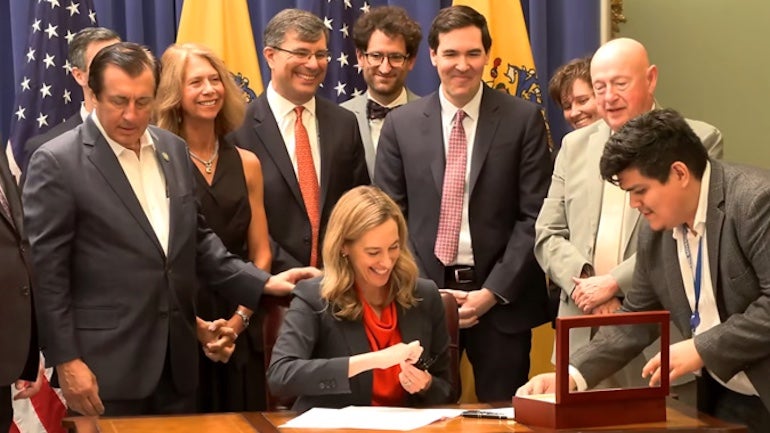
New Jersey Governor Mikie Sherrill has signed the Power NJ Act into law, establishing a landmark competitive framework to procure at least 1,100 MWe of new nuclear energy. The unanimous, bipartisan legislation (Assembly Bill 4881/Senate Bill 4296) aims to expand the state’s clean energy grid and secure long-term utility affordability while protecting consumers from financial risk.
The state aims to procure a minimum of 1,100 MW. The project will be managed jointly by the New Jersey Board of Public Utilities (NJBPU) and the New Jersey Economic Development Authority (NJEDA). This follows the administration’s April 2026 removal of a 50-year-old regulatory moratorium on new nuclear facilities. Potential development is targeted near the Salem and Hope Creek NPPs.
Land adjacent to New Jersey’s Salem Nuclear Power Plant and Hope Creek Nuclear Generating Station in Lower Alloways Creek has long been designated by the Nuclear Regulatory Commission (NRC) as a potential location for an additional reactor. Estimates are that it would take at least 10 years and about $24bn to build a large convention nuclear power reactor in New Jersey. Federal financing programmes may guarantee or finance up to 80% of a project’s cost.
The Power Act specified that ratepayers will not pay any costs while projects are under construction. Project developers will bear 100% of non-performance or construction budget overruns. Developers must secure federal financing to completely insulate local consumers from baseline capital risks. Once an advanced reactor becomes fully operational, electricity suppliers will purchase energy via a Reliable Capacity Credit (RCC) programme at fixed, negotiated rates rather than relying on volatile wholesale markets.
The state must review independent impact assessments from the New Jersey Division of Rate Counsel. The law requires a minimum of two public comment windows and an active public hearing in any proposed host municipality. The statutory schedule sets a transparent path through final project approval over the next two years
By 9 January 2027, NJBPU must open the official request. Developers get a 60-day window to submit detailed regulatory, environmental, and financial plans. By 9 April, NJBPU must complete a review to determine which developer proposals are qualified to advance or face rejection.
By 9 April, regulators must directly negotiate exact commercial definitions, including power pricing structures and target grid operation timelines. Before 8 July 2028 NJBPU may issue final approvals, provided a project satisfies all net-benefit, federal funding, and cost-cap parameters. energy that will help New Jersey meet its growing energy needs. The bill will establish a transparent,
“The decisions we make today will determine the future we leave our kids, so we are putting New Jersey on a path to an affordable and secure energy future,” said Governor Sherrill. “I am excited to launch our state’s process to procure new, advanced nuclear power that will provide clean, reliable energy at scale for generations to come and meet our growing energy demands – from powering our small businesses, schools, and hospitals, to strengthening grid capacity and reliability for extreme weather that is becoming unfortunately all too frequent.”
She added: “This is how we don’t kick the can down the road, and we make sure in 10 years we’re not still facing a power generation problem or affordability crisis…. This bill creates a competitive process to build new nuclear projects that can power hundreds of thousands of homes. To be clear, this isn’t a subsidy. We’re setting up a program to purchase nuclear energy at a fair price, and we’re making sure we do it right by our ratepayers every step of the way.”
The two-unit Salem and the single-unit Hope Creek, both owned by PSEG – currently provide more than 40% of New Jersey’s electricity and represent more than 80% of the state’s clean energy supply. In April 2024, PSEG announced its intention to seek subsequent licence renewal for the Salem and Hope Creek plants. It informed NRC that it expects to submit the application in the second quarter of 2027. If approved, the licences for Salem 1&2 would be extended from 2036 and 2040 to 2056 and 2060, respectively. The Hope Creek’s licence would be extended from 2046 to 2066.


