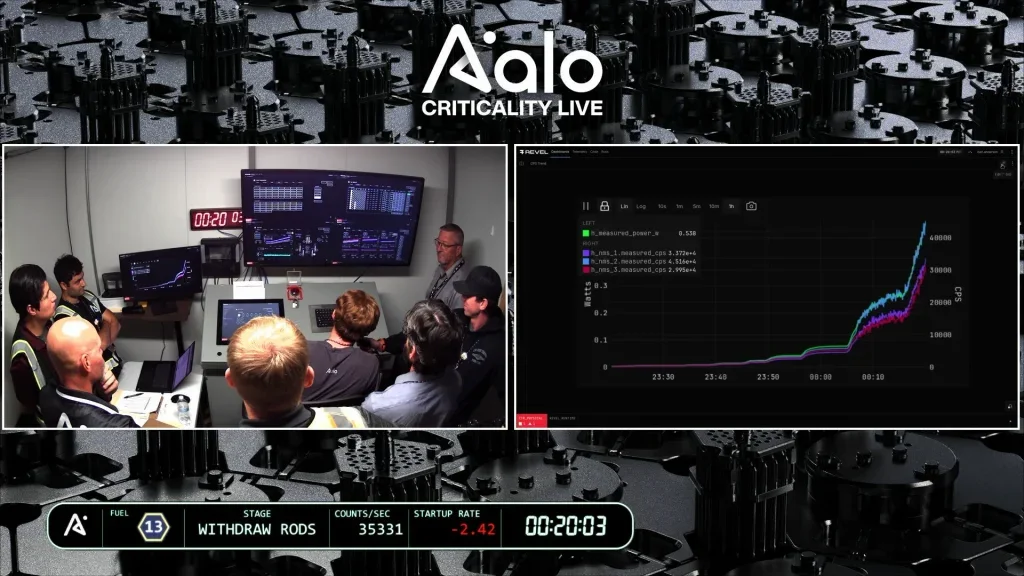
Aalo Atomics’ critical test reactor (CTR), Aalo-X, completed a zero-power fuelled criticality demonstration at Idaho National Laboratory (INL) on 4 July to become the fourth DOE-authorised advanced reactor to meet the deadline outlined in President Trump’s May 2025 Executive Order (EO) 14301, Reforming Nuclear Reactor Testing at the Department of Energy.
Aalo-X is a graphite moderated, liquid sodium cooled reactor that uses uranium dioxide fuel. The integration of the graphite moderator and liquid sodium coolant is handled through a unique “stack” architecture that balances thermal efficiency with structural simplicity. The core is composed of high-purity nuclear-grade graphite blocks precisely machined with vertical channels. Within these graphite blocks, Aalo places stainless steel cladding tubes inside which the uranium dioxide fuel pellets are sealed. The liquid sodium flows in the narrow “annulus” (gap) between the fuel pins and the graphite walls. The core can be factory-fabricated in sections and shipped to the site for final assembly.
In June, Antares Nuclear’s Mark-0, Valar Atomics’ Ward 250 and Deployable Energy’s Unity Nuclear Battery (UNB) reactors also achieved criticality. Mark-0 is a high-temperature sodium heat-pipe reactor, utilising entirely passive, redundant liquid metal heat pipes instead of high-pressure liquid pumps. The core uses graphite and boron carbide control drums turned by independent actuator motors. Ward 250 is a 100 kWt high temperature gas-cooled reactor (HTGR) design that uses TRISO fuel, helium coolant and graphite moderators. UNB is a 1 MWe gas‑cooled microreactor that uses an actively cooled helium primary loop and standard low-enriched uranium dioxide fuel.
The development of Aalo Atomics stands as one of the fastest ever “founding-to-fission” timelines, taking less than three years to build an operational nuclear reactor. Aalo was founded in 2023 by serial entrepreneur Matt Loszak and nuclear architect Yasir Arafat (former lead of the INL’s MARVEL reactor project). It secured $6m in seed funding to begin conceptual designs for a mass-manufacturable nuclear plant drawing technical inspiration from the MARVEL test reactor
In 2024, Aalo raised a $30m Series A funding round to scale up corporate operations and began construction on a 40,000-square-foot pilot manufacturing plant located in Austin, Texas. This facility was designed to shift reactor construction toward assembly-line manufacturing. In 2025 a Series B round raised $100m and a full-scale non-nuclear prototype began high-temperature sodium loop testing. Aalo commissioned GE Vernova’s Global Nuclear Fuel to begin fabricating the fuel rods for the Aalo-X test reactor.
Aalo broke ground on the CTR site at INL in January. Using a controlled vertical-drilling technique, excavation was fast-tracked by 50%. The reactor building structure was erected in 36 days and the reactor hardware, which was trucked across standard highways from the Austin factory, in just 40 days.
Following the test’s success, Aalo announced plans to expand into a 1m-square-foot factory to begin the assembly-line mass production of commercial Aalo Pods – five individual 10 MWe reactors bundled together to form a 50 MWe power plant tailored for AI data centres. According to Aalo’s Roadmap, the company’s next immediate objective for 2027 is to construct a full-scale Aalo-X power plant and officially use it to power a co-located, operational data centre.
Aalo rapid development was made possible by heavy, multi-layered regulatory and infrastructural support from the Department of Energy (DOE) and INL. Rather than standard financial grants, the DOE provided Aalo with real estate, streamlined safety approvals, and laboratory technical infrastructure. DOE in August 2025 selected Aalo as one of 11 advanced reactor projects for inclusion in the Reactor Pilot Program (RPP).
Because the reactor was built as a non-commercial test bed on a federal site, Aalo operated under DOE’s internal regulatory authority rather than the Nuclear Regulatory Commission (NRC) licensing process. This cut years off the permitting timeline. In May 2026, the DOE-Idaho Operations Office formally reviewed and approved Aalo’s Documented Safety Analysis, clearing the path for immediate assembly.
DOE Idaho Operations Office granted Aalo formal land-use authorisation to deploy and construct the CTR directly on INL’s dedicated testing grounds. The experiment could not proceed until it passed a strict federal Readiness Assessment. Secretary of Energy Chris Wright signed the final execution order on 25 June allowing Aalo to legally load fuel.
DOE also supported Aalo through its Gateway for Accelerated Innovation in Nuclear (GAIN) program. Through GAIN vouchers, the DOE funded INL experts to work directly with Aalo. They adapted the lab’s proprietary EMRALD software to run economic risk-analysis and generational safety modelling for the Aalo-X core layout. DOE coordinated supply frameworks that allowed Aalo to utilise low-enriched uranium (LEU) feedstock. This enabled Urenco USA and GE Vernova’s Global Nuclear Fuel to quickly refine and manufacture the specialised fuel rods needed for the 4 July criticality.
“The hardest problem in nuclear was never the physics, our country simply forgot how to build. The success of the Department of Energy Reactor Pilot Program is proof America can execute again,” said Yasir Arafat, Aalo President & CTO. “We are proud to play a major role in America’s nuclear renaissance, going from breaking ground to a sustained chain reaction in just eight months, one of the fastest reactor builds in modern American history.”
Aalo said the CTR includes a full-scale core, demonstrating the nuclear components of the 10 MWe reactors, which will be deployed in 50 MWe Aalo Pods to power AI data centres. “We took on the largest scope within the Reactor Pilot Program: we built, licensed, and operated the reactor facility from scratch. We stood up our own safety programs, built 10 MW worth of fuel assemblies, and manufactured and quality-controlled commercial scale systems in-house…. Our mission starts by powering the data centre industry with the Aalo Pod. But the goal is unlocking energy abundance at civilisational scale. Criticality is just the beginning.”