
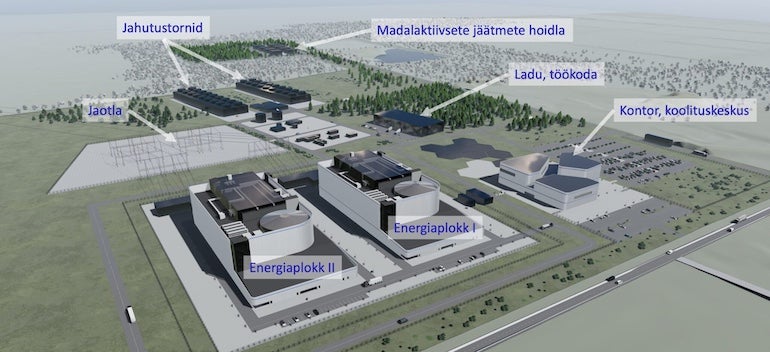
The passage of the Nuclear Energy and Safety Act by the Estonian Parliament (Riigikogu) represents a key legislative shift that clears the primary legal barrier for nuclear power development in Estonia. The act was passed by a vote of 63 in favour, 10 against and one abstention. Estonia can now move ahead more concretely with plans to build a NPP and can continue the first stage of the National Designated Spatial Plan.
The concept of a National Designated Spatial Plan (riigi eriplaneering) was officially introduced into Estonian law when the comprehensive Planning Act was passed in 2015. This law created the legal blueprint for a state-level designated spatial plan to expedite high-impact infrastructure and was used for major industrial, transport and defence projects.
In 2019, Fermi Energia was founded by Estonian energy and nuclear experts, alongside venture capital funds, private investors, and European energy utilities such as Sweden’s Vattenfall to promote nuclear development. In 2023, Fermi Energia selected the GE Hitachi BWRX-300 small modular reactor (SMR) design for its planned NPP and formed commercial partnerships with companies including Samsung C&T to build it.
Fermi Energia’s commercial interest prompted the Estonian government to form the National Nuclear Energy Working Group in 2020 to study the feasibility of nuclear power. In May 2025, the government utilised the existing 2015 planning framework to initiate a specific spatial planning process for the planned NPP. While the state manages the National Designated Spatial Plan to find a site, Fermi Energia financially covers the costs of the state’s environmental and technical impact assessments.
Although the location of the nuclear power plant has not yet been decided, Fermi Energia purchased a property from Viru-Nigula Municipality in Lääne-Viru County in May this year. The deal was structured so that Fermi will complete the purchase only if that specific location is approved in the designated spatial plan.
The Nuclear Energy and Safety Act effectively bridges the gap between physical land planning and nuclear regulation, formalising how the spatial plan feeds into a legally binding nuclear permitting pipeline.
The new legislation appoints the Consumer Protection & Technical Regulatory Authority (TTJA) as the official nuclear regulator, which is scheduled to begin formal operations on 1 January 2027. The act mandates a strict five-stage permit structure for a nuclear facility covering preliminary assessment, construction, testing, operation, and eventual decommissioning. It places all safety, decommissioning, and waste-disposal costs directly onto the developer and operator through a dedicated national fund.
The legislation requires explicit site and project sign-off from the regulator, the national government, and a final vote by the Riigikogu. Potential developers are restricted to using nuclear technologies that are already operational and proven in practice.
The ongoing First Stage of the National Designated Spatial Plan focuses on selecting the precise geographical site, which officials expect to finalise by November 2027. At present, six potential locations are being considered.
The Second Stage will transition into intensive, site-specific environmental impact assessments and technical feasibility surveys. Studies are expected to focus on coastal zones within the Viru-Nigula and Lüganuse municipalities, particularly near Kunda and Aa. The new act guarantees host municipalities and nearby residents direct financial payments funded by production fees.
Fermi Energia intends to deploy a 600 MWe NPP comprising two GE Hitachi BWRX-300 SMRs. The BWRX-300 design is a 300 MWe water-cooled, natural circulation SMR with passive safety systems that leverages the design and licensing basis of the company’s ESBWR boiling water reactor.
The anticipated submission date for the preliminary assessment and initial construction permit applications is mid-2029. Construction is planned to start in 2031 with physical site excavation and infrastructure building. The application process for the operating licence will proceed in parallel. The targeted timeline for the first 300 MWe unit is 2036 followed by the second unit in 2038.
In April 2025, Fermi Energia and South Korea’s Samsung C&T agreed to collaborate on the deployment of the two BWRX-300 SMRs, including the formation of an Engineering, Procurement & Construction (EPC) partnership.
“Our goal is to submit the application to initiate the preliminary assessment by the middle of 2029, perhaps in May, affirmed Fermi CEO Kalev Kallemets. Before that, however, an investment decision must be made and Fermi Energia is seeking certain guarantees from the state. A recent study prepared by Erkki Raasuke and Anne Sulling, Feedback from Foreign Investors on Making Large Energy Infrastructure Investments in Estonia,” found that attracting major investments requires more than state-backed loan guarantees. Above all, investors need a clear plan from the state on what areas of the energy sector are to be prioritised.
Referring to the study, Kallemets said that, as a major infrastructure investment, a NPP would require a state-backed contract-for-difference (CfD) mechanism, similar to those offered in renewable energy auctions. “This needs to be thoroughly analysed and incorporated into the Electricity Market Act so that potential final investors can form their own view on whether they are prepared to participate in the final investment in building the nuclear power plant,” he noted.
Fermi Energia’s preliminary estimates put the cost of building the NPP at €4.5bn ($5.1bn), including a 15% contingency margin. Equity would account for 38% of the financing, Kallemets said. The company is assuming a 10% return on equity and borrowing costs of 5%.
In addition to investing in the plant, Fermi Energia plans to invest €15m in Viru-Nigula Municipality: €5m in direct investments, €5m in housing development and €5m in a visitor centre at the plant. The agreement is conditional and will take effect only if the designated spatial plan confirms the location in Viru-Nigula Municipality. Under the new law, Fermi Energia will pay an annual community compensation fee of around €750,000 per reactor, half of which will go to the municipality and half to local residents.
Although the Nuclear Energy and Safety Act has been passed by the Riigikogu, implementing regulations still need to be adopted. The Ministry of Climate is currently preparing dozens of such regulations, Tooming said. These regulations are needed, for example, to prepare applications for construction permits.
Antti Tooming, Deputy Secretary General at the Ministry of Climate noted that, under the new act, the owner of any NPP must have a plan for decommissioning and waste disposal before construction begins. What will ultimately be done with the nuclear waste will be decided by the state over the next 10 years, he said. “Since waste management technologies are still developing, we are not prescribing a final solution at the legislative level today. Instead, the state must adopt a strategy and then determine how it should be implemented.” He added that Estonia was studying the deep geological disposal solutions adopted by Finland and Sweden.
As to funding the NPP, Tooming said the current political position is that the state will not participate in financing. “That is the position today and the state has the option of reconsidering it in the future. If we look at examples from other countries, the state is generally involved in one way or another. At the moment, however, no such decision has been made in Estonia…. If there is political will for the state to take a stake or support the process in some other way, that is something for the future.”


