
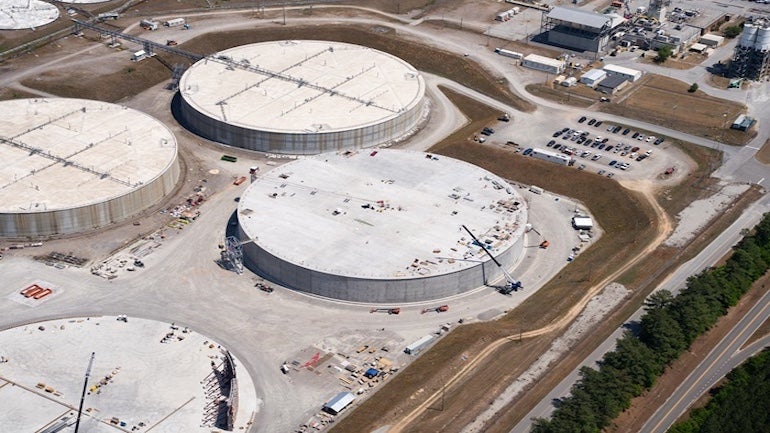
All concrete construction on the eleventh massive saltstone disposal unit (SDU) has been completed at the US Department of Energy’s (DOE’s) Savannah River Site (SRS). With 25 wall sections, 208 support columns, and seven roof sections, SDU 11 will hold over 33 million gallons of saltstone – a decontaminated, hardened material safe for long-term onsite disposal. The unit will now be wrapped with seven layers of steel cable, totalling over 340 miles, to ensure structural integrity and enhanced durability.
Chuck Comeau, DOE-Savannah River federal project director, said the SDUs are key components of the SRS liquid waste program and meeting DOE’s Office of Environmental Management (EM) cleanup responsibilities.
“The SDUs provide safe, permanent storage for the decontaminated salt solution from the Salt Waste Processing Facility (SWPF),” said Comeau. “With SWPF processing at an accelerated rate, it is important to have the SDUs ready for operation. Completing construction milestones ahead of schedule ensures that the SDUs will be ready when needed.”
It takes more than 20,000 cubic yards of concrete to build an SDU, which is the end of the salt waste processing path. The SWPF produces the decontaminated material that is sent to the Saltstone Production Facility, where it is mixed with dry materials to make a cement-like grout. The grout is pumped into the SDUs, where it solidifies into a monolithic, non-hazardous form.
The larger SDUs are designed to support the increased material production from SWPF. The new SDUs result in more than $500m in cost savings over the life of the liquid waste programme because they require less infrastructure and materials than the previous 80 smaller SDUs.
EM’s liquid waste contractor at SRS, Savannah River Mission Completion (SRMC), manages the construction and operation of the SDUs. Subcontractors Quality Plus Services, US FUSION & Specialty Construction, and DN Tanks completed the site preparation, interior and exterior liner systems, and unit construction.
Finishing all the concrete placements on SDU 11 is a noteworthy achievement on the journey to mission completion, according to SRMC President and Program Manager Thomas Burns Jr.
“Building all the SDUs onsite has been a tremendous work in progress,” Burns said. “We have reached another satisfying milestone that is positive encouragement for the team to keep up the diligence, the ownership and the excellence as we work to have all the SDUs done and dusted in the near future.”
The SDU project team earned the DOE 2025 Project Controls Excellence Award for demonstrating superior project controls, rigorous data integrity and continuous improvement in practices.
The remaining two SDUs are in various stages of construction. Concrete construction of SDU 10 was completed in 2024 and it was deemed leak-tight in 2025. SDU 12, the final SDU needed for the SRS liquid waste mission, is under construction now.
SRMC is accelerating the radioactive liquid waste cleanup mission at SRS through advanced engineering solutions and innovative approaches, making significant progress toward safely and efficiently closing all waste tanks at SRS.
The radioactive liquid waste generated by the chemical separations processes at SRS in South Caroline has been stored in the Tank Farms in both solid and liquid forms since 1954. The radioactive liquid waste stored at SRS was generated as byproducts from the processing of nuclear materials for national defence, research, medical programs and NASA space missions during and after the Cold War.
About 160m gallons of radioactive waste has been generated and concentrated by evaporation to a current volume of approximately 35m gallons. SRS has a total of 51 waste tanks built in the Site’s F and H Areas; eight of those tanks have been operationally closed. Several of the remaining 43 waste tanks are in various stages of the waste removal, cleaning, and operational closure process.
The SWPF and Defense Waste Processing Facility (DWPF) are enabling unprecedented throughput of the over 30m gallons of Cold War era radioactive waste stored in underground tanks.


