
US-based nuclear energy startup Ampera has established a new subsidiary, Ampera Australia Pty Ltd, to secure a raw thorium supply and vertically integrate its entire nuclear fuel value chain. Ampera will procure raw monazite crystal (the primary thorium-bearing mineral) from Geoscience Australia deposits. The material will then be shipped to the United States. The company plans to process the raw thorium in-house at its facility in Florida and to use its proprietary jetting technology to manufacture high-quality Tri-structural Isotropic (TRISO) fuel kernels.
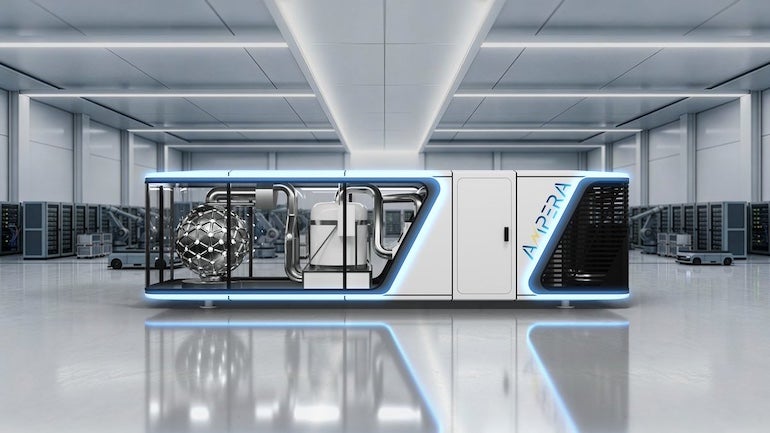
The processed fuel will power Ampera’s planned factory-built, containerised, supercritical modular based on a hybrid fusion-fission architecture. Instead of maintaining a traditional self-sustaining fission chain reaction, they rely on a built-in neutron source to sustain the reaction. This eliminates the physics-based risk of a runaway meltdown. Rather than uranium, the reactor is designed to run on thorium-based TRISO fuel that can withstand extreme heat without melting and cannot be easily weaponised. The company will build components using heavy metal 3D printing and will also use AI-driven autonomous controls and a “safeguards-by-design” architecture.
Ampera plans to build containerised 15 MWe and 30 MWe units. They are designed to be factory-fabricated, sealed, shipped to a site, and left to run autonomously for 30 years without refuelling or producing long-lived nuclear waste. The company is scaling its infrastructure to mass-produce 300 units a year and plans to grow its workforce to 2,500 employees. The target applications for these microreactors include AI data centres, military bases, industrial facilities, and maritime shipping. Ampera aims to have its first operational commercial microreactors deployed at customer locations by 2030.
This expansion leverages a bilateral critical minerals framework agreement signed between the US and Australian governments. In addition, Ampera has already initiated the pre-application licensing process with the US Nuclear Regulatory Commission (NRC).
In October 2025, the United States government announced a framework with Australia securing supply for mining and processing of critical, rare-Earth minerals. In February, Ampera formed Ampera Australia Pty Ltd to expedite the procurement and import of thorium to the US.
“Our strategy is to secure thorium directly at the source and vertically integrate the entire fuel value chain, from mineral supply through advanced fuel production,” said Ampera Founder & CEO Brian Matthews. “Thorium offers a compelling combination of abundance, energy potential, economics, and safety, making it an ideal fuel for Ampera’s advanced microreactors and a promising resource for the broader nuclear industry.”
Ampera said its broad fuel platform is built on proprietary processes protected by trade secrets and more than 60 patents for nuclear fuel manufacturing, including proprietary jetting technology used to produce TRISO fuel. “Thorium is the future for ultra-safe, clean power production,” Matthews said. “By producing TRISO thorium kernels in the United States, we can ensure ample access to the needed fuel supply as we scale up and also minimise price volatility risk.”
Ampera emerged from stealth mode in November 2025. The company was founded by Brian Matthews, a British nuclear physicist, serial deeptech entrepreneur, and the head of global metal 3D-printing firm ADDiTEC.
The startup is heavily backed by an unnamed Fortune 500 technology provider with global operations across more than 100 countries, heavily anchoring its business model artificial intelligence (AI), cloud computing and data centre infrastructure. Because this backer already commands a massive international data footprint, Ampera’s business model is directly anchored to it. Rather than trying to sell microreactors to a cold market, it plans to deploy its 30 MWe units directly to the backer’s grid-constrained compute clusters around the world. By keeping the partner unnamed during the initial pre-application licensing with NRC, Ampera protects its proprietary development timeline and competitive real estate edge in the race for data centre power.
In April Ampera launched its 100,000-square-foot global headquarters in Palm Beach Gardens, Florida, which functions as an R&D and advanced additive manufacturing hub. The campus spans two physical buildings totalling nearly 100,000 square feet. This site serves as the company’s central command. It houses its core research & development (R&D), engineering labs, back-office administration, and proprietary heavy metal additive manufacturing (3D-printing) facilities. It also includes assembly operations where the containerised microreactors will be factory-built, alongside its in-house TRISO nuclear fuel kernel fabrication platform.
Ampera is also planning a second facility in Florida. The company’s commercial roadmap states that they are currently evaluating a 300,000-square-foot facility within Palm Beach County, positioned near their existing headquarters. This larger secondary space is being secured to house their first full-scale mass-production line. It will accommodate the transition from R&D to manufacturing their specialized thorium-based TRISO fuel kernels and core components as they scale up production.
As to its Australian operation, the subsidiary was registered as an Australian proprietary limited company to manage supply chain logistics, trade Compliance under the US-Australia bilateral framework, and the export of raw materials. Its primary function is moving material out of the country rather than operating a heavy industrial plant locally. The exact physical or registered office address for Ampera Australia Pty Ltd has not been publicly released or detailed in the company’s official corporate announcements.
Ampera is not opening a new nuclear mine but aims to partner with existing commercial heavy mineral sand mining operations which extract mineral sands to obtain ilmenite, rutile, and zircon for standard industrial uses. A secondary byproduct of this process is monazite, a crystal rich in rare earth elements and raw thorium. Historically, Australian mining companies treated thorium as an unwanted radioactive waste byproduct and buried it back in the ground because there was no buyer. Ampera is capitalisng on this by contracting with suppliers to intercept and purchase this monazite stockpile directly at the source.
Ampera’s business model relies on “vertical integration” via strictly guarded trade secrets and proprietary patents. By masking the exact mining entities, they protect their specific supply pricing and prevent competitors from locking down the same commercial monazite streams. Additionally, since they are leveraging the October 2025 US-Australia Critical Minerals Framework, these supply contracts fall under strategic government trade umbrellas that are closely guarded for economic security.


