
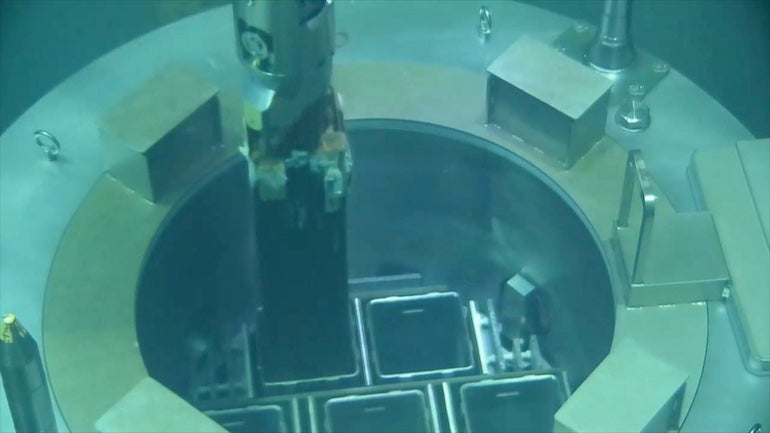
Tokyo Electric Power Company (Tepco) has begun removing fuel assemblies from the used fuel storage pool of the badly damaged unit 2 at the Fukushima Daiichi NPP. A total of 615 fuel assemblies (587 used and 28 unused) are stored in pool. They will be transferred to a general used fuel pool located elsewhere on the plant site.
There are six reactor units at the Fukushima Daiichi nuclear plant. Units 1-4 were heavily damaged during the 2011 accident. Unit 1suffered a severe hydrogen explosion and a full core meltdown after losing power. Unit 2 suffered a core meltdown and an explosion near its suppression pool, releasing high amounts of radiation. Unit 3 suffered a massive hydrogen explosion and a full core meltdown. Unit 4 suffered a hydrogen explosion and severe structural damage, although its reactor was offline for maintenance at the time. Units 5&6 remained safely intact because a single operational diesel generator kept their cooling systems running.
Removal of the fuel from unit 2 required years of preparation. After studies were conducted based on various risk scenarios, it was decided to revise the plans calling for dismantling of the upper part of the reactor building, given the downward trend in air dose rates on the operating floor. Following the revision, a fuel handling facility (access gantry and front chamber) was constructed for transporting fuel rod assemblies out of the building on the south side. By connecting the front chamber and the building, the fuel removal system enabled the fuel to be removed by remote operation.
In preparation for fuel removal a front chamber was built on the west side of the reactor building. Then in June 2018, an outer wall opening was completed on the west side of the building. Survey work inside the operating floor was conducted in advance of studies on measures to suppress scattering of radioactive materials when the upper part of the reactor building is dismantled.
In June 2020, Tepco completed an initial survey of the unit 2 fuel storage pool using an underwater remote-controlled vehicle and found no obstacles to removing the assemblies from the pool. In June 2024, Tepco completed a working fuel removal platform at unit 2.
Fuel handling equipment was brought to the port of the Fukushima Daiichi Nuclear Power Station by sea, transported by supercarriers from the port to the vicinity of the fuel removal work platform. In May 2025, the fuel handling equipment was lifted onto the fuel removal work platform by cranes and affixed to runway girder rails. Test operation of the fuel handling equipment began in December 2025. It passed the pre-operational inspection and installation of the equipment was completed on 18 March 2026. Tepco then conducted training in which the fuel handling equipment and shipping containers located on site were used to move simulated fuel to practise the removal procedure.
Tepco said the first fuel assembly was lifted from a rack inside the storage pool using a remotely operated crane and loaded into a shipping container in the pool. Once filled, the container will be lifted from the pool and lowered onto the trailer from a platform installed next to the building. The company expects the removal process for all 615 assemblies to be completed in fiscal year 2028 (ending March 2029).
Used fuel has already been removed from units 3,4 and 6 and is underway at unit 5, while preparatory work is underway at unit 1. In December 2014, Tepco completed removal of 1,331 used fuel assemblies and 202 unused assemblies from a storage pool on the roof of unit 4 eliminating a significant radiological hazard at the site. Removal of all 566 fuel assemblies from the storage pool at unit 3 was completed in February 2021 after several years of work to remove debris from the maintenance floor of the reactor building. Removal of 398 fuel assemblies from unit 6 was completed in April 2025, while work to remove 1,388 assemblies from the unit 5 pool has been underway since July 2025.
Removal of 392 fuel assemblies from the storage pool at unit 1, where a hydrogen explosion occurred, has not yet begun. A large cover was installed over the entire reactor building in October 2011, to prevent the scattering of radioactive materials from the building before any work could begin. Measures to prevent and mitigate rubble fall on the operating floor were completed in November 2020. The dismantling of the building cover that would interfere with the construction of a more appropriate cover was completed in June 2021. The installation of that cover for the purpose of suppressing dust dispersion and developing a work environment when removing rubble and suppressing rainwater inflow was completed in January 2026.
Tepco said that “going forward, we are working to install an overhead crane, related equipment including a dust monitor and air conditioning system in preparation for the full-scale rubble removal, and planning to commence fuel removal in fiscal years 2027-2028”.


