
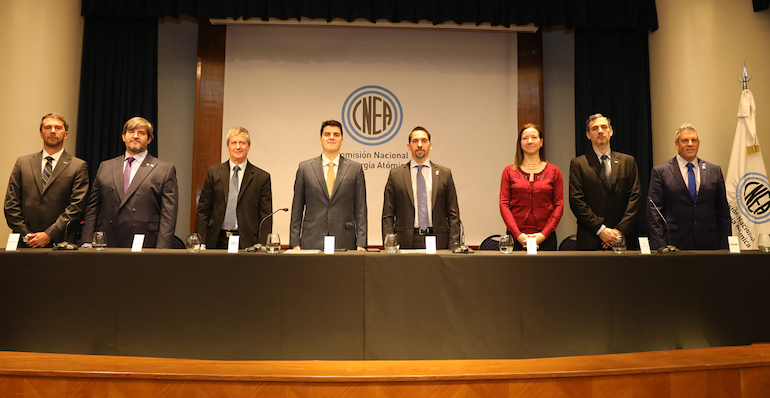
Argentina’s National Atomic Energy Commission (CNEA Comisión Nacional de Energía Atómica) marked its 76th anniversary and National Atomic Energy Day by presenting the Guidelines of the Argentine Nuclear Policy 2026. The event, led by CNEA President Martín Porro, and the Secretary of Nuclear Affairs, Federico Ramos Napoli, outlined a major strategic shift toward private capital integration and commercial viability.
The new doctrinal framework introduces four strictly ordered hierarchical pillars. If goals conflict, the higher-ranking objective takes absolute precedence:
- High-Value Exports: Prioritising international sales of nuclear technology, domestically produced fuel components, maintenance services, and reactors.
- Energy Security: Delivering affordable, reliable baseload electricity to support demanding domestic industries, mining, and artificial intelligence data centres.
- Proprietary Technology Development: Preserving and advancing domestic technological capabilities and scientific research.
- Regional Leadership: Securing Argentina’s position as the primary nuclear hub across Latin America Shift Toward Private Capital.
The framework pivots away from decades of exclusive state funding. The State intends to retain strict regulatory control, non-proliferation credentials, and security oversight, while actively inviting foreign and local private investments to scale up production and infrastructure. Emerging projects include:
- Fuel Production: US-based Nano Nuclear Energy aims to invest over $230 million alongside Dioxitek to produce nuclear fuel in Formosa province. Dioxitek is legally and financially controlled by the CNEA, but operates as a distinct state-owned corporate entity. Dioxitek processes uranium concentrates to manufacture uranium dioxide (UO₂) powder. This powder is then sent directly to CONUAR (another CNEA-affiliated facility) to be turned into the fuel pellets and assemblies used by Argentina’s nuclear power plants.
- Reactor Development: State tech company INVAP is collaborating with Meitner Energy on new reactor concepts tailored specifically for the export market. The flagship of INVAP’s new power-generation catalogue is the ACR-300, a small modular reactor (SMR) patented in the US. Meitner Energy, a firm that holds a 40% stake in INVAP and owns the patent for the reactor design. In 2025, government officials announced intentions to construct a cluster of four ACR-300 reactors at the Atucha Nuclear Complex to anchor domestic energy grids. While the ACR-300 targets the energy market, INVAP remains a dominant global exporter of open-pool, water-moderated multipurpose research reactors.
While government officials highlight these updates as a pathway to massive dollar inflows and structural modernisation, the new framework is contentious. Civil sector groups and labour unions have organised public demonstrations, raising concerns over the potential defunding, privatisation, or fragmentation of foundational national projects such as the CAREM and RA-10 reactors.
Both the CAREM and RA-10 projects represent the pinnacle of Argentine nuclear engineering but serve completely different purposes and face distinct operational paths under the country’s new commercialised nuclear policy.
The Central Argentina de Elementos Modulares (CAREM) is Argentina’s first domestically designed and developed SMR. It is a 25–29 MWe pressurised water reactor and was on track to be the world’s first operating SMR. However, the original CAREM-25 design faced governmental criticism for not being commercially scalable or financially viable and the administration of President Milei shifted priorities toward the INVAP-designed ACR-300. Construction has been severely delayed due to budget cuts and high inflation. The project has faced periodic work halts as the government pivots toward incorporating private capital and seeking foreign partnerships (notably with US firms) to advance next-generation reactors.
The RA-10, a 30 MWt open-pool multipurpose research reactor located at the Ezeiza Atomic Centre has received continued government support as a highly lucrative asset designed to replace the ageing RA-3 reactor. Once fully operational, it will make Argentina entirely self-sufficient in medical radioisotopes and capture up to 20% of global demand for molybdenum-99. The project is in its advanced, final pre-operational testing phase. CNEA recently completed successful structural and functional tests of its primary cooling systems using dummy fuel elements. Commissioning and core critical testing are slated to continue through 2026, with full-scale commercial operations projected for 2027.
This new guidelines establish a clear distinction between political leadership and technical operation, promoting for the first time the call for private capital to invest in national projects.
CNEA President Martín Porro stressed the need for a change in the operational and management paradigm. “The CNEA has managed to impose itself in the sector in these 76 years, but today we must work for the next 76 years”, he maintained. “We have to improve and think about the day after; what we have in mind is a business model, sustainable and executable over time, on time and on budget, but also with a future projection.”


