
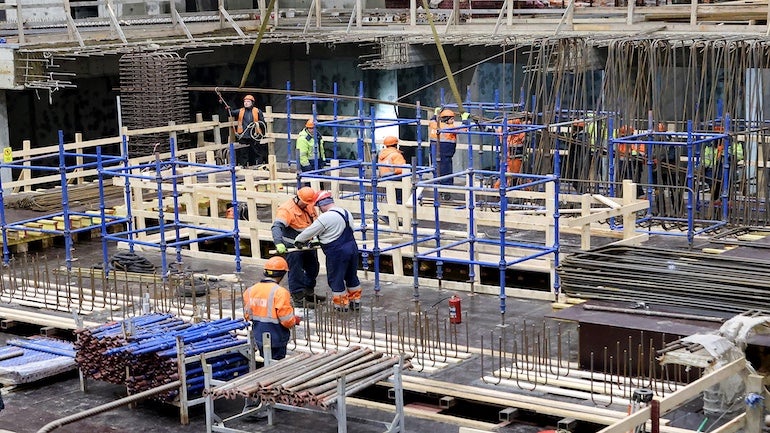
Work has begun to concrete the foundation of the turbine and generator of the BREST-OD-300 reactor under construction at the Siberian Chemical Combine (SKhK – Sibirskovo Khimicheskovo Kombinata) in Seversk, Tomsk region as part of the pilot demonstration power complex (ODEK – Opitno Demonstratsionovo Energo-Kompleksa).
The construction of the BREST-OD-300 turbine-generator foundation involves specialised engineering to support a massive machinery load while mitigating extreme operational vibrations. The foundation is integrated with 36 specialised spring elements. These reduce the vibration load transmitted from the spinning turbine-generator unit to the structural support columns and surrounding process equipment. This design also protects the machinery from severe earthquakes.
The structural base is engineered to provide perfectly stable, long-term support for a total machinery weight exceeding 1,700 tonnes. The concrete pouring operation requires a total volume of more than 620 cubic metres of various classes of concrete from heavy to fine-grained. The structural core integrates over 100 tonnes of steel reinforcement bars (rebar) and specialised embedded components.
To manage heat generation and material curing safely, the concreting process is split into three distinct stages. Once the final layer of concrete is poured, the foundation must be left completely undisturbed for several months to reach its peak structural strength. Embedded monitoring sensors are cast directly into the concrete. These sensors will track minor shifts or positional movements of the foundation across the entire operational lifespan of the reactor.
“Concreting such a critical unit is a long and labor-intensive process. But for equipment with a total weight of more than 1,700 tonnes, a stable support becomes not just important, but critically necessary,” said Ivan Babich, a representative of the management of the ODEK Complex at SKhK.
The turbogenerator equipment for the BREST-OD-300 reactor represents a unique, entirely Russian engineering design tailored for Generation IV power generation. Unlike traditional heavy-duty power plant generators, this system features a fully air-cooled design, intentionally eliminating complex hydrogen or water-cooling circuits to maximise operational safety and efficiency.
The turbogenerator equipment for the BREST-OD-300 power unit was delivered to the site at the end of 2025. It was manufactured by the Russian heavy engineering consortium Power Machines. The production was split across two of its primary specialised manufacturing subsidiaries located in St Petersburg. The Steam Turbine: Engineered and built by the Leningrad Metal Plant (LMZ), which specializes in high-capacity high-speed steam turbines for nuclear power plants. The Air-Cooled Generator: Engineered and built by the Electrosila plant, a premier facility specialising in generator stators and electrical rotor machinery.
Meanwhile, long-term life tests of the Main Circulation Pump Unit (MCPU) prototype are continuing at ODEK representing one of the most critical engineering hurdles for the entire BREST-OD-300 reactor system. Moving dense, highly corrosive liquid metal at a massive scale requires completely unprecedented material science and mechanical reliability.
The single prototype assembly stands over 12 metres tall and weighs more than 30 tonnes once integrated with its heavy-duty electric drive motor. The unit must displace 11 tonnes of molten lead every second through the primary circuit. The machinery is engineered to function continuously at baseline temperatures exceeding 420°C to 450°C, safely preventing the lead from solidifying. Pumping molten lead introduces brutal operational conditions, specifically erosion and liquid metal corrosion. To prevent the pump’s internal components and impellers from dissolving over decades of operation, the developer, the Central Design Bureau of Machine Building (TsKBM – Tsentralnovo Konstruktorskovo ByuroMashinostroeniya) had to pioneer entirely new material pairings.
The BREST-OD-300, being built under the Breakthrough (Proryv) Project, is intended to demonstrate closed fuel cycle technology. As well as BREST, ODEK also includes on-site nuclear fuel cycle facilities including a module for fuel fabrication and refabrication and a module for reprocessing and recycling irradiated fuel. The fuel fabrication unit began operation in December 2024.
Currently, the BREST-OD-300 reactor unit is approximately 70% assembled. Completion of work to assemble the reactor vessel is scheduled for the end of 2026. Rosatom originally planned to launch the reactor in 2026. However, additional research and development work was required, and the launch has now been postponed to 2029.
Initial operation of the demonstration unit will be focused on performance and after 10 years or so it will be commercially oriented. In the future, Rosatom intends to scale up the Brest-OD-300 reactor unit to the BR-1200 with a capacity of 1,200 MWe. According to Russia’s plans for power generation facilities to 2042, eight units with BR-1200 reactors are to be built at new sites fi two at the Reftinskaya NPP (Sverdlovsk Region), two at the Yuzhnouralskaya NPP (Chelyabinsk Region), two at the Severskaya NPP, and two at the Siberian NPP (Irkutsk Region). In addition, around 2035, Rosatom expects to prepare an export version of these Gen IV power complexes.


