
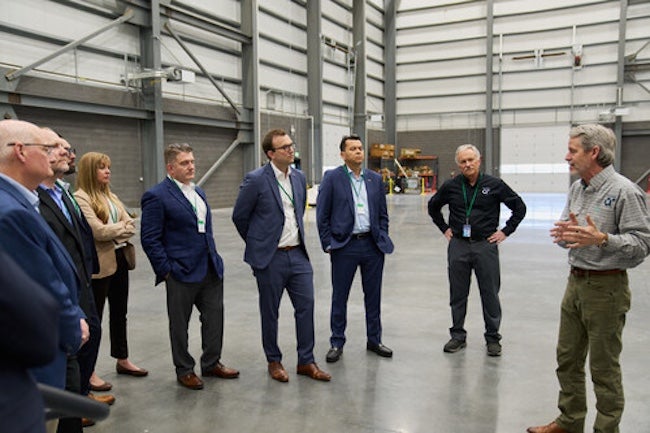
US start-up First American Nuclear (FANCO) and Canada-based AtkinsRéalis have signed a 20-year Strategic Alliance Agreement to accelerate the deployment of advanced small modular reactors (SMRs) across the United States. The alliance focuses on deploying FANCO’s EAGL-1 reactor, a fast-spectrum SMR designed to deliver 240 MWe.
AtkinsRéalis will act as the exclusive engineering, procurement and construction management (EPCM) provider for EAGL-1 projects in North America. The company also plans to establish a significant presence in Indiana, including an office near FANCO headquarters, collaboration on workforce and supply chain development initiatives, and participation in the Nuclear Indiana Coalition and other industry groups.
The initial contract covers task orders worth up CAD250m ($181m) over the first five years. Testing, design reviews, and licensing validations are underway to enable the EAGL-1 system to begin delivering utility-scale power by 2033.
EAGL-1 is a 240 MWe/600 MWt liquid-metal fast reactor (LMFR) and is the only US design currently using lead-bismuth cooling technology. It is designed for clustered deployment to maximise economies of scale while maintaining a footprint ten times smaller than traditional plants. The reactor is designed to use multiple fuel types, including uranium oxide (UO2), mixed oxide (mox), recycled uranium, and transuranic (TRU) fuels.
In April, FANCO submitted its Regulatory Engagement Plan (REP) to the US Nuclear Regulatory Commission (NRC) for EAGL-1 fast-spectrum SMR. This began the pre-application phase, providing a roadmap for technical reviews and topical report submittals that pave the way for an eventual construction permit.
“This partnership pushes our mission to provide affordable, reliable, and secure energy forward,” said Jeff Kendall, President, AtkinsRéalis US Nuclear. “With national leadership prioritising commercial nuclear growth, our collaboration brings advanced reactors and fuel recycling to market faster, delivering the dependable power America needs.”
“SMR technology is an important part of the energy mix needed to create stable, affordable, and reliable power grids that meet the energy needs of economies and communities worldwide,” said AtkinsRéalis President and CEO Ian L Edwards. “This partnership with FANCO marks an important step in delivering innovative and scalable nuclear technology precisely when the United States is embracing a new era of energy leadership. As the government modernises pathways for commercial reactor deployment, we are poised to help shape a safer, more secure energy future for generations to come.”
FANCO was officially incorporated and launched in early 2025. However, the technology behind FANCO’s EAGL-1 reactor originally received financial backing from a Department of Energy (DOE) Advanced Reactor Demonstration Program (ARDP) grant. It was developed under a consortium as part of the Advanced Reactor Concepts-20 (ARC-20) pathway.
Subsequently a formal review was conducted by the Pacific Northwest National Laboratory (PNNL) under a DOE GAIN (Gateway for Accelerated Innovation in Nuclear – PNNL-28013) programme voucher announced in January 2025. The review concluded that the EAGL-1 design is licensable under existing NRC criteria without the need for new rules or novel regulatory frameworks, provided further design development and analysis are completed. As part of the award, FANCO was responsible for a minimum 20% cost-share, which is standard for GAIN recipients.
The FANCO design separates EAGL-1 and its core safety systems from the balance of plant (BOP) power conversion block, which includes the turbine, generator, condenser, and condensate systems. The BOP will comprise entirely commercial off-the-shelf systems, which can be sourced from established industrial suppliers. This proprietary system, called Bridge Power, will let FANCO construct and commission the BOP using conventional commercial package boilers while EAGL-1 is under NRC review. The power conversion structure will begin generating gas power in the short-term, then seamlessly transitions to nuclear when licensing is complete.
In November 2025, FANCO announced plans to establish Indiana as the company’s headquarters, manufacturing facilities, and an energy park. The energy park is designed to be the first in the US to operate in a “closed-fuel cycle”, meaning it will reprocess and reuse used nuclear fuel on-site. FANCO has engaged AtkinsRéalis as primary architect-engineer.
According to the FANCO website, the company’s team “supported some of the most advanced reactor projects in US history and abroad, from liquid-metal fast reactors to next-generation fuel cycle systems”. The team’s track record “spans the Fast Flux Test Facility (FFTF), the Global Nuclear Energy Partnership, the Advanced Reactor Concepts programme, and early studies for the Versatile Test Reactor (VTR)”. FANCO claims: “With EAGL-1, we’re translating that experience into a commercially ready solution.”
The website notes: “Using safe and benign lead-bismuth coolant, EAGL-1 takes packaged power plant systems and combines them with a compact low-pressure fast reactor design.”
However, the world’s only operating lead-bismuth-cooled fast reactors were developed in the 1960s by the Soviet Union. These reactors powered the Alfa-class submarines, which were operational from the 1960s until the 1990s. Use of the reactors was discontinued because of issues such as lead bismuth solidification, corrosion, and the generation of polonium-210. They were decidedly not “benign”.
As to US experience with fast reactors, it was discontinued in the mid-1990s. The EBR-II (Experimental Breeder Reactor-II) was a sodium-cooled fast reactor that operated from 1964 to 1994 at Argonne National Laboratory. The FFTF operated from 1982 to 1992 to test various aspects of commercial reactor design and operation. It was also cooled using liquid sodium, not lead-bismuth. The VTR was a planned DOE project to build a high-flux, fast-neutron test reactor but the project’s funding was cancelled.
Development of a lead-bismuth-cooled fast reactor will require the development of special metals and materials to overcome the problems encountered by the Alpha submarines. Moreover, bismuth is not widely available. Global production is dominated by a few countries, primarily China, which refines most of the world’s bismuth. Other countries have largely ceased their own refining operations.


