
Chicago-based Clean Core Thorium Energy (CCTE) has confirmed that its patented ANEEL (Advanced Nuclear Energy for Enriched Life) fuel successfully reached a burnup of over 60 GWd/MTU (gigawatt-days per metric tonne of heavy metal) during testing at the Idaho National Laboratory (INL). The fuel is a mixture of thorium and high-assay low-enriched uranium (HALEU) and is engineered to be proliferation-resistant.
The irradiation results build on decades of global research into thorium fuel cycles to improve fuel utilisation and resource efficiency in existing heavy-water reactor fleets without reactor modifications. CCTE said the final set of irradiation capsules had achieved more than 60 GWd/MTU of burnup at INL’s Advanced Test Reactor (ATR), representing more than eight times the typical discharge burnup of traditional pressurised heavy water reactors (PHWRs) and Canada Deuterium Uranium (Candu) reactors, which usually operate around 7.5 GWd/MTU. This highlights the potential of ANEEL fuel to dramatically improve fuel utilisation in existing reactor fleets and paves the way for near term commercialisation.
The fuel is designed to match the geometry of existing 19- and 37-element bundles, meaning it can be used in current Candu and PHWR fleets without any modifications to the reactor core or systems. By extracting more energy from the same amount of fuel, waste volume can be reduced by up to 87.5%.
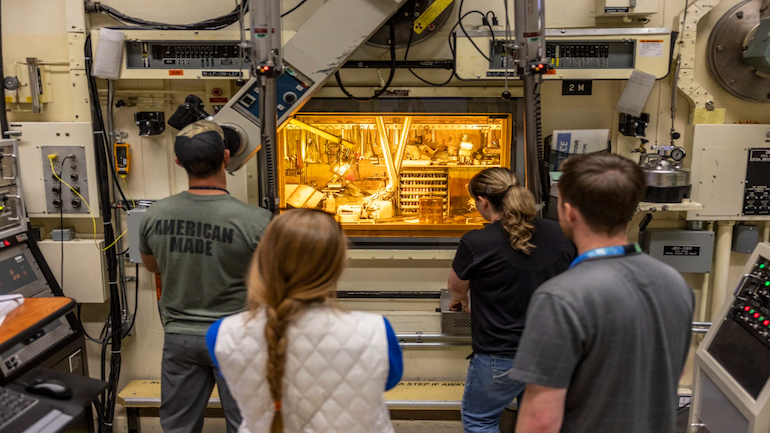
The ATR irradiation campaign involved 12 ANEEL fuel rodlets that were loaded into the reactor in May 2024 and designed to reach three burnup targets: 20, 40, and 60 GWd/MTU. Eight rodlets exceeded the first two burnup targets in 2025 and are currently undergoing post-irradiation examination (PIE) at INL’s Materials and Fuels Complex (MFC).
Less than two years after irradiation began, the remaining four rodlets have now reached the highest burnup target, over 60 GWd/MTU, and will be transferred to MFC following a short cooling period. The irradiation campaign represents an important step in generating real-world performance data for ANEEL fuel under reactor conditions. Results obtained during PIE will provide detailed insight into fuel behaviour, microstructure, and performance at high burnup levels.
Because of its compact, high-flux nature, irradiation conditions in the ATR are typically more aggressive than in a PHWR. This allows fuel behaviour to be evaluated under accelerated conditions that simulate extended reactor operation. PIE results obtained to date are consistent with findings reported in the literature and suggest that ANEEL fuel performs well, with some test rodlets exhibiting superior fission gas retention compared to traditional UO2 fuel. Initial observations also show that ANEEL fuel maintains structural integrity and favourable fission gas retention behaviour throughout irradiation.
“Surpassing 60 GWd/MTU of burnup in the Advanced Test Reactor marks an important milestone for the ANEEL fuel programme,” said CCTE CEO Mehul Shah. “This irradiation campaign provides meaningful performance data and demonstrates that thorium-HALEU fuel can achieve burnup levels comparable to those seen in PWR [pressurised water reactor] fuels while offering improved fuel utilisation, enhanced safety characteristics, inherent proliferation resistance, and meaningful reductions in long-lived nuclear spent fuel radioisotopes. Our objective has been to introduce thorium into the nuclear fuel cycle in a practical way using existing reactors, and this milestone represents a significant step toward that goal.”
Kelley Walker, principal investigator for the CCTE irradiation campaign at INL, noted: “This final portion of the irradiation experiment has been several years in the making and I congratulate Clean Core on their major accomplishment. This has been an exciting project to support, and I’m eager to see what can be learned from the upcoming high burnup sample PIE results.”
With the ATR irradiation complete and post-irradiation examination underway, CCTE is already planning its next milestone: a demonstration irradiation in a commercial power reactor that will move ANEEL fuel from proven test concept to commercial reality. The company will continue to work with INL and industry partners in support of a cleaner, more efficient global nuclear fleet.
In April 2026, CCTE and Canadian Nuclear Laboratories (CNL) signed a definitive agreement to move ANEEL fuel from lab-scale testing to full-scale commercial demonstration. This agreement is a critical step in the commercialisation of thorium-based fuels. CNL will manufacture full-scale, reactor-ready DI bundles at its Chalk River Laboratories. These bundles match the exact physical specifications (geometry and weight) of standard fuel used in commercial Candu and PHWR reactors. The bundles will use the patented blend of Thorium and HALEU.
The agreement shifts the focus from theoretical models to generating real-world operational The manufactured bundles will undergo irradiation testing to provide practical performance data under real operating conditions. CNL is leading the development and qualification of the fuel under Canadian Standard Association (CSA) requirements. The partnership supports CCTE’s ongoing Phase 1 Pre-licensing Vendor Design Review with the Canadian Nuclear Safety Commission (CNSC).
By proving the fuel works in standard bundles, CCTE aims to enable utilities to switch to ANEEL fuel with zero hardware modifications to their reactors. This phase follows the successful completion of a Canadian Nuclear Research Initiative (CNRI) project that validated the computer codes used for ANEEL’s safety analysis.
CCTE, founded in 2017, aims to accelerate the transition to thorium-based energy without waiting for new reactor designs. Its “drop-in” strategy allows existing Candu and PHWRs to use ANEEL fuel immediately, bypassing the decades of development typically needed for new nuclear technology.
The company operates through high-level collaborations with government labs and international industry leaders. In addition to INL and CNL, these include Larsen & Toubro (L&T) and NTPC in India. CCTE has signed agreements with these companies to develop a thorium supply chain and deploy ANEEL fuel in India’s extensive PHWR fleet. CCTE also collaborates with US Centrus Energy on the supply of HALEU.
CCTE raised approximately $15.5m in a 2025 Series Seed round led by a Singapore-based family office and notable business leaders. CCTE recently secured a US export licence enabling it to transfer technical data and fuel to India, which holds some of the world’s largest thorium reserves.
While CCTE’s immediate commercial focus is on PHWRs, the company has clear ambitions to expand its ANEEL fuel technology to Light-Water Reactors (LWRs), which constitute the majority of the global nuclear fleet. Within the next two years, CCTE plans to design a version of ANEEL fuel specifically for LWRs. The recent 60 GWd/MTU burnup milestone at INL was intentionally chosen to demonstrate that thorium-HALEU fuel can achieve energy extraction levels comparable to those seen in PWR fuels.
However, unlike PHWRs, which use a “once-through” fuel cycle that is more easily adapted to thorium, LWRs have different neutronics. CCTE is leveraging its partnership with INL and advanced modelling and simulation to refine the fuel’s performance for the more “neutron-hungry” light-water environment.


