
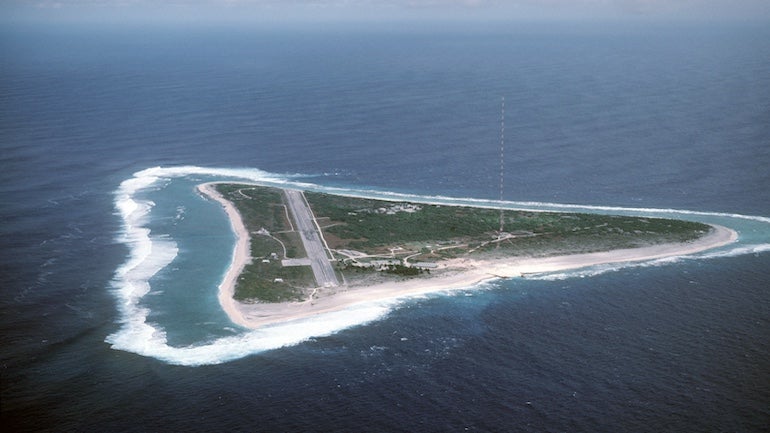
The mayor of a Tokyo village has expressed willingness to allow the government to conduct a survey on the suitability of Minami-Torishima Island, which is located at the easternmost edge of Japan’s territory in the Pacific, as an underground disposal site for high-level radioactive waste (HLW).
Minami-Torishima Island, which is Japan’s easternmost island and administered by Tokyo, is located about 1,950 kilometres southeast of central Tokyo and about 1,200 kilometres from Chichijima Island, where the village office is located. The island, with an area of 1.5 square kilometres, is entirely state owned.
“The decision (on whether to conduct the survey) should be made responsibly by the government,” Ogasawara Mayor Masaaki Shibuya said during a community meeting on Hahajima Island, part of the Ogasawara chain. Another meeting was held later on Chichijima Island.
Shibuya sought “firm assurances” that the site has not already been chosen, from the Tokyo-based quasi-governmental Nuclear Waste Management Organisation (NWMO) that runs high-level radioactive waste disposal projects. NWMO noted that, if the survey begins, the island will become the fourth such site. The first stage of the three-stage survey has been completed in Suttsu and Kamoenai in Hokkaido, and is currently underway in Genkai in Saga Prefecture.
Unlike the other three municipalities, however, Minami-Torishima Island, which is under the jurisdiction of the Tokyo Metropolitan Government, has no civilian population. Its only inhabitants are about 30 Japanese Maritime Self-Defense Force members and government personnel.
The survey begins either when municipalities apply or when the government seeks their consent, with participating municipalities receiving up to JPY2bn ($12.5m) in stipends. The first stage, a literature survey, takes about two years, while the entire process is expected to last around 20 years.
The Ministry of Economy, Trade and Industry sought consent from the Ogasawara village in March and explained the survey process and disposal methods to local residents in four sessions together with the NWMO.
Shibuya said he told the central government to increase the number of candidate sites and that he hopes the survey on Minami-Torishima Island “will foster broader public understanding and discussion regarding the disposal”.
Japan’s waste problem is a critical bottleneck for its energy policy, characterised by decades of accumulated waste and dwindling storage capacity. As of 2024, Japan had approximately 19,000 units of vitrified (glass-solidified) HLW stored across its facilities. Much of this waste is currently held at an interim facility in Rokkasho, Aomori Prefecture. As of mid-2025, this facility was 80% full and has a strict legal limit to house waste for no more than 50 years.
For over 20 years, the Japanese government has struggled to find a municipality willing to host a final disposal site due to intense local opposition and safety concerns. Japan is one of the most tectonically active regions on Earth. Finding a site without active faults or volcanic activity that can remain stable for the 100,000 years required for the waste to become safe is a monumental scientific challenge. Minami Torishima is seen as “promising” because it is state-owned, uninhabited and located far from major fault lines.
The proposed final disposal facilities are specifically designed for vitrified high-level waste (HLW) rather than used fuel, which is not considered “waste” but a resource to be reprocessed. Used fuel is sent to plants such as Rokkasho to extract usable uranium and plutonium for re-use as mixed-oxide fuel. The residual highly radioactive liquid is mixed with glass (vitrified) and poured into stainless steel canisters, which NWMO is tasked with burying at least 300 metres underground.


