
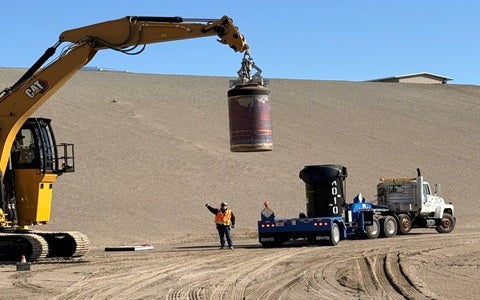
The US Department of Energy’s (DOE’s) Hanford Site in Washington state and its contractor, Central Plateau Cleanup Company (CPCCo) has completed permanent disposal of the first containers of vitrified low-activity tank waste. DOE said this is “a pivotal step in the nation’s tank waste cleanup mission and demonstrates progress toward steady‑state Direct‑Feed Low‑Activity Waste (DFLAW) operations, permanent disposal, reducing risks and delivering results for the American people”.
The Hanford site was used to produce plutonium over a 40-year period during WWII and the Cold War resulting in 56m gallons of radioactive and chemical wastes, which are now stored in 158 underground tanks. DOE contracted Bechtel National to design and build the Waste Treatment & Immobilisation Plant (WTP), the world’s largest radioactive-waste treatment plant, which was commissioned in December 2025.
The plant uses vitrification technology, which involves mixing the waste with glass-forming materials and heating it to 2,100 degrees Fahrenheit inside large melters. This mixture is poured into stainless steel canisters to cool and solidify into a glass form that will be stable and impervious to the environment while its radioactivity dissipates over hundreds to thousands of years. Each container holds 6.6 tonnes of waste. The Integrated Disposal Facility (IDF) received the first 25 containers in autumn 2025, staging them on a nearby concrete pad to prepare them for disposal.
“This is a proud and meaningful achievement for the entire Hanford team,” said Hanford Site Manager Ray Geimer. “Safely beginning disposal shows that the systems, facilities and people needed to support tank waste treatment are working together. Each container placed in the IDF reduces long‑term environmental risk and moves us forward on DOE’s commitment to protect the community and the environment.”


