
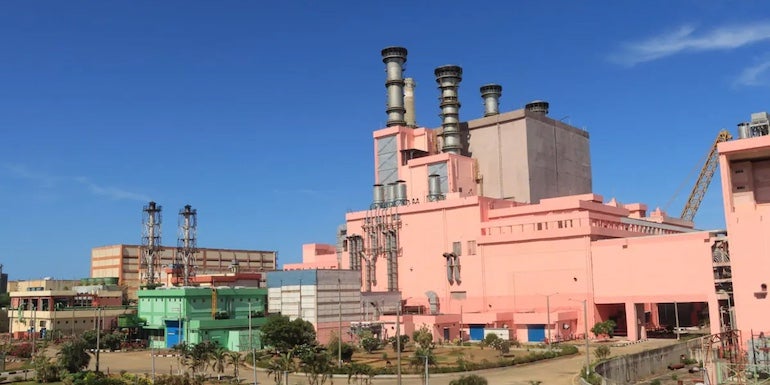
India’s 500 MWe Prototype Fast Breeder Reactor (PFBR) has achieved first criticality (start of controlled fission chain reaction) after meeting all the stipulations of the Atomic Energy Regulatory Board (AERB), which had issued clearance after a rigorous review of safety of the plant systems. This marks “a historic step in providing long-term energy security and advancing indigenous nuclear technology capabilities,” according to a Science Ministry press release.
The technology development and design of PFBR, a sodium-cooled fast reactor, was indigenously done by the Indira Gandhi Centre for Atomic Research (IGCAR), an R&D Centre of the Department of Atomic Energy (DAE). It was built & commissioned by Bharatiya Nabhikiya Vidyut Nigam Ltd (BHAVINI), a Public Sector Undertaking (PSU) under the DAE.
Attending the event was Dr Ajit Kumar Mohanty, DAE Secretary & Atomic Energy Commission (AEC) Chairman; IGCAR Director Shri Sreekumar G Pillai; Shri Allu Ananth, Acting Chairman & Managing Director at BHAVINI; and Shri KV Suresh Kumar, Former Chairman & Managing Director at BHAVINI & Homi Sethna Chair.
With the achievement of first criticality, India moves closer to realising its three-stage nuclear power programme. Fast breeder reactors (FBRs) represents stage two and forms the vital bridge between the current fleet of pressurised heavy water reactors (stage one) and the future deployment of thorium-based reactors (stage three), leveraging India’s abundant thorium resources for long-term clean energy generation.
India’s three-stage nuclear power programme was planned by physicist Homi Bhabha in the 1950s to to reduce dependence on imported uranium through the use of thorium reserves found in the monazite sands of coastal regions of South India.
“Today India takes a defining step in its civil nuclear journey advancing the second stage of its nuclear programme…the PFBR at Kalpakkam has attained criticality…it is a decisive step towards harnessing our vast thorium reserves,” Prime Minister Narendra Modi posted on X.
The PFBR uses uranium-plutonium mixed oxide (mox) fuel. The core is surrounded by a blanket of uranium-238. Fast neutrons convert fertile uranium-238 into fissile plutonium-239, enabling the reactor to produce more fuel than it consumes. The reactor is designed to eventually use thorium-232 in the blanket. Through transmutation, thorium-232 will be converted into uranium-233 in the third stage of India’s nuclear power programme. This enables India to extract far greater energy from its limited uranium reserves while also preparing for large-scale use of thorium in the future.
“The project also reflects the dedication of significant number of scientists, engineers, technicians and industry partners who have contributed to the design, fabrication and construction of the reactor using predominantly indigenous technologies and components,” the Ministry press release said. “Their efforts highlight the nation’s growing capability in advanced nuclear engineering and reinforce India’s commitment to technological self-reliance complying with Atmanirbhar Bharat [Self-Reliant India – a government campaign launched in 2020 with the goal of making India more self-sufficient].”
Beyond energy generation, the fast breeder programme strengthens strategic capabilities in nuclear fuel cycle technologies, advanced materials, reactor physics and large-scale engineering. The knowledge and infrastructure developed through this programme will support future reactor designs and next-generation nuclear technologies.
“The attainment of first criticality represents not only a technological milestone but also a major step towards a sustainable and self-reliant energy future for Viksit Bharat [Developed India – the government’s vision to transform the country into a fully developed nation by 2047, the 100th anniversary of its independence]”.
Anil Kakodkar, AEC Member and former DAE head, told The Hindu: “This is a historic moment. What this means is that we are now on our way to extract 80-100 times more energy from a given quantity of uranium.”
The PFBR was loaded with fuel in October 2025. It will be some months before it reaches full capacity and even longer before it produces useful electricity. Multiple experiments have to be conducted at low power to check it is operating after which the AERB must approve it for commercial power operation.
Once operational, the PFBR is expected to generate 500 MWe of electricity with a design life of 40 years. Current plans call for building six FBR-600 units, co-locating two reactors at each site to share common auxiliary systems and reduce costs. The first twin unit is planned at the BHAVINI premises at Kalpakkam, close to the PFBR.
Simultaneously, the Fast Reactor Fuel Cycle Facility (FRFCF) is under construction at Kalpakkam. It is designed to reprocess used fuel from FBRs and is expected to be completed by December 2027. This facility will be essential for closing the fuel cycle and extracting bred plutonium for use in future FBRs, according to documents on the DAE website.
Developing the PFBR was not an easy task. Construction of the PFBR began in 2004 and was originally scheduled to be completed in 2010. The project was delayed by approximately 16 years due to a combination of technical, financial, and external challenges. The 2004 Indian Ocean tsunami that struck the Kalpakkam site shortly after construction began required a re-evaluation of safety features and protective structures. Repeated delays caused the project cost to more than double, rising from an original estimate of about INR 35bn ($375m) to approximately INR77bn.
India’s PFBR is a pool-type reactor. In this design, the entire primary circuit (the core, pumps, and intermediate heat exchangers) is housed inside a single massive stainless steel main vessel filled with liquid sodium. Fabricating a vessel of that size (nearly 13 metres wide) to hold 1,150 tonnes of sodium at high temperatures while ensuring it could withstand seismic activity was a massive hurdle for Indian industry.
Because of India’s historical position outside the Nuclear Non-Proliferation Treaty (NPT), there was very little sharing of technical “know-how” from Russia or the West for the PFBR. India’s exclusion from the NPT also led to international trade bans, making it difficult to procure high-end nuclear components and technology.
India had to develop its own materials, such as specific grades of stainless steel (316LN) that could survive 40 years of sodium exposure without corroding or becoming brittle. Every component – from the sodium pumps to the steam generators – had to be designed and manufactured by Indian companies (such as L&T and BHEL) for the first time. India also had to integrated post-Fukushima safety requirements into a breeder design.
Handling liquid sodium is extremely complex as it reacts violently with air and water. Significant setbacks occurred during the commissioning of sodium pumps and secondary cooling systems. There were also persistent difficulties in producing the mixed oxide (mox) fuel elements required for the core.
Despite these difficulties, India’s nuclear programme is progressing. Currently India has a fleet of 18-20 pressurised heavy water reactors (PHWRs) that use natural uranium as fuel and produce plutonium-239 (Pu-239) as a by-product in used fuel – the first stage of the programme. With criticality of the PFBR it is now embarking on stage two.


