
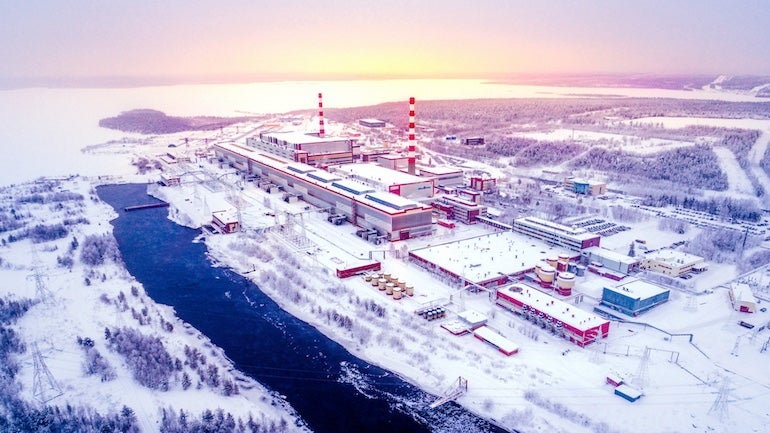
Russian nuclear utility Rosenergoatom and Titan-2 (both part of Rosatom) have signed a general contract agreement for the construction of two 600 MWe VVER-S reactors at the Kola-II NPP at Kola NPP-2. The project is being implemented in accordance with the General Scheme for the Location of Energy Facilities until 2042 and is aimed at ensuring reliable energy supply to the northwestern region of the country. Titan-2 will be general contractor for the project.
“The implementation of the Kola NPP-2 project is of strategic importance for the development of the region’s energy system. The signing of an agreement with Titan-2 allows us to move to the practical stage of work and ensure the systematic implementation of the project with the involvement of nuclear industry enterprises, said Igor Marakulin, Deputy Director of the Kola NPP under Development.
Igor Koshin, Director of the program for the construction Kola-II at Titan-2 noted: “We have the necessary competencies and practical experience in implementing complex infrastructure projects, and are ready to ensure high-quality construction and installation work of innovative VVER-S power units.”
The VVER-S (Spectral) is Rosatom’s next-generation “medium-power” reactor, designed to fill the gap between Small Modular Reactors (SMRs) and 1200 MWe units. The design has reached a critical “technical project” milestone, with the OKB Gidropress design bureau finalising the core physics for the 600 MWe version.
Traditional VVER reactors control the nuclear reaction by dissolving boric acid in the cooling water. While effective, this “soaks up” neutrons and wastes fuel. The VVER-S replaces most of this chemical control with mechanical spectral regulation. At the start of a fuel cycle, metal “displacement rods” are inserted into the core. These rods push water out, hardening the neutron spectrum (making neutrons move faster). These fast neutrons convert non-fissile
As the fuel is used up, the rods are slowly pulled out. Water rushes back in, slowing the neutrons down to burn the newly “bred” plutonium. The VVER-S can operate on a 100% mox (mixed oxide) fuel load, recycling plutonium from the used fuel of older reactors. Because it “breeds” and then burns its own fuel, it significantly reduces the amount of high-level radioactive waste produced per kilowatt-hour. Spectral regulation also allows the reactor to change its power output much more quickly than traditional plants, making it a perfect partner for unreliable wind and solar grids. By eliminating boric acid, the primary cooling circuit becomes less corrosive, extending the reactor’s lifespan to 60–80 years.
The “Technical Project” phase is slated for completion by the end of 2026. The first “lead” VVER-S unit will be at Kola-II. Rosatom aims to offer the VVER-S for export by 2030, targeting countries with mid-sized power grids that cannot handle a massive 1200 MWe plant.
The North-West region of Russia is traditionally characterised by high energy consumption with well-developed industry and port infrastructure. Currently the Leningrad and Kola NPPs jointly providing more than 35% of power generation.
Kola NPP is located 200 km south of Murmansk on the shores of Lake Imandra and comprises four VVER-440 units scheduled to retire in the 2030-2040s. Construction of Kola-II is included in the General Scheme for the Location of Electric Power Facilities to 2042, adopted at the end of 2024. Initially, it was planned to build not four, but three units planned for 2035, 2037 and 2042. It is expected that the fourth unit will be included in the next General Scheme for the Location of Electric Power Facilities to 2044.


