
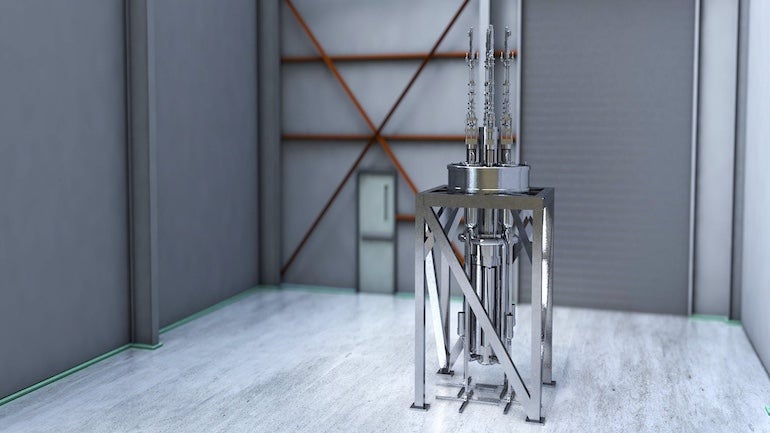
The US Department of Energy’s (DOE’s) Idaho Operations Office has approved a key safety document, the Preliminary Documented Safety Analysis (PDSA), for the MARVEL microreactor at Idaho National Laboratory (INL). The document which serves as the “safety basis” for the reactor‘s first nuclear experiments. It officially clears the project to conduct its “dry criticality” test – a near-zero-power experiment to validate the reactor’s physics before coolant is added.
The PDSA reflects the culmination of extensive safety calculations and engineering analyses that define the safety basis for MARVEL’s initial criticality. The PDSA affirms that the reactor can operate safely under this configuration and paves the way for final safety documentation and full assembly of the reactor.
The MARVEL (Microreactor Applications Research Validation and Evaluation) unit is a sodium-potassium-cooled test bed designed to generate 85–100 kWt and approximately 20 kWe. It is intended to help private-sector companies, such as Amazon Web Services and GE Vernova, to test how microreactors can power data centres and industrial processes.
Earlier in March, researchers unveiled the first new microreactor control system built in decades, which uses control drums instead of traditional rods to regulate the fission reaction.
The project is currently finalising requirements for the full assembly of the reactor. Fuel delivery for MARVEL is expected in mid-2026 (specifically July/August), with fuel loading anticipated shortly thereafter. The initial “dry criticality” experiment is slated for 2027. The reactor is expected to achieve full-power operations by 2028, initially focusing on electricity generation followed by process heat applications.
“This is more than just a regulatory requirement – it’s a blueprint for the future of advanced nuclear,” said INL’s Abdalla Abou-Jaoude, MARVEL microreactor lead. “By receiving approval for our safety documentation, we are now able to share this template with developers to learn from our process and streamline their own timelines.”
John Jackson, National Technical Director for the DOE Office of Nuclear Energy’s Microreactor Program, noted: “This is a pivotal moment. We’re proud to play a leading role in helping to make microreactors commercially available.”
The PDSA builds on a 2024 version and incorporates updated modelling, lessons learned and a risk-informed methodology – an approach that uses risk analysis to guide design decisions and enhance safety. MARVEL’s approach has already influenced other DOE-authorised reactor projects such as Pele, the Molten Chloride Reactor Experiment and the Versatile Autonomous Lightweight Kilowatt-class Reactor Experiment, commonly known as VALKRE.
Researchers will conduct the dry criticality experiment at INL’s Transient Reactor Test Facility, a DOE-authorised research facility that supports a variety of reactor experiments. The next phase includes engagement with DOE-Idaho and project stakeholders to finalise the safety basis for full reactor assembly and fuel loading. This phased approach is designed to identify and address potential issues earlier in development.


