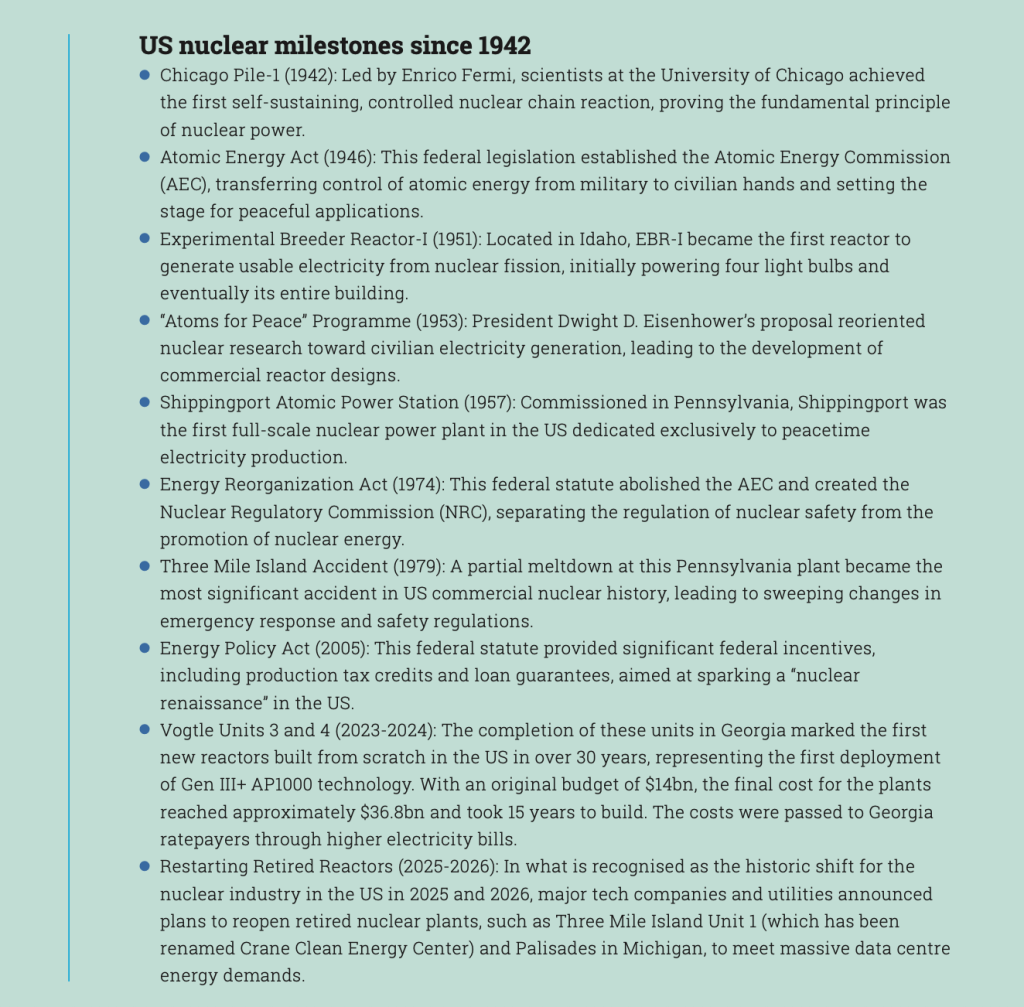
Since 1920, nuclear power generation in the US has evolved from experimental physics to a major component of the national energy grid. Significant technological breakthroughs and regulatory changes have triggered a modern resurgence. According to the US Energy Information Administration, nuclear power is projected to maintain a consistent 18% share of national electricity generation in 2026, similar to 2025 levels even while the overall consumption of electricity in the US has hit record highs. Nuclear power generation nonetheless is a major component of the low-carbon energy mix.
However, nuclear energy expansion in the US dropped after 1990 due to high construction costs, long project timelines, and competition from cheap natural gas. Following the 1979 Three Mile Island accident, stricter regulations, public opposition, and slowing electricity demand led to widespread project cancellations and a halt in new orders for decades.
In early 2026, the convergence of federal policy shifts and massive private investment is rapidly accelerating the deployment of nuclear energy for industrial use. To meet the goal of significantly expanding US nuclear capacity, both the Biden and Trump administrations have implemented several landmark legislative and regulatory reforms. The Biden Administration’s ADVANCE Act (2024) was passed with bipartisan support. It requires the NRC to take a number of actions, particularly in the areas of licensing of new reactors and fuels, while maintaining the NRC’s core safety and security mission. The Act affects a wide range of NRC activities, including by supporting the recruitment and retention of the NRC workforce, adding flexibility in the NRC’s budgeting process, enhancing the regulatory framework for advanced reactors and fusion technology, and requiring initiatives to support the NRC’s efficient, timely, and predictable reviews of license applications. In part, the statute will reduce regulatory fees for advanced reactor applicants starting in FY 2026 and will implement a “rewards” system to incentivise and develop new technology.
As early as 2023, the NRC began development of a new, technology-inclusive licensing framework. Unlike older rules, the new programme is performance-based, allowing engineers to prove safety through data rather than following rigid, decades-old design prescriptions.
The US Department of Energy (DOE) also developed a fast-track pilot programme whereby specific advanced reactors can achieve “criticality” at non-federal sites as early as 4 July, 2026, bypassing some traditional NRC licensing steps for initial testing.
In September 2025, the NRC submitted a report to Congress addressing matters specified in the Advance Act which requires the NRC to implement strategies or a rulemaking to “enable efficient, timely, and predictable licensing reviews for, and to support the oversight of, production and utilization facilities at brownfield and/or retired fossil fuel sites.” New rules would be designed to simplify the environmental review process for building nuclear plants on retired coal or fossil-fuel sites, with the objective of leveraging existing grid connections to avoid years of construction time.
On 23 May, 2025, President Trump signed four Executive Orders (EOs) aimed at quadrupling US nuclear capacity to 400 GW by 2050 by accelerating licensing, reforming the NRC, and boosting fuel supply. The orders focus on speeding up reactor deployment, particularly for AI infrastructure, and enhancing national security.
Ordering the Reform of the Nuclear Regulatory Commission (EO 14300): Directs the NRC to modernise its culture, streamline licensing, and reduce bureaucracy to accelerate approval of reactor designs, with a goal of evaluating new licenses within 18 months.
Reforming Nuclear Reactor Testing at the Department of Energy (EO 4301): Establishes a DOE test reactor pilot program to expedite the review, approval, and deployment of reactors at DOE and national lab sites.
Reinvigorating the Nuclear Industrial Base (EO 14302): Focuses on strengthening the domestic nuclear fuel cycle, increasing uranium conversion / enrichment, and encouraging nuclear workforce development.
Deploying Advanced Nuclear Reactor Technologies for National Security (EO 14299): Directs the US Department of Defense, to operate a reactor at a domestic military base, increases nuclear technology exports, and establishes the National Environmental Policy Act categorical exclusions for reactor construction on federal sites.
New nuclear drivers
Reducing carbon emissions is a major driver behind the development of modern nuclear power technologies. Nuclear serves as a reliable, baseload, low-carbon energy source and will help meet “Net Zero” goals by providing 24/7 power and serving as an alternative to fossil fuels.
The demand for energy required by artificial intelligence data centers is another significant force behind development of new nuclear power technologies. The International Energy Agency (IEA) projects that global data centre electricity consumption will reach 620-1050 TWh by 2026, contributing to an estimated 290-490 million tonnes of carbon emissions globally. To support AI, over 4000 data centers are in operation today in the US, with nearly 3000 more planned or under construction. The heaviest concentrations are in Virginia, Texas, and California. Major hubs include Northern Virginia (known as Data Center Alley), Dallas, Silicon Valley, and emerging spots in Ohio, Arizona, and Oregon.
A report prepared by the Union of Concerned Scientists states that, “Without stronger clean energy policies, the additional fossil fuel generation used to power data centres results in an increase in annual US power plant emissions of carbon dioxide (CO2) of 19 to 29% (229 to 342 million tonnes) by 2035”. And the environmental benefits of nuclear power? In 2026, the environmental impact of nuclear energy for data centres is increasingly quantified by the “carbon avoidance” it provides over natural gas given gas is the dominant alternative to provide reliable 24/7 power to the grid.
The DOE summarises nuclear as the largest source of clean power in the United States. It generates nearly 775 TWh of electricity each year and produces nearly half of the nation’s emissions-free electricity. This avoids more than 471 million tonnes of carbon each year, which is the equivalent of removing 100 million cars off the road.
Technologies and projects that are shaping the industry
A surprise to many is that the US is the world’s largest producer of nuclear electricity. Domestically, nuclear electricity accounted for 19% of the country’s electricity generation in 2024. There are currently 54 commercially operating nuclear power plants with 94 nuclear power reactors in 28 states in the US. Illinois has 11 reactors, the most in any state. Of the 54 operating nuclear power plants, 19 have one reactor, 31 have two reactors, four have three reactors, and one has four reactors.
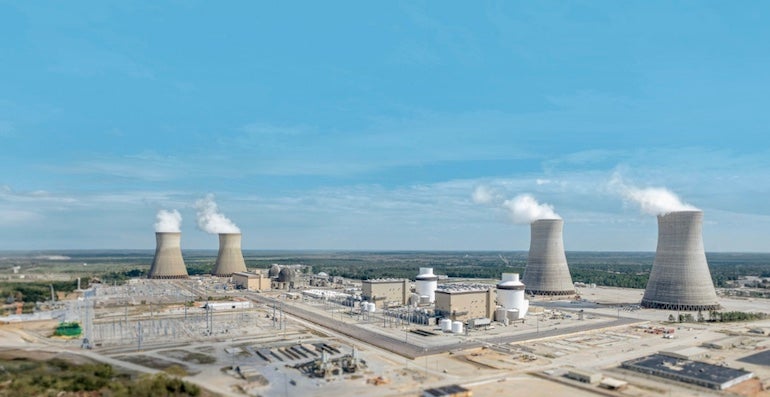
In spite of the hurdles, a consortium of utility partners succeeded in completing the newest nuclear reactor to enter service in the US. After 15 years of design, regulatory, and financial struggles, the Vogtle Unit 4 at the Alvin W. Vogtle Electric Generating Plant in Georgia began commercial operation in April 2024.
Construction at the two new reactor sites began in 2009. Originally expected to cost $14bn and begin commercial operation in 2016 (Vogtle 3) and in 2017 (Vogtle 4), the project ran into significant construction delays and cost overruns. Georgia Power now estimates the total cost of the project to be more than $30bn. Vogtle Units 3 and 4 are the first and only US deployments of the AP1000 Generation III+ reactor.
The Alvin W. Vogtle plant is now the largest US nuclear power plant with four reactors. The R.E. Ginna Nuclear Power Plant in New York is the smallest nuclear facility with one reactor. The smallest individual reactors are the two units at the Prairie Island nuclear plant in Minnesota.
What’s happening now?
TerraPower, a Bill Gates company aims to see nuclear power emerge in the middle of ‘coal country’ in the town of Kemmerer, Wyoming. In a project that’s been more than 15 years in the making TerraPower is designing and building a next-generation sodium-cooled fast reactor power plant called the Natrium plant. Commercial operations are potentially scheduled for as soon as 2030. The Natrium reactor is a 345 MW unit coupled with TerraPower’s molten salt energy storage system, providing built-in gigawatt-scale energy storage. According to TerraPower this makes the plant a perfect support for high-renewable penetration grids where variable power output is a concern.
A $4bn project – $2 bn of which will ultimately come from the US Department of Energy pursuant to its Advanced Reactor Demonstration Program (ARDP), the Natrium plant will include a capability of ramping up to 500 MW for short periods of time. The reactor will use high-assay, low-enriched uranium (HALEU) fuel.
On 9 January, 2026, TerraPower and Meta announced an agreement to develop up to eight Natrium reactor and energy storage system plants in the US. Acknowledged as Meta’s largest investment in advanced nuclear technology, Meta will get up to 2.8 GW of carbon-free baseload energy and up to 4 GW at peak. Under the commercial agreement, Meta will provide funding to support the deployment of the Natrium plants, with delivery of the initial units as early as 2032.
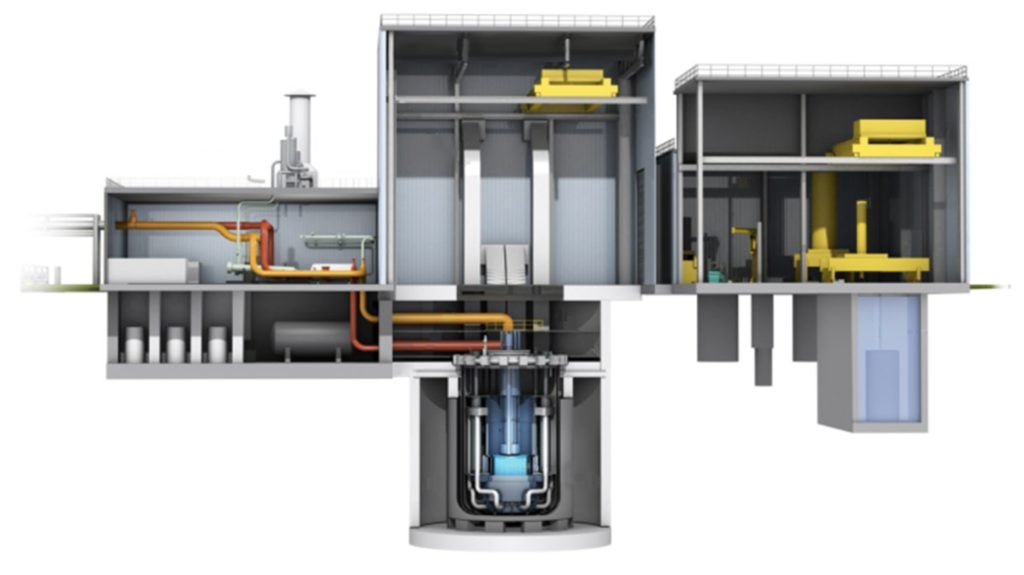
While the TerraPower development is significant, the US Department of Energy has selected the Tennessee Valley Authority (TVA) and Holtec Government Services to receive up to $400m each in cost-shared funding for early deployment of advanced small modular reactors (SMRs).
TVA will build the GE Vernova Hitachi BWRX-300 reactors at its Clinch River site. The federal funding will also assist TVA in its plans to deploy other SMRs in partnership with Indiana Michigan Power and Elementl. Holtec will build its SMR-300 units at the Palisades plant in Michigan, aiming for early 2030s operation.
Meanwhile, 1 MW portable microreactors designed to replace diesel generators are also under development in the US. Radiant Nuclear has announced that it plans to test Kaleidos, a 1 MW portable, gas-cooled nuclear microreactor at Idaho National Laboratory’s DOME facility in the summer of 2026. The trailer-sized unit is intended for military bases and remote, critical applications, with initial customer deployments scheduled to begin in 2028.
Beyond the US, globally as of mid-2025, there were over 127 identified small modular reactor designs at various stages of development, with over 30 countries actively exploring their deployment. While many are in conceptual stages, seven designs are either currently operating or under construction in countries like China and Russia.
The Future? A complex balancing act
The future of nuclear energy in the US stands at a critical juncture, balancing the urgent necessity of carbon-free baseload power against significant economic and logistical headwinds. While the resurgence of interest in SMRs and advanced, next-generation technologies offers a pathway to faster, safer, and more flexible deployment, the industry must overcome high capital costs, supply chain limitations, and regulatory challenges to succeed.
To achieve ambitious net-zero carbon emission goals, provide electricity for thousands of AI data centres that are now operating and planned, and to ensure grid reliability, a sustained commitment from both the public and private sectors is required to modernise the nuclear industrial base and secure public trust. Ultimately, nuclear power is poised to remain a foundational pillar of the US energy portfolio, but its long-term viability will depend on the successful, on-budget rollout of new, innovative designs.