
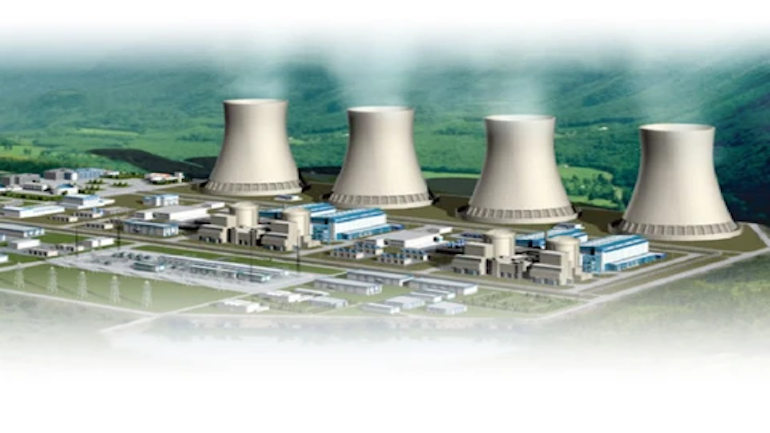
Vietnam’s National Assembly has adopted a resolution approving agreements to build the Ninh Thuan 1 NPP in Phước Dinh Commune, Thuận Nam District. This approval revives the nation’s nuclear sector after a decade-long pause, positioning Russia’s state nuclear company Rosatom to construct a 2,400 MWe facility featuring two Russian-designed VVER-1200 reactors with the Leningrad-II NPP as the reference plant.
The project is based on a foundational legal framework established during Prime Minister Pham Minh Chinh’s four-day diplomatic visit to Moscow in March, after which Rosatom and Vietnamese officials sign an updated intergovernmental cooperation agreement, establishing a new legal framework to revive construction.
This originates from the project’s original inception in 2009–2010, before the programme was scrapped in 2016 due to severe public economic concerns and skyrocketing projected costs. In recent years, lawmakers petitioned the government to resume the programme, clearing the path for the new intergovernmental agreement and this final parliamentary approval.
The revived agreement includes an $8bn inter-governmental export credit agreement provided by Russia to finance the vast majority of the construction costs. The loan is structured to cover up to 85% of the total design and construction costs for Ninh Thuan 1. Vietnam’s state utility, Electricity of Vietnam (EVN), is responsible for securing the remaining 15% via domestic equity and local capital markets.
The loan framework specifically finances a complete turnkey model. This means it does not just cover the physical VVER-1200 reactors, but also includes the initial site preparation, engineering documentation, immediate safety infrastructure, and fuel supply contracts. The framework also covers adjacent strategic initiatives, including the construction of a separate Centre for Nuclear Science and Technology (CNST) in Hanoi and long-term training of hundreds of Vietnamese nuclear engineers at Russian universities.
The loan was originally agreed in 2010 and the funds remained earmarked by the Russian government even after Vietnam temporarily paused the project in 2016. The reactivated framework adjusted the deployment milestones to align with Vietnam’s new accelerated target to bring the station online between 2030 and 2035.
Vietnam is now targeting aggressive annual economic growth of at least 10%. This is heavily driven by rapidly expanding investments in semiconductors, artificial intelligence (AI), and data centres, which require vast amounts of uninterrupted electricity. Under the revised Power Development Plan VIII (PDP8), Vietnam plans to expand its total energy capacity from 82.4 GWe to up to 236.4 GWe by 2030.
While solar and wind are growing massively, nuclear will provide the necessary stable baseload capacity. Recent geopolitical tensions in the Middle East caused fuel import price spikes (+50% for petrol, +70% for diesel), forcing Hanoi to shift away from fossil fuels toward nuclear energy and long-term Russian LNG partnerships.
The assembly voted by an overwhelming 95.2% majority to split the original Ninh Thuan nuclear programme into three independent projects, allowing each individual plant to clear investment approvals separately and expedite deployment. The three independent, standalone projects include:
- Ninh Thuận 1 – the Rosatom project;
- Ninh Thuận 2 – This covers the second nuclear power facility at Vĩnh Hải, with project documentation and investor-partner participation managed by PetroVietnam (PVN); and
- The Compensation, Support, and Resettlement Project – a dedicated, standalone civil project specifically designed to handle land clearance, citizen relocation, and local infrastructure compensation across the 1,642-hectare site footprint.
Under the original 2009 programme framework, all components were bundled together as a single mega-project. This created legal bottlenecks because a delay in local land resettlement or a change at one plant completely froze the investment approvals and financing for the other. By splitting them, Vietnam allows EVN and PVN to advance their respective power plants independently through the regulatory pipeline, drastically accelerating the overall timeline.
Ninh Thuận 2 in Vĩnh Hải Commune, Ninh Hải District is slated for standard pressurised water reactors (PWRs), with the specific reactor model open to bidding. Originally, Japan (Japan Atomic Power Company) was the designated partner but withdrew earlier this year due to the aggressive construction timeline required by Hanoi.
PVN signed a memorandum of understanding (MOU) with South Korea’s Kepco in April to cooperate on development. Simultaneously, South Korean President Lee Jae-myung and Vietnamese President To Lam established an intergovernmental working group to map out financial models. Additional interest has been officially logged from nuclear technology firms in France and the US.
Vietnam’s Ministry of Industry & Trade (MIT) has mandated that the selected foreign vendor must fulfil a strict 30-60% local content requirement. Rather than treating Ninh Thuận 2 as a standard import project, Hanoi is leveraging it to seed a domestic high-tech nuclear supply chain, using state-owned PVN as the industrial anchor.
In the early phases of construction, the foreign vendor must source at least 30% of materials, structural steel, and non-nuclear components directly from Vietnamese factories. This target scales up to 60% as the regional nuclear ecosystem matures. The selected partner must legally agree to transfer technical designs and advanced manufacturing intellectual property. This ensures local heavy industrial firms can independently manufacture structural segments and replacement components for future reactors.
A mandatory condition of the upcoming partner selection is that the foreign vendor must actively integrate Vietnamese industrial enterprises into their global commercial nuclear value chains.
This aggressive target is a major reason why Kepco emerged as the leading candidate. Major South Korean industrial giants like Doosan, Samsung, and LG already possess massive manufacturing networks inside Vietnam. Doosan in particular has heavy industrial factories in central Vietnam capable of transitioning to nuclear-grade component fabrication. Kepco has already launched a dedicated team to structure the requested under-3% interest concessional loan.
PVN is using its specialised engineering subsidiaries such as PTSC (PetroVietnam Technical Services Corporation) and PV GAS. PTSC already boasts world-class maritime engineering capabilities, deep-water port facilities, and precision heavy steel welding capacity developed from building massive offshore oil, gas, and wind installations.
MIT and PVN are organising site surveys across Vietnamese heavy industrial zones to audit local sub-contractors. These factories must upgrade their certifications to meet international nuclear-grade quality standards before primary site construction begins.
A final decision on the preferred strategic partner is slated for the third quarter of 2026. Other potential bidders include:
- France’s state-owned EDF is pitching its EPR (European Pressurised Reactor) or its scaled-down EPR1200 variants, which are specifically designed to meet mid-sized baseload grid deployments. France is strongly positioning itself on the strict safety standards and regulatory compliance frameworks Vietnam is currently writing into its updated Atomic Energy Law.
- US-based Westinghouse), which has expressed formal interest through diplomatic and commercial channels is offering its AP1000 PWR. Westinghouse has long-standing interest in Vietnam’s nuclear sector, having initially pitched the AP1000 prior to the 2016 programme freeze and is arguing the need for geopolitical balance against a purely Russia-backed energy grid. However, strict export controls on advanced intellectual property and complex financing mechanisms make meeting the full technology transfer and “sub-3% interest loan mandates highly challenging for a US commercial entity.
- China (CNNC/CGN), considered a “dark horse” contender, is offering its Hualong One (HPR1000) reactor. China possesses the fastest domestic nuclear construction supply chain in the world and ample state capital to easily absorb the sub-3% financial requirements. However, deep-seated geopolitical tensions regarding South China Sea maritime boundaries make a Chinese project politically highly sensitive for the Vietnamese parliament.


