
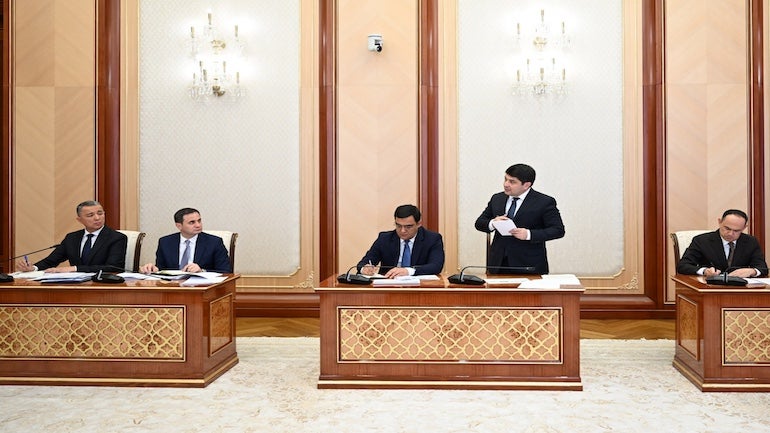
Uzbek President Shavkat Mirziyoyev has reviewed a presentation of progress on construction of an integrated nuclear power plant and the development of a modern satellite town in the Jizzakh region. The development of nuclear energy is of strategic importance for strengthening Uzbekistan’s energy security, creating stable baseload generating capacity, and diversifying energy sources.
A contract was signed with Rosatom in May 2024 for two 55 MWe low-power NPPs (ASMM – Atomnoi Stantsii Maloi Moshnosti) with a RITM-200N reactors. First concrete was poured in June in the Farish district of the Jizzakh region for the first unit. In March a roadmap for nuclear cooperation was signed by Rosatom and Uzatom as well as an additional agreement to the contract for NPP construction expanding the scope of the ASMMs to also include two VVER-1000 reactors on the same site. When the NPP is fully operational, it will generate about 17.2 TWh a year, providing up to 14% of Uzbekistan’s total energy needs and save more than 3.5bn cubic metres of gas annually. Documents related to the expanded project signed in September 2025 were formalised as a contract.
To date, excavation of the foundation pit for the reactor building has been fully completed, with more than 1m cubic metres of soil removed. A total of 916 cubic metres of concrete has been poured for the foundation slab. Earthworks have been completed across 100 hectares at the construction and installation base. Currently, 450 workers and specialists are working at the construction site, supported by more than 100 units of specialised equipment.
The total cost of the project is $9.5bn. About 3,000 types of products and equipment are expected to be used during construction. According to preliminary estimates, locally produced goods account for 21% of the project, equivalent to $1.9bn. President Mirziyoyev noted that this is not enough. The task was set to increase the share of domestically produced goods in the project to at least 30%, ensure that domestic enterprises carry out 65% of construction and installation work, and involve 7,000 local workers and specialists.
For this purpose, it was proposed to establish a 200-hectare industrial zone in the Farish district specialising in the production of construction materials. The zone is expected to accommodate at least 100 joint ventures and localise production in 15 areas through technology transfer. Mirziyoyev approved the proposal and instructed that a draft resolution providing tax and customs benefits for participants in the industrial zone be submitted by the end of the year.
It was particularly emphasised that construction quality and safety must remain an absolute priority and that all work must fully comply with International Atomic Energy Agency (IAEA) requirements and international standards. During the presentation, it was noted that a comprehensive IAEA assessment mission took place in June resulting in a high assessment of the level of development of Uzbekistan’s national nuclear infrastructure.
As part of the development of the plant’s external engineering infrastructure, 388 kilometres of power lines, a 110-kilovolt substation, 21 kilometres of drinking water pipelines, 120 kilometres of technical water supply pipelines, 39.5 kilometres of roads, and 11 kilometres of railway lines will be built. The President emphasised the need to ensure that locally produced goods and services account for 60–70% of the construction of these facilities.
A project for a town for nuclear specialists was also reviewed to provide suitable living conditions for workers, specialists, and their families during the construction period. The 200-hectare development will include about 10,000 apartments for nearly 33,000 residents, including 3,000 apartments in the first phase. The town will feature energy-efficient multi-story residential buildings, schools and preschools, healthcare, sports and cultural facilities, recreation areas, and extensive green spaces. Modern thermal insulation technologies, alternative energy sources, and smart lighting systems will be used in its construction.
To improve project management, strengthen technical oversight, and conduct independent reviews of technological solutions, it was proposed to establish a joint venture with leading foreign engineering companies. Measures were also identified to adapt and introduce about 1,000 industry standards into the national system.
The need to begin targeted training of highly qualified operators, engineers, and radiation safety specialists who will operate the plant in the future was also noted. Since 2023, 216 students have graduated from the Tashkent branch of the Russian National Research Nuclear University. Of these, 83 are continuing their studies in master’s and doctoral programmes at leading universities in China, Hungary, France, Italy, and the Republic of Korea. Another 100 specialists are being trained at four higher education institutions in Uzbekistan.
Taking into account the expanding functions of the Uzatom Agency and the NPP Construction Directorate, proposals for the phased strengthening of their organisational and human resource capacity were also reviewed. Uzbekistan is the world’s fifth-ranking uranium supplier. It has also had two research reactors, a 10 MW tank type – WWR-SM – which has been operating since 1959 at the Institute of Nuclear Physics, Uzbek Academy of Sciences near Tashkent, and a small 20 kW one operated by JSC Foton in Tashkent which was decommissioned between 2015-19.


