
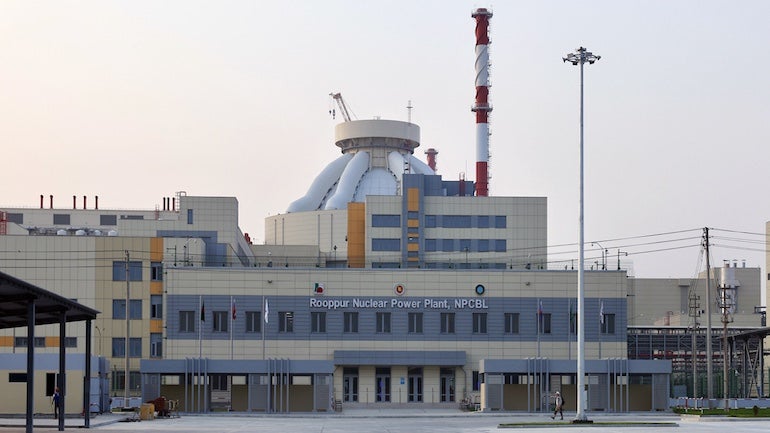
Bangladesh’s Science & Technology Minister, Fakir Mahbub Anam, has said the timeline for starting power supply from the first unit of the Rooppur NPP to the national grid is being pushed back due to problems with safety valves. He told a press conference that he could not provide a specific timeline for when the safety valve problems would be repaired or when the first unit would begin supplying electricity.
The Rooppur plant is being built by Rosatom on the eastern bank of the Ganges River in the Pabna district of Bangladesh, about 160 km northwest of Dhaka. It will comprise two VVER-1200 reactors. In November 2011, Russia and Bangladesh signed an inter-governmental agreement on cooperation in the construction of the NPP, and in mid-December 2015 a general contract worth $12.65bn was signed. Construction of unit 1 began in November 2017 and unit 2 in July 2018. The plant’s design life is 60 years, with the possibility of extending its operating life for another 20 years. Fresh fuel for the units was delivered to the site in the latter part of 2023. An operating licence was issued by the Bangladesh Nuclear Regulatory Authority earlier in April.
Anam said preparatory tests began on 28 April at Rooppur unit 1 ahead of fuel loading. At that stage, the target was to begin supplying electricity to the national grid within four to six months. Tests have now been completed through several stages, with Stage B completed. However, the plant cannot proceed to Stage C because of problems with two safety valves.
“We cannot say anything specific at this moment. A team of experts will come from Russia to determine why the safety valves are not working. The actual cause of the problem will be known after their examination and assessment,” he said.
The added that the project designer’s assessment indicated that the two safety valves might need to be completely replaced. Two options are being considered. One is to take the valves allocated for the second unit and install them in the first unit. The other is to ask Rosatom to manufacture and supply new valves as quickly as possible.


