
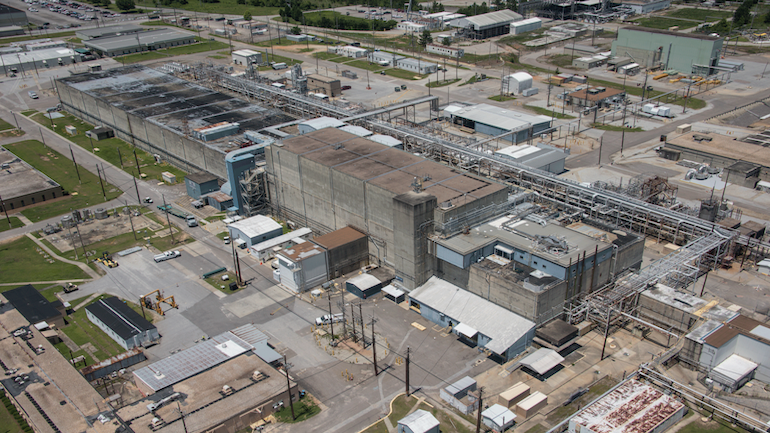
The US Department of Energy’s (DOE) Office of Environmental Management (EM) is restarting uranium recovery operations at the Savannah River Site (SRS) H Canyon facility in South Carolina. DOE said this marks a strategic step forward in strengthening America’s nuclear industrial base and advancing energy independence. The decision enables the facility to once again recover uranium and valuable isotopes through its chemical separations capabilities while continuing to safely process used nuclear fuel as part of the site’s cleanup mission.
The decision to restart uranium recovery will produce high-assay low-enriched uranium (HALEU) needed for advanced reactors and will create an opportunity to recover valuable isotopes with limited availability and is intended to demonstrate America’s capability to manage the complete nuclear fuel cycle.
The restart is in line with two of the four Executive Orders (EOs) signed by President Donald Trump in May 2025: EO 14302 – Reinvigorating the Nuclear Industrial Base and EO 14299 –Deploying Advanced Nuclear Reactor Technologies for National Security, which call for jumpstarting America’s nuclear industrial base.
The current inventory of used nuclear fuel at SRS contains enough highly enriched uranium to create as many as 19 tonnes of HALEU, enough to fuel several proposed small modular reactors. Recovering uranium from used fuel before final disposal also reduces the number of high-level waste canisters needed, advancing EM’s cleanup mission by reducing long-term risks and cost.
“Thanks to President Trump’s leadership, we’re maximising the value of existing assets, supporting national security objectives and advancing our cleanup mission, all while supplying America’s next generation of advanced nuclear reactors,” said EM Assistant Secretary Tim Walsh.
H Canyon, the only operating, production-scale, radiologically-shielded chemical separations facility in the US, began operations in the early 1950s. The facility’s operations historically recovered uranium and neptunium from fuel tubes used in nuclear reactors at the Savannah River Site, to produce radioactive materials needed for nuclear weapons. After the end of the Cold War, the facility’s mission changed to one of non-proliferation and environmental clean-up.
The interior of the facility resembles a canyon. Most operations in the facility are executed from a control room using remote control cranes. One side of the canyon is considered “hot” because it has higher radiation levels, while the other side of the canyon is “warm” because it has lower radiation levels. No one has been inside the “hot” side of the canyon since it began operation.
Employees who work in the building are protected from radiation by the thick, steel-reinforced concrete walls. Irradiated used fuel rods are transported to H Canyon in shielded cask cars from L Area storage. The used fuel rods are dissolved in nitric acid. Uranium liquid, also known as Target Residue Material, is also received from the Chalk River Facilities in Canada. The uranium from these sources is recovered through a complex chemical process, including solvent extraction cycle operations. The cycles remove impurities that are present in the feed. The impurities are then transferred to waste management facilities.
The uranium is down-blended with natural uranium and loaded into shipping containers for shipment off-site. Blending down uranium not only makes it undesirable for use in nuclear weapons, but also enables it to be converted to fuel rods and used in commercial nuclear reactors operated by the Tennessee Valley Authority to make electricity. H Canyon is also being used as a “test bed” for new technologies, allowing outside parties to test in a real-life operating facility.

Read also: Savannah River seeks AI developers


