
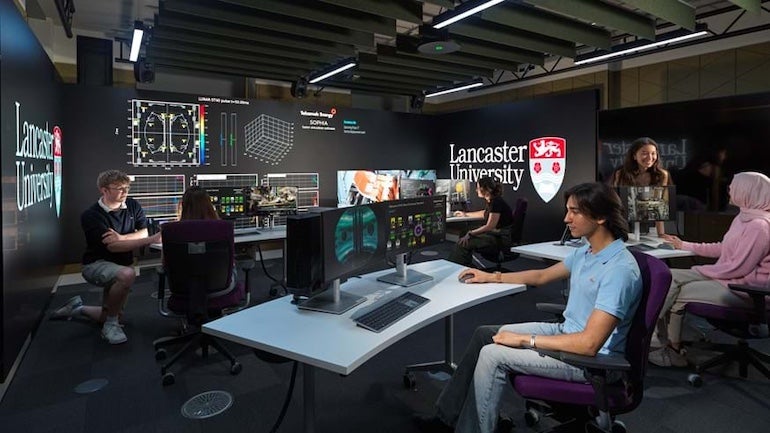
Lancaster University in the UK has launched a nuclear facility control room simulator that will offer a ‘high-fidelity’ deeply immersive learning experience for its students across subjects such as nuclear engineering and cyber security.
The Lancaster University Nuclear Operations Simulator (LUNOS) is a £2m $2.69m) facility funded by the UK Office for Students. It stands as the first of its kind in the UK due to its unique, highly reconfigurable architecture capable of mimicking multiple reactor types. Key operational features and capabilities of this new facility include multi-reactor fission & fusion modelling. Unlike static, single-technology platforms, the software can quickly pivot to simulate distinct power generation models.
These models are built using industry-grade source code from global organisations such as Westinghouse, GSE Solutions, Tokamak Energy, and Norway’s Institute for Energy Technology. They include pressurised water reactors (PWRs), small modular reactors (SMRs), and tokamak fusion reactors.
The physical space is built to reflect true-to-life operating environments. Wrap-around displays feature a massive, three-sided immersive screen setup that serves as a plant-wide overview. Students can physically move furniture and consoles to match the exact layouts of different real-world control rooms. Advanced digital operator workstations match modern control room frameworks.
The simulator serves several distinct academic and national strategic targets including:
- Cyber Security – providing high-fidelity scenarios where nuclear facilities undergo simulated cyberattacks, training professionals to protect critical national infrastructure.
- Nuclear Engineering – allowing undergraduate, master’s, and doctoral students to put theoretical concepts into hands-on practice.
- Human Factors & Psychology – the university’s psychology department uses the facility to track human behaviour, safety protocols, and group decision-making under high-stress emergency conditions.
- Advanced Session Replay – including multi-stream recording software that bundles audio, video, screen captures, data logs, and instructor-led malfunctions into a single playback file for deep post-scenario reviews.
The facility is located directly on the main campus next to the Data Immersion Suite, the facility will officially welcome its first cohorts of students starting in the autumn academic term.
“This fabulous new facility will augment Lancaster’s long-established strength across disciplines such as nuclear engineering and cyber security, providing our students with a truly excellent learning experience,” said Professor Rebecca Lingwood, Deputy Vice-Chancellor at Lancaster University. “Lancaster University plays a vital role as an economic anchor institution in north-west England and this facility will further enable us in helping to deliver a new generation of young people equipped with the skills needed to support a low-carbon energy sector vital for national energy security, as well as a critical sector for the region’s economy.”
Lancaster University was one of the first UK universities accredited by the National Cyber Security Centre as an Academic Centre of Excellence in Cyber Security Research and Education. In addition, it currently hosts the only single honours Nuclear Engineering undergraduate programme in the UK. It has one of the UK’s strongest nuclear science and technology research communities with expertise across the fission and fusion fuel cycles, nuclear medicine, nuclear security and safeguards.
Professor Paul Smith, Chair in Networking and Principal Investigator of the initiative, said: “This high-fidelity simulator will enable us to create simulations of scenarios where nuclear facilities are cyber attacked, providing valuable in-depth learning experiences for our cyber security students, some of which may become future cyber security professionals protecting our critical national infrastructure.”


