
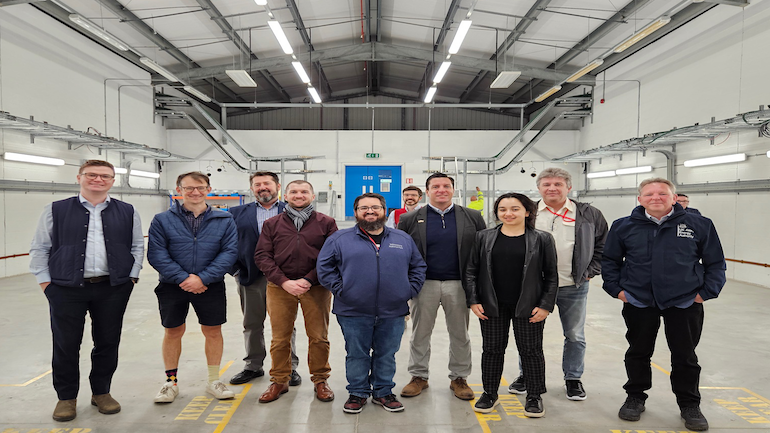
TAE Beam UK is now formally established and fully funded at the UK Atomic Energy Authority (UKAEA) Culham Campus to commercialise advanced particle accelerator technology. This joint venture between US private fusion firm TAE Technologies and UKAEA builds on a strategic partnership announced in 2025 combining American patented intellectual property with UK operational fusion expertise.
TAE Beam UK’s technical programme will begin with the development of neutral beams, a critically enabling particle accelerator technology to heat and sustain fusion reactions for electricity generation. It is funded by a £5.6m ($7.5m) equity investment from UKAEA supported by a nine-figure investment from TAE Technologies to fulfil its internal reactor development needs. The venture aims to deliver its first short-pulse particle beams within 18 to 24 months of starting technical operations. This venture runs parallel to TAE’s existing UK footprint, which includes its power management subsidiary, TAE Power Solutions, located in the West Midlands.
TAE Technologies is one of the world’s oldest, largest, and highest-funded private fusion energy companies. The company, founded in 1998 and headquartered in Foothill Ranch, California, spent its first decade operating in near-total stealth. Instead of traditional magnetic confinement such as tokamaks, TAE developed a non-traditional, ultra-clean fuel cycle using a unique linear reactor design.
The science behind TAE began at the University of California, Irvine (UCI) in the early 1990s. Canadian plasma physicist Dr Norman Rostoker recognised major engineering limitations in mainstream fusion designs (such as the massive scale and radioactive tritium fuel required by tokamaks). Alongside his PhD student Dr Michl Binderbauer (now TAE CEO), Rostoker co-founded the company with just $1,000.
The firm initially incorporated as Colliding Beam Fusion Reactor, before changing its name to Tri Alpha Energy. The name refers to the three alpha particles (helium nuclei) generated during a hydrogen-boron fusion reaction. It rebranded to TAE Technologies in 2017. Rostoker assembled a diverse roster of co-founders and early backers, including Apollo 11 astronaut Buzz Aldrin, Nobel Laureate Glenn Seaborg, and actor/environmentalist Harry Hamlin.
For its first 15+ years, TAE operated in complete secrecy, lacking even a public website. While competitors relied heavily on government grants and public academic progress reports, TAE relied exclusively on private capital. This shielded them from public scrutiny and let them focus on building incremental proof-of-concept hardware.
Over its lifetime, TAE has raised well over $1.2bn from investors such as Goldman Sachs, Google, Chevron, Vulcan Capital, and the late Microsoft co-founder Paul Allen. TAE’s core philosophy is “build the reactor that the fuel demands” rather than forcing a fuel into a reactor design. Most fusion companies use Deuterium-Tritium (D-T) fuel, which releases high-energy neutrons that degrade reactor walls and create radioactive waste. TAE instead uses proton-boron, which is non-radioactive, safe, and abundant, but requires much higher core temperatures of around 3bn degrees Celsius.
To hold this superheated plasma, TAE uses Field-Reversed Configuration (FRC) – a linear, cylinder-shaped accelerator rather than a donut-shaped tokamak. Two spinning smoke-ring-like structures of plasma are shot from opposite ends into a central chamber at supersonic speeds, fusing into a hollow, high-stability “football” shape held together by its own magnetic fields. TAE uses massive high-energy particle accelerators (atom guns) along the reactor walls to continuously inject neutral atoms, heating and stabilising the plasma matrix
TAE validates its physics through sequentially larger, more powerful machines. In 2015, their C-2U machine proved that sustaining FRC plasma via neutral beams was possible. In 2017, they turned on C-2W (nicknamed Norman after their late founder). Norman repeatedly broke company records, keeping plasma stable at up to 75m degrees Celsius.
In 2025, TAE proved they could form, heat, and sustain FRC plasma directly and solely using neutral beam injection, completely removing massive, expensive “formation sections” from the reactor body. This design iteration (demonstrated in the newest operational platform, Norm) dramatically slashes capital costs and hardware complexity. TAE is currently advancing towards Copernicus, a machine designed to demonstrate net energy capability using conventional fuels. This clears the runway for Da Vinci, their planned first commercial utility-scale reactor.
TAE has also spun their technology out into commercial ecosystems outside of energy production. TAE Life Sciences was set up in 2017 to adapt their fusion accelerator beam guns into Boron Neutron Capture Therapy (BNCT) devices to target and treat cancer. TAE Power Solutions was formed to deploy the company’s proprietary, power management software and hardware to enhance EV charging and grid storage efficiency.
“Commercial fusion power has the potential to transform energy independence and access to cost-competitive electricity. Neutral beams are a key component for that vision to become reality,” said CEO Michl Binderbauer. “Establishing TAE Beam UK with our colleagues in Culham is an important step in translating breakthrough science into deployable technology. In addition to producing neutral beams for TAE’s first power plant design, TAE Beam UK is poised to make our world-leading technology available for a wide range of fusion configurations – supporting both our commercialisation roadmap and the broader fusion ecosystem.”
TAE Technologies have maintained a highly integrated partnership with Google since 2014, combining Google’s advanced computing with TAE’s plasma physics. Google is both a major financial backer (recently re-investing in TAE’s $150m funding round) and a direct technical collaborator through Google Research. This relationship addresses two goals: accelerating commercial fusion and solving Google’s soaring data centre energy demands.
Managing a FRC plasma reactor involves adjusting hundreds of unstable variables simultaneously, which is beyond human engineers. Google engineers work directly onsite at TAE to deploy machine learning algorithms to solve this. The Optometrist Algorithm AI, developed jointly by both teams, presents human physicists with variations in reactor configurations, learns from their expert feedback, and iteratively optimises plasma temperature and stability.
By leveraging Google’s vast cloud computing power, computational tasks and plasma simulation changes that historically took over a month can be solved in a day. Because plasma inside a reactor exceeds tens of millions of degrees, scientists cannot insert physical diagnostic probes into the core without destroying them. Google Research built breakthrough plasma reconstruction algorithms. The AI aggregates thousands of external, non-invasive diagnostic sensor data streams simultaneously. It synthesises this data to produce high-fidelity 3D digital renderings of the hidden plasma reactions in real-time.
This partnership directly enabled TAE’s hardware breakthrough. Through Google’s AI-generated 3D plasma reconstructions, TAE physicists discovered they could sustain stable plasma using only neutral beam injection. TAE completely stripped out the massive, expensive, and complex magnetic formation sections of their reactor blueprint. They built Norm, a streamlined, highly economic machine that holds stable plasma at over 70m degrees C, drastically lowering the capital cost of commercial fusion
Google’s backing is fuelled by its urgent need for clean baseload power. Google’s greenhouse gas emissions have risen significantly due to the rapid scaling of data centres and AI workloads. While Google has signed near-term power agreements for fission reactors, its investment in TAE is a primary bet on fusion to power its future global AI infrastructure safely and sustainably.


