
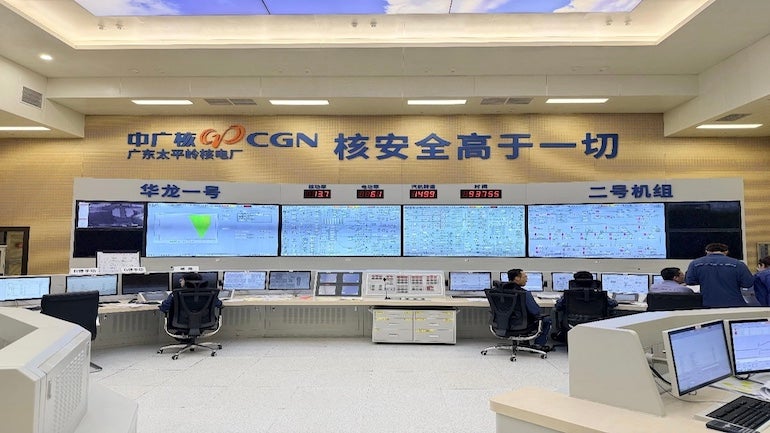
China’s Taipingling NPP project in Huizhou has delivered its first kilowatt-hour of electricity, China General Nuclear (CGN) reported. This means that the second unit of the first Hualong One nuclear power base in the Guangdong-Hong Kong-Macao Greater Bay Area has taken a key step toward the goal of commercial operation.
“After on-site confirmation following the grid connection, the unit is in good operating condition, and all technical indicators meet design expectations,” CGN said. “The unit will subsequently undergo a series of tests as planned to further verify its performance, and it is expected to be officially commissioned for power generation in the second half of 2026.”
Once fully operational, unit 2 is expected to generate over nine billion kilowatt-hours of electricity annually, meeting the production and daily use power demand of nearly one million residents and further strengthening CGN’s capacity to supply clean energy to the Greater Bay Area, said Zhang Guoqiang, Chairman of CGN Huizhou Nuclear Power, the CGN subsidiary responsible for the project.
CGN broke ground at the Taipingling plant in December 2019. With a total investment of over CNY120bn ($17.7bn), the project will have six Hualong One nuclear power units with an installed capacity of 1,209 MWe each. Upon completion, the plant is expected to produce more than 55 TWh of electricity a year, cutting standard coal consumption by around 16.65m tonnes and reducing carbon dioxide emissions by about 50.8m tonnes a year. Taipingling 1 was put into commercial service in April. Construction of unit 3 started in June 2025, with initial grid connection scheduled for the end of 2027. First concrete for the nuclear island of unit 4 was poured in May.
CGN said that, during the construction of Taipingling 2, a series of digitalisation and intelligent technologies were widely applied. The project successively promoted the application of intelligent equipment and systems such as smart construction site, digital handover, and exoskeleton robots. It also implemented the first digital transformation project for spare parts management within CGN, empowering the full business process of nuclear power with intelligent solutions.
In addition, the project continuously advanced process innovation and technology iteration, achieving new breakthroughs such as using mobile aerial work platforms for nuclear cleaning of the inner dome and polar crane, and optimising the pressurisation and depressurisation rates of containment tests. It also promoted modularisation and automatic welding processes, and for the first time in a Hualong One project, innovatively applied integrated hoisting technology for frustum modules and steel liner base plates, providing strong support for improving quality and efficiency in nuclear power engineering construction.


