
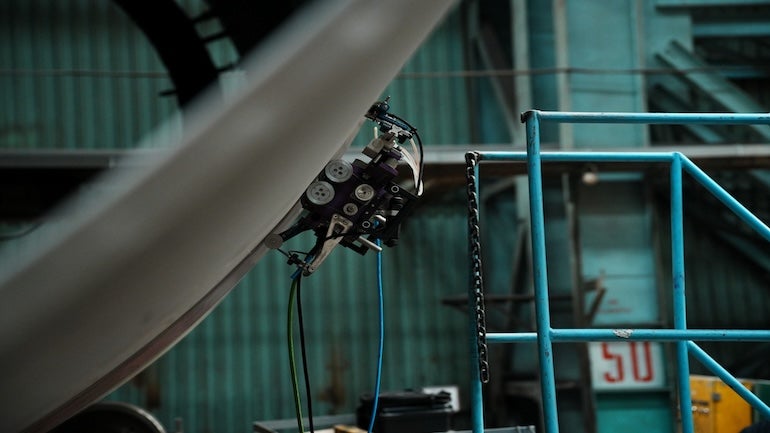
Russia’s Atommash plant (part of Rosatom’s Mechanical Engineering Division) has launched a robotic complex for ultrasonic testing of welded joints on reactors and steam generators at NPPs. The installation monitors the quality of welds – up to 30 cm thick – three times faster than conventional methods, ensuring high accuracy of defect detection, and is capable of operating on surfaces with complex geometry.
The spider robot is equipped with a new generation ultrasonic transducer and enables weld inspection using the most advanced methods. In addition, it is capable of operating in hard-to-reach areas.
“Atommash today is a synthesis of many years of experience and the latest technologies,” said Plant Quality Director Oleg Shubin. “By introducing robotisation, we not only increase production efficiency, but also create the working environment of the future. To make a qualitative leap in development, we must create products that will determine the future. Digitalisation is becoming the main tools in this. A modern factory is a place for innovation and bold projects. The Spider-Robot is a clear example of how technology serves the safety of nuclear energy.”
Ultrasonic testing makes it possible to identify defects that cannot be detected by visual inspection. Since welds are a critical element of any design, increased attention is paid to their quality. Ultrasonic testing is carried out by contact, moving the finder along the surface of the product manually. When the robot is launched, the scanner is moved using the control unit, which greatly simplifies the process.
The enterprises of Rosatom’s Mechanical Engineering Division implement activities to create a digital factory – a system based on principles of lean manufacturing and digital solutions. Almost all processes have been digitised: from production to quality control for remote logistics, remote acceptance of equipment using augmented reality technologies, and digital monitoring of the condition of equipment. In parallel, a set of projects in the field of robotisation is being implemented – 30 projects have been selected that will save about 500,000 standard hours of processes for transportation, welding, cleaning and control.


