
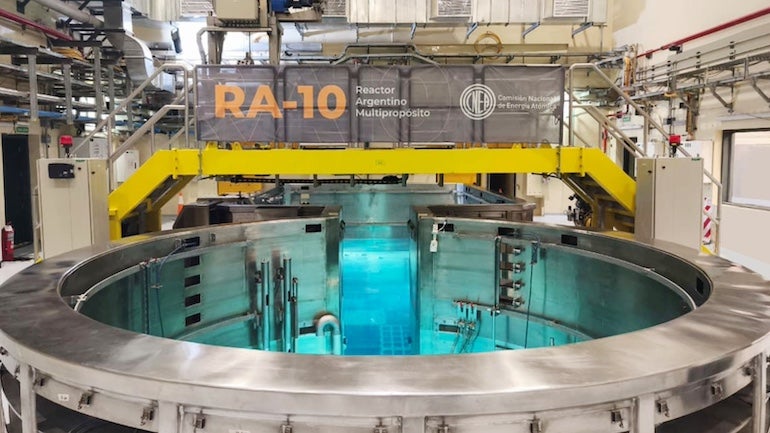
Argentina’s RA-10 multipurpose reactor is entering its final operational phase, with National Atomic Energy Commission (CNEA – Comisión Nacional de Energía Atómica) confirming that start-up commissioning will begin before the end of 2026. This 30 MWt open-pool research reactor, developed alongside nuclear contractor INVAP, has reached 96% completion. Currently, a team of 530 people is completing the assembly and carrying out tests to verify the operation of the systems, prior to the start-up and subsequent operation.
The Secretariat of Nuclear Affairs (SAN – Secretaría de Asuntos Nucleares) and CNEA outlined the roadmap to move forward with the project, once the relevant licence has been obtained from the Nuclear Regulatory Authority (ARN – Autoridad Regulatoria Nuclear), with the aim of completing the process in the first months of 2027. They also announced plans to incorporate private capital to finance the construction of the associated production plant and develop productive and commercial activities linked to the reactor.
The presentation took place at the RA-10 facilities, at the Ezeiza Atomic Centre in Buenos Aires, and was headed by the Secretary of Nuclear Affairs Dr Federico Ramos Napoli, and CNEA President Martin Porro. The event brought together authorities from the nuclear sector, company representatives and institutional guests, and included a tour of the facilities.
The RA-10 is a state-of-the-art 30 MWt open-pool research reactor developed by CNEA currently undergoing pre-operational cold testing. The project was approved by the government and officially started by CNEA in 2010, receiving a construction licence from ARN in 2014. The project completed its main civil construction works in early 2024 with nuclear technology firm INVAP serving as the main contractor.
The RA-10 will replace the older 10 MWt RA-3 reactor. It is designed to make Argentina entirely self-sufficient in medical radioisotopes and capture up to 20% of global market demand. It will also expand therapeutic capabilities by enabling the local production of advanced isotopes including molybdenum-99, from which technetium-99m is obtained, widely used in diagnostic imaging studies. It will also produce lutetium-177, used in oncological treatments, and iridium-192, used in medical and industrial applications.
The projected production capacity of molybdenum-99 is equivalent to approximately 20% of current world demand, which will position Argentina as a key international supplier of this radioisotope. The reactor will also allow production doped silicon by neutron transmutation, used in the manufacture of high-power semiconductors for industrial applications, electrical systems, renewable energy and transportation.
The RA-10 will provide irradiation and materials testing services and will allow neutron activation analysis to be carried out for scientific, technological and industrial applications. It will also host the Argentine Neutron Beam Laboratory (LAHN – Laboratorio Argentino de Haces de Neutrones) and a specialised laboratory to test and qualify advanced nuclear fuels locally rather than relying on facilities abroad.
To develop the production of radioisotopes on a commercial scale it will be necessary to have an associated production plant – the Fission Radioisotope Production Plant (PPRF – Planta de Producción de Radioisótopos por Fisión). In this facility, the targets irradiated in the RA-10 will be processed to obtain the radioisotopes, which will be destined for the health system and export markets. SAN presented a model intended to enable the incorporation of private capital to finance the development and construction of this plant, as well as the productive and commercial activities associated with the reactor.
The scheme promotes coordination between the public and private sectors in the productive and commercial sphere. This integration has precedents in the Argentine nuclear industry, such as CONUAR, which manufactures fuel elements and fuel cycle components, whose shareholders include CNEA and private investors.
The Government and SAN have released structural details explaining exactly how this private capital injection and the plant itself will function. The state intends to create a state-controlled public-private tech company (empresa mixta), copying the corporate model of CONUAR. The selected private partner will be expected to inject roughly $200m to finish and scale the PPRF Plus plant.
Transitioning the plant’s management into a private law corporation is intended to relieve it of rigid state procurement, complex hiring rules, and bureaucratic gridlock. This grants the facility the high operational flexibility required to manage time-sensitive radioactive shipping. The RA-10 reactor complex carries a massive annual operational expenditure of $14m accounting for 10% to 15% of CNEA’s total budget. The private operator will absorb this operational cost burden completely.
The transition to private financing reflects a major policy shift by President Javier Milei’s administration. The strategy ensures that while the state-backed reactor itself remains public, the highly lucrative commercial arm will leverage private capital to operationalise its global distribution network.
This funding strategy mirrors a broader initiative to privatise and downsize state-funded elements of the nuclear sector. Alongside the RA-10’s commercial facility, Argentina recently approved a separate $1.2bn, 100% privately funded small modular reactor (SMR) called the ACR-300, built by US-based Meitner Energy.
Official tender release dates for the private funding of the PPPF have not yet been formally established or announced by the Government. SAN and CNEA are currently designing the public-private partnership legal structure under Milei’s broader deregulation framework. This means the state is still finalising the specific bidding conditions, asset-sharing templates, and regulatory guarantees before publishing the official procurement calendar.
While the overarching tender for the plant’s private operator is pending, smaller technical tenders directly tied to the reactor are already being rolled out. CNEA has released localised tenders for systems like the RA-10 Access Control System and specialised Equipment Calibration Services.
The timeline for the main commercial tender is expected to leverage Argentina’s newly implemented Large Investment Incentive Regime (RIGI – Régimen de Incentivo para Grandes Inversiones). This law aims to secure a 30-year window of fiscal stability, which the government is using as the primary mechanism to attract foreign consortiums to the bidding table.


